|
The
Pensula Sun-Times |
|
 |
|
Volume viij |
|
|
|
|
|
|
March 27, 1803 |
|
|
|
|
|
|
3rd Edition |
|
|
|
|
|
|
Opinions &
Editorials
A note to the Gentle Reader: Any and all opinions that are expressed
in the following article are of no relation, whatsoever, to the
Pensula Sun-Times and its employees.
Last week we presented the following topic to the reading public:
What do you think of magic and its related institutions? Although we
received countless responses, we were only able to publish a scant
few letters, as our space in this periodical is limited. Therefore,
the editorial staff here at the Sun Times labored arduously to piece
together the best arguments given for each side of the debate. They
are presented, unchanged as received, below.
To the Staff at
the Pensula Sun-Times,
Before I begin with my argument, I would like to state my
credentials, as they will give merit to all that I have to say. I am
a professor of psychology at the Teresia Academy of Higher Learning.
In my time I have studied many phenomena of the mind, from ordinary
disorders to even stranger mental behaviors. My expertise in this
field leads me to believe that this “magic” which everyone argues
over is merely an exercise in sensationalism. I can assure you that
there is nothing at all mystical about mages and their spells. The
existence of some sort of ethereal energy is mere poppycock, a
travesty to logic.
How, you may ask, am I so sure of these claims? In my research, I
have found a most fascinating behavior in the human mind. After
exposure to certain stimuli, both chemical and electrical, the mind
can become capable of altering the world around it. These stimuli
“unlock”, so to speak, a dormant part of the brain that allows the
patient to accomplish many feats that seem “magical” in nature,
giving new meaning to the phrase “Mind over matter”.
Therefore, the nature of this alleged “magic” starts to become
clearer. These mages, mystical as they seem, are actually the result
of an accident of birth which has opened up a part of their brain
that lies dormant in the rest of us. So, as you can see, there is
nothing so “special” about them. My research at the Teresia Academy
is presently working on fine tuning my “unlocking” procedure, which
I believe should be available to the public in a matter of years. I
hope this has dispelled any and all of the superstitious nonsense
about “magic”.
Dr. Arthur
Wellington
Professor of
Psychology at the Teresia Academy
To Whom It May
Concern,
I write to your fine paper in defense of my profession; nay, my
art. I am a professor of Divination at the Pensula City School of
Magic. I realize that most of the readers have already formulated
their opinions so steadfast that they will not sway. To those, my
words are nothing more than leaves in a hurricane. I write this
modest essay for those precious few readers who are willing to
listen, to learn, and to formulate their own opinions. All others
need not read further.
Over the last few decades, magic has been slandered and defaced.
It has been called an outdated institution, an inferior, obsolete
school of thought. It has been labeled as frivolous, a triviality.
Some have even gone so far as to say that magic is tyrannical, an
institution that is building up power so that it can attempt to
dominate the world. I assure the readers, using magic does not make
one want to take over the world. Magic is merely being used as a
scapegoat for a deeper sociological problem. In the future, as my
way of living becomes marginalized, I can foresee scientists
becoming the next scapegoat.
But I have digressed. My reason for writing was to give an
adequate, although very layman, definition of what magic is. Many
scientists have tried to define magic as a part of the physical
world, and they have always failed. That is because magic itself is
not a part of this world. It is an unseen, unidentifiable force from
another plane of existence. We mages have been born with the innate
ability to channel this force into our own world and to manipulate
it to cast spells. Magic is not something that can be quantified,
calculated, or studied. It just is, and this infuriates scientists.
Therefore, they forget about magic entirely, concentrating on the
effects of magic, the spells. They formulate excuses, loosely based
on supposed experiments, for how these spells manifest themselves.
However, in ignoring magic itself, they miss the point entirely. I
would like to end this letter with one final disclaimer. I am not a
man who is afraid of progress. On the contrary, I look upon the
creations of science and technology, and I marvel at them. I merely
wish that there be prudence. Scientists should not libel or
discredit the magical institution for merely having a different
school of thought. We are working towards the same goals, the
advancement of both our minds and our society. Thank you.
Tobias Marl
|
|
(The Editor would like to note that the next letter came without a
return address and was scrawled haphazardly on several napkins. Its
inclusion into this piece was a matter of debate, but was finally
resolved when it was observed that the author had a most unusual and
unique perspective.)
Dear Pensula
Sun-Times,
I have finally found it, the secret that has been plaguing
scientists for years. I have discovered what magic is. Or, perhaps I
am getting ahead of myself. I haven’t necessarily found out “what”
it is, per se, but I am very close. Most importantly, I have found
that it is a part of our world, a part of everything. It is a
physical substance, or perhaps a part of a physical substance, which
is in all matter.
But first, I suppose I should divulge some information. I can’t
tell too much, as the nature of my research is enough to have me
labeled a heretic by scientists and mages alike. Already, I am in
constant fear of assassination. The most I can say is that, at one
time, I was a professor. However, my interests into fields that were
considered “not of the physical world” drove me to my present
seclusion.
Anyway, back to my research. Magic is a part of the world, in
particular, a part of matter. Of this, I am sure. It’s composition
and its structure, however, is unknown to me. Still, I am quite sure
how magic is used to manifest spells. Magic can be moved, it can be
affected, just like matter. When magic is combined together in a
specific arrangement, a single spell is manifested. Now, the
attentive reader is probably wondering why riding a carriage, or
merely walking down the street does not spontaneously create a
spell. After all, matter, and undoubtedly magic, is being displaced
by these actions. However, the arrangements in which magic must come
together are enormously complex and require an amazingly dense
concentration in a relatively small location. By simple entropy,
spontaneous spell creation proves statistically impossible within
the lifespan of the universe. Mages, then, must have some mechanism
by which they can draw in magic from their surroundings, as well as
a way of affecting its structure and arrangement, in order to cast
spells. Unfortunately, due to my seclusion, I have been unable to
observe a magic user casting a spell. I have, however, developed a
device through which I can adequately affect the magic around me.
Results, though, have been mixed.
My theory poses an interesting debate: If magic is a part of the
physical world, why do mages, who work so intimately with magic,
argue that it is a part of another dimension? I have come up with
two theories, the latter more probable than the former. Perhaps this
behavior manifested itself as a mental self-defense mechanism. Back
in the early stages of mental development, though who were magically
inclined may have suffered great mental strain because of their
abilities. Perhaps the mind dealt with this stress by making the
source of these abilities seem ambiguous and distant. However, a
great deal of study must be done in order to prove this theory. A
simpler idea is that this behavior is deeply rooted in culture.
Mages have been taught for centuries that their powers come from
another plane. The belief is probably kept alive because of
adherence to tradition, as well as a great appreciation and respect
for the past, a sentiment that mages are notorious for. Either way,
it certainly is food for thought.
In closing, I would like to state that I was uncertain as to
whether or not I should send this letter to your publication. I am
sure that my theories will not be greeted warmly. Also, the threat
of attempted assassination from fanatics, should anyone discover my
identity, is not something I take lightly. However, the truth must
be revealed, no matter what the cost.
Sincerely,
R.
The Editor would like to thank everyone who submitted a letter for
this week’s editorial. The subject of next week’s editorial shall
be: What do you think of "R’s" theory? Does it have any validity?
|
|
|
|
|
|
|
Chapter Six:
Opposing Forces
Natural and Supernatural
Law
Natural Law is
the means by which scholars have come to describe the behavior of reality. They
know, for example, that all matter has mass and thus exerts a Gravitational
Force on all other matter in the universe. This is a law of nature, never
broken unless it is altered by the presence of a Supernatural Force.
Supernatural Force is a fact of life in Færith’s universe. It is as real as
gravity, electricity, and magnetism. And, like these other recognized,
fundamental forces, it obeys laws that wizards have long understood and employed
in their spellcasting.
One of the
fundamental precepts of Supernatural Theory states that Supernatural Force, by
definition, is incapable of shaping any of the basic features of reality without
a focus to direct it. In other words, all of the planets and stars and galaxies
and forces and energies and even living things must have come about through
means of Natural Law, because Supernatural Law does not apply to the material
universe unless somehow willed or directed to.
Even priests are
bound by Supernatural Law, though they tend to view the world in much simpler
terms. All but the most detached and philosophical of clergy tend to
regard Supernatural Force as a gift from God, a tool used by those who are wise
enough in His sight. To a vast majority of priests, trying to explain this in
terms of a science is at best folly, and at worst, blasphemy.
But since when
has that ever stopped a wizard?
Supernatural Forces
Supernatural
Force, like any other force, can be described as an energy field that occurs in
nature. This energy doesn’t really do anything, however, unless channeled by
intelligent being in one way or another. Various ways to move a Supernatural
Force include spellcraft and psionics but either method draws upon a different
sort of energy (mana for magic and chi for psionics) in order to produce an
effect.
Though several
different energies can be used to produce a Supernatural Force, the result is
nevertheless the same. Therefore, the lines between arcane, divine, and
animistic magic, and even psionic power, are characteristically blurry. Magic
and psionics are not different forces in Færith; just two means to the same end.
Magic
The art of
spellcraft: bubbling potions, enchanted staffs, and tomes of draconic lore.
Such are the images dreamed up when one imagines the power of the arcane.
Magic, in all of its common forms, is basically understood to be Supernatural
Force housed in the spirit of the caster, in one way or another. The act of
casting a spell allows a magician to “gather up” nearby Supernatural Force and
work that energy into altering reality, the way a child gathers snow and forms
it into a snowball.
Ideally, magic
should be able to change the real world however the caster imagines he can do
so. In casting, the magician is basically imagining something new into
existence, and then willing it to exist. The more a spell is supposed to change
reality, however, the more difficult it is for the rational mind to believe the
effect could ever be real; that’s why it takes a great deal of experience and
skill to cast the more powerful enchantments. Wish is really the
ultimate expression of magic, for it allows a magician to alter the world around
him in any fashion imaginable; thus, a magician who can wish has gained
mastery over his rational mind.
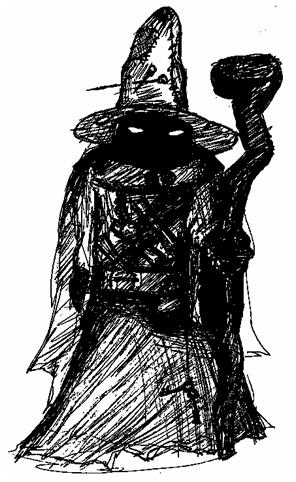
Arcane Magick
Of all the forms
of magic, arcane magecraft is undoubtedly the most common. A magician is one
who uses a genius intellect to formulate spells and will them into being. It
takes great intelligence to craft the proper circular logics and unfounded
principles necessary to believe something that isn’t, and then make it so;
magicians excel at such things.
Animistic Sorcery
Magicians derive
their spells from careful study and experimentation, but shamans and
spirit-mediums need only barter for them. Of course, it’s a bit more
complicated than that, since the only place a prospective practitioner of
sorcery can go to learn spells is the spirit world. In order to learn magic, a
shaman must enter a meditative trance and send out his spirit to bargain with
some extraplanar entity. The shaman then makes a deal with whatever type of
entity he contacts. Good spirits (like celestials) often ask that the shaman
complete valorous quests in exchange for magic. Evil spirits (particularly
fiends) will often dole out powerful spells, seemingly for free, and then watch
in amusement as the shaman damns his own soul. Shamans are more likely to
attract stronger spirits and get “better deals” if they have the personality to
get noticed and get what they want – so most shamans tend to be as charismatic
as they are wise. As to whether the shaman makes his bargains with polite
diplomacy or an outright bluff, though… that’s another story.
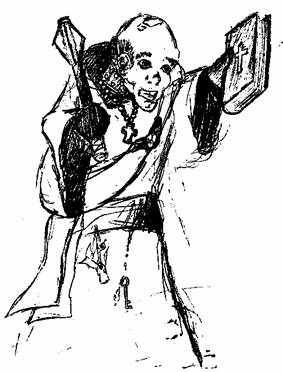
Divine Theurgy
Theurgies are
spells that priests have divined from the holy writings of their various
religions. In Færith, magic is not considered sinful by any religion. Rather,
it is a wondrous gift from on high that may be used as any other tool or weapon:
to heal, protect, and defend, or to seize, control, and destroy. Priests have
learned to use magic to the more noble ends. Their spells are almost
universally defensive, capable of warding off evil outsiders, destroying foul
undead, and curing all manner of wounds, diseases, and curses. Priests in
Færith are well aware that their spells are only that – spells that they have
developed through study – and they hold no illusions that they are receiving
miracles straight from God (the exception being spells like miracle,
naturally). Instead, they look upon theurgical magic the same way they look
upon science: as a scholarly pursuit with the potential to do much good in the
right hands. Even though priestly magic is just as worldly and studious as
arcane magic, priests have an easier time collecting complete spellbooks. Since
the various churches of Lethandria train the priests and keep all the common
theurgical spells collected in the monasteries and seminaries of the continent,
a priest is easily able to learn all the spells of a given spell level as soon
as he can cast them.
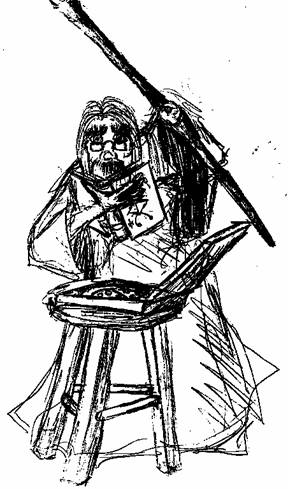
Spellbooks:
Priests keep spellbooks as magicians do, but they need not seek out other
scrolls or spellbooks to fill them. A priest's spellbook contains all the
common priest spells that exist, plus any that the priest researches for
himself.
Psionics
Psychic power is
a supernatural effect that comes from the very mind and soul of an intelligent,
living being. Supernatural Force can be created by the mana that flows from the
very planet and powers spells; or by chi, energy which is produced by all life
and can be tapped when body and mind are in balance. Psionics are fueled by
chi, which can be shaped by the intellect through strict meditation and control,
intuitive understanding of one’s own soul, or by cutting loose sheer emotion and
releasing a cascade of latent power. Psionicists are able to use their minds
touch that reserve of latent chi that rests hidden within the body – whether
they were born with the talent, or discover later it through arduous,
introspective soul-searching.
Power
Acquisition: Psionicists discover their latent powers
within, but they may also draw new powers out of power stones or the minds of
other psionicists. A psychic begins with 3 + his Intelligence modifier in
psionic powers and discovers 2 new powers (of any level he is able to manifest)
at each level thereafter. To draw a power from an outside source is a more
complex process, similar to an arcane spellcaster scribing a spell from a scroll
into a spellbook.
The psychic must
first make psionic contact with the source of the power, which requires a full
round of physical contact and a Psicraft check vs. DC 15 + the highest level
power contained in the power stone or the other psychic’s repertoire. A psychic
can only make contact with another psychic who is willing, or unconscious. Once
mental contact is achieved, the psychic becomes aware of all the powers stored
in the stone or all the powers the other character knows, up to the level he is
able to manifest.
Next, the
psychic must make a Psicraft check vs. DC 15 + the power’s level to see if he
understands the power. If the power belongs to a discipline that the psychic
does not have access to, this check automatically fails. If the check fails,
the psychic cannot understand, manifest, or learn the power, even from a
different source, until gaining a rank in Psicraft. If the psychic does
understand the power, he can attempt to manifest it normally on his next turn,
or he may attempt to permanently commit it to his own repertoire.
This process
requires 8 hours of uninterrupted meditation. The psychic does not need to keep
in contact with the power stone or other character, but he may not manifest any
other psionic power while meditating, or else the process fails and may not be
attempted again until a rank in Psicraft is gained.
Unique Powers
per Day: The psychic does not prepare his powers ahead
of time, but he may still only manifest a limited number of powers in a given
day (see Chapter 3). For example, a 3rd level psychic has unique
power limits of 3/2/1. This means that even if he knows five 1st-level
powers, he may only manifest three of those 1st-level powers in one
day. The powers he can use need not be chosen ahead of time, and he can
continue to manifest them as long as he has power points, but after manifesting
his limit in distinct powers, he would not be able to manifest a fourth,
different 1st-level power until he rested for eight hours.
Minor Magic-Users
The bard,
knight, mystic, ninja, and ranger are all able to use a limited selection of
supernatural FX. Bards and ninjas cast arcane spells. Knights cast divine
theurgies in the same manner as priests, while rangers use the animistic
sorceries of shamans. Mystics use psionic powers.
Bards
• Starting
Spells: A 1st-level bard acquires a
spellbook containing 1d6 + Int mod cantrips and 1d4 1st-level spells.
• Spell
Acquisition: Bards receive 2 free spells at each
level up. Otherwise, bards must acquire new spells the same way magicians do.
• Spell
Preparation: Bards prepare their spells from their
spellbook, just like magicians.
Knights
• Spell
Acquisition: A 2nd-level knight gains a
spellbook containing all of the 1st-level paladin spells. Like
priests, a knight's spellbook already contains all the knight spells commonly
known. Thus, a knight may always prepare any spell on the paladin spell list.
• Spell
Preparation: Knights must have their spellbook to
prepare spells.
Mystics
• Power
Acquisition: Mystics acquire their powers the same way psychics do, starting
with 1d4 + key ability mod in free 1st-level powers, discovering 2
free powers at each level, and drawing new powers out of power stones or other
psionic characters by making the needed Psicraft checks.
• Unique
Powers per Day: The mystic does not prepare his
powers ahead of time, but he may still only manifest a limited number of unique
powers each day at each power level (see the
mystic class in Chapter 4).
Ninjas
• Spell
Acquisition: A 2nd-level ninja gains a
spellbook containing 1d4 1st-level assassin spells. Ninjas receive 1
free spell at each level up. Otherwise, ninjas must acquire new spells the same
way magicians do.
• Spell
Preparation: Ninjas prepare their spells from their spellbook, just like
magicians.
Rangers
• Spell
Acquisition: A 2nd-level ranger gains the
ability to contact the spirit world and retrieve spells, just like a shaman.
The ranger may retrieve any spell on the ranger spell list.
• Spell
Preparation: Rangers do not need a spellbook to
prepare common ranger spells, but any spells that they research for themselves
require a spellbook for preparation.
|
Table 6-1: Armor Spell Failure |
|
Armor |
Magician |
Bard, Ninja,
Shaman |
Priest, Ranger |
Knight |
|
Light |
Yes |
No |
No |
No |
|
Medium |
Yes |
Yes (-20%) |
No |
No |
|
Heavy |
Yes |
Yes (-20%) |
Yes (-30%) |
No |
|
Shield |
Yes |
No |
No |
No |
|
Tower shield |
Yes |
Yes (-20%) |
Yes (-30%) |
No |
Ninjas, bards, and shamans ignore the first
20% of armor spell failure due to medium and heavy armors. Priests and rangers
ignore the first 30% of armor spell failure due to heavy armors.
Magic
Points
Magic points
make up the heart of the Relative Entropy
campaign’s magic system.
The Core
Mechanic
All spellcasters
both prepare their spells and cast them spontaneously. A set number of spells
are prepared at each level using spell slots which are based on class
level and fixed in number. Spells may then be cast using magic points,
which are based on both class level and key ability score.
Spells
Known
Magicians keep
spellbooks which they must fill with spells learned from studious research or
the scrolls and spellbooks of other mages. Priests keep spellbooks as well, but
their books are automatically filled with all priest spells. Shamans have
access to all shaman spells via contact with the spirit world.
Spells Prepared
All spellcasters
prepare a set number of spells ahead of time, choosing from their broader list
of spells known which ones they’d like to make available for casting. A
spellcaster’s array of prepared spells is given by his spell progression, but
this number is fixed at each level – a character does not prepare additional
spells for a high ability score. Specialist mages, shamans, and priests are all
able to prepare a single bonus spell at each level (from a specialty school or a
domain). Normally, a spellcaster may not change his or her prepared spells
without first resting for eight hours, but priests, shamans, and magicians with
the Signature Spell feat are able to spontaneously swap a prepared spell for
another spell (cure spells for priests, summon nature's ally
spells for shamans, and any chosen Signature Spells for magicians). Once this
swap has been made, it may not be changed back until the character is able to
rest and prepare spells again.
Magic
Points
A character
casts a spell by expending the appropriate amount of magic points. A
spellcaster's total MP are equal to the base MP from class level plus bonus MP
from a high ability score. Bonus MP are equal to your (key ability modifier ×
class level × one-half).
|
Spell Level |
MP Cost |
|
0-lv |
0 or 1 |
|
1st |
1 |
|
2nd |
3 |
|
3rd |
5 |
|
4th |
7 |
|
5th |
9 |
|
6th |
11 |
|
7th |
13 |
|
8th |
15 |
|
9th |
17 |
Multiclassed
spellcasters may only pool their magic points from different classes if the two
classes cast the same type of spells. Thus, priests and knights can combine
their total MP, as can shamans and rangers, and magicians with bards and
ninjas. (At most, a character can have three separate MP pools, one each for
arcane magicks, divine theurgies, and animistic sorceries).
0-level spells
normally cost 0 MP. A spellcaster can cast his 0-level spells a number of times
per day equal to 3 + one-half his class level. After reaching this limit,
0-level spells cost 1 MP.
Most spells use
the MP cost given on the chart, but for spells that deal so many dice of damage
per caster level, you have to add 1 MP for each additional caster level above
the minimum, up to the maximum allowed by your level. A 1 MP magic missile
will always fire only one missile, and a 5 MP fireball will always
deal 5d6 damage, no matter what your actual caster level is, but a 9th
level mage can fire five magic missiles or shoot a 9d6 fireball
for 9 MP.
Metamagic
Metamagic is
applied when you cast a spell, not when you prepare it. Metamagic feats
increase the MP cost of a spell by 2 for each added spell level (note, though
that these additional MP do not increase the damage dice of a scaling spell).
You cannot use metamagic to raise a spell’s effective level above what you could
normally cast, so a 10th-level magician is still only able to Quicken
cantrips and 1st-level spells. Due to the added flexibility of the
MP system, each metamagic feat may only be used thrice per day, applying its
effects on the fly. You may, however, take a metamagic feat more than once,
gaining an additional three daily uses of the feat each time you take it.
Epic Levels
Relative Entropy’s
rules for magic and psionics require special attention directed at epic levels.
Spellcasters
Characters do
not increase their base MP after reaching 20th level in a class, but
they continue to increase their bonus MP by raising their class level and key
ability score. Because metamagic no longer requires use of a higher-level spell
slot, there’s no such thing as a spell slot above 9th level; so, the
Improved Spell Capacity feat merely grants additional 9th-level spell
slots (or 6th-level for bards, or 4th-level for ninjas,
knights, and rangers), which let a character prepare a spell of any level he
knows. The first time a magician, priest, or shaman takes Improved Spell
Capacity, that character also gains 19 MP; the second time, he gains 21 MP; the
third time, 23 MP; and so on. (For a bard, this would be 13 MP the first time,
15 MP the second time, and so on. For knights, rangers, and ninjas, it starts
at 9 MP, then 11 MP, etc.)
A character is
able to apply metamagic as if his spells prepared had continued to go up by one
spell level at every odd spellcaster level: a 19th level magician is
treated as “able to cast 10th-level spells” with regard to metamagic,
and a 21st-level magician is treated as “able to cast 11th-level
spells.”
Epic spells are
prepared as normal, based on the number of ranks a character has in the
appropriate Knowledge category (supernatural sciences for magicians, theology &
philosophy for priests, or natural sciences for shamans). Once prepared, an
epic spell is cast by spending MP equal to its Spellcraft DC. Hellball,
for example, is a DC 90 epic spell, so it costs 90 MP to cast – but a character
can continue to cast his prepared epic spells so long as he has sufficient MP.
Psionicists
A psionic
character’s base PP do not increase after 20th level, but bonus PP
continue to accrue for both class level and high Intelligence. Otherwise, epic
psionics work much like in the core rules. Each time a psychic takes Improved
Manifestation, he also gains an additional 9th-level unique power per
day (6th-level for a mystic; the mystic also gains only 13 PP for
taking Improved Manifestation, not 19).
An epic psychic
is able to manifest one unique epic psionic power in a day for every 10 ranks in
Knowledge (supernatural sciences). The PP cost to manifest each power is equal
to its Psicraft DC.
Craft Points
Craft points are designed to simplify the crafting
process and replace the "downtime" that often breaks up the action of the game
while characters pause to take a few weeks off adventuring in order to build
something. It unifies the rules for crafting mundane, magical, and high-tech
items, while also replicating a character's ability to come up with just the
thing he needs for a specific task in the nick of time. It glosses over the
realities of such work-tool kits, alchemical reagents, laboratories, long hours
of toil, and the like-to keep the game moving along at an exciting pace. After
all, building things is a central feature of the
Relative Entropy
setting, and with half the party tinkering on half a dozen inventions at any
given time, a rule mechanic like this becomes necessary to keep the game moving.
To craft an item without spending the normal labor time, a character with the
appropriate item creation feat (such as Brew Potion or
Craft Staff; see below) can pay 1/100th the item's base price (in guilders) in
craft points (minimum 1 point). (1/100th the item's base price in
guilders is the same as 1/10th its base price in gold pieces). He must
also pay material costs equal to one-half the item's base price (this replaces
the normal material cost for crafting an item). For a magical or technological item,
the character must also pay the normal experience point cost for crafting the
item. Once the character declares that he is spending these craft points and
guilders (and experience points, for a magic or mastercraft item), the item is
automatically completed one day later (typically the next morning).
Though this makes it appear as if the item was created "instantly," the
assumption is that the character has actually been working on it for a while,
but only now got around to finishing it. For instance, the party scientist might
have been tinkering with the soldier's sword for some time, but only now has
finished improving its enhancement bonus. The system simply assumes that
characters are always working on various projects in their spare time, whether
between forays into the dungeon, while on the road, or even while gathered
around the campfire after battling goblins in enemy territory. Thus, when the
time comes, they simply spend the requisite cash and craft points, and the item
is "finished" one day later.
To spend craft points toward the creation of a or magic item,
you must have the requisite item creation feat or assist someone who does;
likewise, to make a technological item, you must be a scientist of the
appropriate level, or assist one who is (see
Assisting, below). Crafting mundane armor and weapons or simple items and
devices like
tools, chests, saddles, and the like doesn't require a Craft feat. Anyone who
helps with the creation of such an item can contribute craft points at the
normal rate.
For common items, you must make a successful Craft check to complete the
item. For a masterwork item, two separate checks have to be rolled, one for the
item and one for its masterwork component. A failed check means you waste
one-half of the money and craft points required for the item, but you may try
again as soon as the next day if you still have enough guilders and craft points
to complete the item. Magic items and technological inventions require no skill check to complete.
Masterwork items require separate Craft
checks for each component involved. You must succeed at all the requisite
checks before the item is considered complete, but any or all of the checks may
be attempted at the same time. You only need to wait a day to retry a
failed check.
You can reduce the amount of craft points required by increasing the amount
of time you spend working on the item. For nonmagical items, reduce the craft
point cost by 10 points for every day of work you contribute to the item's
creation (see the Craft skill). For magical items and technological inventions, each 8-hour day spent working
on the item reduces the craft point cost by 100.
Example One
A masterwork suit of full plate armor has a market price of 16,500 silver guilders
(15,000ƒ for the armor, plus 1,500ƒ for the masterwork component).
A character with the Craft (mechanical) skill pays one-half of this price
(8,250ƒ) and spends 165 craft points to complete it one day later with two
successful Craft checks, DC 18 for the armor and DC 20 for "masterworking" it.
(If both checks failed at this point, it would cost the character 4,125ƒ and
82 craft points.). The character could also take five days to work on the
armor, and then spend only 115 craft points.
Example Two
A +2 longsword has a base price of 8,000
gold pieces (not including the material cost of the masterwork longsword itself).
Assuming you had the Craft Magic Arms and Armor feat (and didn't have to make
the masterwork longsword from scratch), you could either spend 8 days of time to
craft the item, or you could spend 800 craft points to finish it "instantly."
(In either case, you have to spend 4,000 gd in addition to the time or craft
points.) If you wanted, you could save 200 craft points by spending two 8-hour
days working on the item.
Assisting
In addition to the primary crafter, who
must have the appropriate Craft feat (if one is required) and be trained in the
appropriate Craft skill (if the skill is trained-only), up to three assistants
can contribute craft points to the creation of the item.
Assistants who have the appropriate Craft feat and/or skill ranks contribute
craft points at full normal value. For untrained assistants (those who don't
have the appropriate Craft feat or skill ranks), each craft point contributed
counts as 1/2 a point of assistance.
The primary creator must contribute at least half of the craft points
required to create an item.
It doesn't matter who contributes the money that goes toward creating the
item. Only the primary creator can contribute experience points toward the
creation of a magical or technological item.
Gaining Craft Points
A 1st-level character has 100 craft points. With each class level
gained, he gains a number of craft points equal to his new level × 100. A
2nd-level character can have as many as 300 craft points, and so forth, all the
way up to a 20th-level character, who would have a total of 21,000 craft points
(assuming he never spent any).
Creatures with Intelligence of 3 or higher have craft points as a character
whose level equals their class levels + Hit Dice. A troll (6 HD), for instance,
has the craft points of a 6th-level character. If that troll gained a class
level, it would gain an additional 700 craft points. Of course, not all
creatures can use their craft points -- despite being at least reasonably
intelligent, a griffon or pegasus is unlikely to be in a position to craft an
item or assist another character in crafting an item. The DM must use his best
judgment when determining whether a creature can use its craft points.
Creatures with Intelligence of 2 or lower (or without an Intelligence score)
never gain craft points.
Familiars or special mounts never gain craft points, regardless of their
intelligence or Hit Dice.
Item Creation Feats
Each time you gain an item creation feat, you gain additional
craft points as noted on Table 6-2: Item Creation Feats. You don't have to spend
these craft points on items appropriate to the feat -- you can spend them on any
item. For example, Craft Wand grants a bonus of 2,500 craft points,
which you can use to craft weapons, armor, potions, or any other item.
|
Table 6-2: Item Creation Feats |
|
Feat |
Prerequisites |
Craft Points Gained |
|
Brew Potion |
Caster level 3rd |
1,500 |
|
Craft Construct |
Craft Wondrous Item,
Craft Magic Arms & Armor |
4,500 |
|
Craft Magic Arms &
Armor |
Caster level 5th |
2,500 |
|
Craft Rod |
Caster level 9th
|
4,500 |
|
Craft Staff |
Caster level 12th
|
6,000 |
|
Craft Wand |
Caster level 5th
|
2,500 |
|
Craft Wondrous Item |
Caster level 3rd
|
1,500 |
|
Forge Ring |
Caster level 12th
|
6,000 |
|
Scribe Scroll |
Caster level 1st
|
500 |
|
Talented Crafter |
Any other item
creation feat |
500 |
Scientists also gain bonus craft points every time they gain access to a new
level of scientific discoveries. The craft points earned are equal to
the discovery level × 1,000
craft points.
High
Technology Reigns
Supernatural Law is
not the only way for the keen mind to adapt to the dangerous world of
professional adventure! Research scientists everywhere are in dire need of
field technologists who can test and apply the theories of Natural Law against
the rigors of real life! Arrayed in the latest metallurgical advancements
and equipped with the finest devices and elixirs modern science has to offer, a
veritable legion of graduates from the universities and technical institutes
from all over Lethandria have joined the ranks of the traditional warriors and
magicians to become the adventurers of today, and the heroes of tomorrow!
Technological Inventions
Any character
can use technology to some extent -- the varied Craft skills are class skills
for just about everybody, and anyone who wants to use Craft (chemical) to make a
bomb or some acid or Craft (mechanical) to make a gun, a light bulb, or a steam
engine can go right ahead. Only scientists, though, can make the truly
astounding machines that are rapidly transforming the face of the world -- the
mechanized weapons, steam-powered armors, airships, advanced explosives and
gadgets, and all manner of devices that rely on science and nature rather than
magic and the supernatural.
There are
eight "schools" of technology that scientists are specially able to work
with: aircraft, armaments, artillery, automata, elixirs, gadgets, grenades,
and surface vehicles. Each of these items has its own rules for
creation and use, but all of them are based upon scientific discoveries that
a scientist must have knowledge of before attempting to craft the item.
Scientific Discoveries
Whether they
come in the form of detailed blueprints and schematics or chalkboard after
chalkboard of advanced chemical formulas or physics equations, discoveries are
the underlying principles behind a scientist's inventions.
Consequentially, the scientist must know the discovery to craft the invention.
Scientists receive a number of free discoveries at the beginning of the game and
as they level up, but most of the time, scientists will be performing their own
research, experimenting in the laboratory and rummaging through the academic
journals of their peers. Scientists need not roll any checks or pay out any
cash for the free discoveries that come with leveling, but when the scientist
wants to add additional discoveries to his portfolio, he must make a Research
check vs. DC 15 + the discovery level and pay 1,000ƒ per discovery level to
represent materials expended during experiments (a 0-level finding counts as
half a discovery level and costs 500ƒ to learn). If he fails the
Research check, the scientist's experiments have failed or produced misleading
results, and so he may not try to understand the discovery again until he has
gained another rank in Research.
The list of
scientific discoveries is given in the next chapter,
Summa Technologica.
Technology Basics
As mentioned above, technological items are divided into categories, depending
on what they do and how they are made and used. Some items, it's also
worth noting, have special quirks, like a tendency to malfunction or a clockwork
brain that bestows artificial intelligence. Finally, a few technological
items are so rare and bizarre that they defy categorization and can only be
termed the creations of "mad science". Creations of mad science are
usually divided into "minor" (difficult to create but not exactly one-of-a-kind,
like a stitched-together corpse animated with electricity) and "major" (one of a
kind and extremely powerful, like a weather-manipulating doomsday device).
Armaments: Technological weapons
and armor usually grant bonuses to AC and DR or attack and damage, along
with many other beneficial abilities. Cartridge-loading and automatic
firearms also fall into this category.
Elixirs & Reagents: Elixirs are
potent pharmaceutical drugs that, when ingested, do something to the
drinker. Reagents are chemicals that are applied externally and have
some effect on whatever they're placed on.
Grenades: Better termed
"grenade-like inventions", this category covers any device that can be used
once, and then destroys itself. Explosives are the most common
example, but others are possible.
Gadgets: Gadgets are the mainstay
of the scientist, arguably the most potent devices in any technologist's
arsenal. A gadget is any device that can do something useful
repeatedly. Gadgets can typically be used 50 times before they wear
out, short-circuit, run down, or become otherwise in need of repairs and
refueling.
Automata: Mechanical constructs,
automata can take any number of shapes, though the most common is that of a
humanoid. Most automata have a modicum of intelligence, but relatively
few are truly sentient.
Surface Vehicles: Automobiles,
locomotives, and ships are all examples of surface vehicles -- any
transportation device that operates in two dimensions.
Aircraft: Airships and airplanes
are the basic examples of aircraft, but this category actually covers any
vehicle that travels in three dimensions (or more), including submarines,
spacecraft, and ships built for planar travel.
Technological Invention Descriptions
Each general category of invention gets an overall description, followed by
descriptions of specific details to consider when creating each item.
Crafter Level: This is the
scientist level at which the item was made, similar to the caster level for a
magic item. Scientists can create items at a crafter level as high as
their current level, or they may voluntarily lower their crafter level and
make a weaker item to lower the cost of the item. The scientist must be
careful about lowering the crafter level below the usual minimum for the
scientist class, though, because exceptionally weak items may malfunction --
there's always a price to pay for shoddy craftsmanship.
Take, for example, an 8th-level
scientist
trying to work the firebomb discovery into a gadget... a firebomb
launcher. Firebomb is a 3rd-level discovery, which, for
scientists, carries with it a minimum crafter level of 6th (because
scientists
gain access to 3rd-level discovers at 6th level). The scientist could
decided to make his firebomb launcher at CL 8, so that it tosses
firebombs that deal 8d6 damage, or he could save some dough by making it at
CL 6, a launcher that throws 6d6-damage firebombs. However, if the
scientist is really strapped for cash and doesn't mind cutting some corners,
he can make the gadget at an even weaker CL -- but for every level below the
minimum, there's a 5% chance that the item won't function properly when
used, and a 1% chance that it will just explode!
If the scientist wanted to make a CL 5
firebomb launcher, for example, he could do it, but it would have a
malfunction threshold of 5%(1%). This means that every time the device
is used, the wielder must roll d%, and on a roll of 5 or lower, the item
simply doesn't work -- nothing happens. On a roll of 1, though, the
item explodes with the force of a hand grenade, dealing 4d6 damage (Reflex
DC 15 for half) to its wielder and anyone within 20 feet! If the
scientist made his firebomb launcher at CL 1, the item's malfunction
threshold would be much higher -- 25%(5%).
Prerequisites: These are the
discoveries required to craft the item. There may be other
miscellaneous requirements, such as feats or skill ranks, depending on the
invention.
Market Price: This is how much it
would cost to buy the item on the market. Market prices will be listed
dually in trade currency (silver guilders) and hard currency (gold
pieces), since most people in the world, player characters included,
carry trade currency for normal transactions; but technological items are
very expensive and usually easier to work with if the price is in gold.
Cost to Create: As described
under the scientist class, the cost to create an item generally includes cash
equal to half the base price (for raw materials), experience points equal to
1/25th the base price in gold (representing the 10% inspiration and
90% perspiration that account for success -- in other words, the blood,
sweat, & tears that go into an inventor's creations), and craft points equal
to 1/10th the item's base price in gold (which abstractly represent
time spent building the item). Remember, you can save 100 craft points
for each additional full day of work you devote to constructing the
invention.
a scientist may also decide to take a
riskier path and gamble on his crafting skills in order to save some EXPs.
To do this, the scientist must roll a Craft check of the appropriate type
against a DC of 15 + the discovery level. If the check fails by less
than 5, there is no effect, good or bad, and the item is completed normally.
If the check fails by 5 or more, the item is not completed, and half of the
raw materials, EXPs, and CPs spent on the item are lost. If the check
succeeds, though, the EXP cost for creating the item has been reduced by a
percentage equal to the check result (see below).
Example: A 4th-level scientist
decides to build a moderate medkit, a gadget based on a 2nd-level
discovery. The base price of the gadget is 750 × 2 × 4 gd, or 6,000 gd.
This price is between 2,000 and 20,000 gd, so the EXP multiplier (according
to the table below) is ×2. The scientist must thus pay 3,000 gd for raw
materials, 600 craft points (minus 100 CPs for each day spent working on the
item), and 480 experience points (6,000, divided by 25, multiplied by 2).
The scientist may roll a Craft check against DC 17 to attempt to save some EXPs. These are the possible outcomes:
• If he rolls between 11 and 16, nothing
happens, and the item is completed one day after the gold, experience, and
craft points are spent, exactly as if he had never opted to roll the Craft
check.
• If he rolls 10 or lower, half of the
raw materials are ruined, and the item is not finished. The scientist
must now spend another 1,500 gold pieces, 300 craft points, and 240
experience points in order to finish the item.
• If he rolls 17 or higher, he deducts
a percentage from of the EXP cost equal to the check result. A roll of 20, for example,
would reduce the item's EXP cost by 20%, from 480 to 384 EXPs.
Note: Since the risks that come
with the Craft check attempt greatly outweigh the potential benefits, it's
not at all overpowering to allow spellcasters and psionicists to attempt the
same thing when creating supernatural items, instead using a Spellcraft or
Psicraft check against a DC of 15 + the highest spell level in the magic
item's prerequisites.
Weight: This entry is only given
for gadgets. A gadget is typically pretty bulky, and weighs 10 lbs.
per discovery level.
Creating Technological Inventions
To create inventions, scientists use their
special skills. They invest time, money, and their own personal energy (in
the form of experience points) in an invention’s creation.
Note that all inventions have prerequisites in their descriptions. These
prerequisites must be met for the item to be created. Most of the time, they
take the form of discoveries that must be known by the invention’s creator
(although this may be circumvented with the Improvise Invention feat).
While invention crafting costs are handled in detail below, note that
normally the two primary factors are the crafter level of the creator and
the level of the discovery worked into the invention. A technologist can
create an item at a lower crafter level than his own, but as described
above, there are problems if the item is created at a level lower than that
of the minimum needed to know the discovery. Using invention feats, a
scientist can also modify the basic nature of his inventions.
Material supplies for items are always half of the base price in gd, EXPs
equal to 1/25th the base price in gd, and CPs equal to 1/10th the base price
in gd. For many items, the market price equals the base price.
Remember, since this game uses level-independent EXP-awards, you have to
multiply the EXP cost for very expensive items, since characters at high
levels earn more experience points than normal, and these EXPs are worth
less.
|
Item Base Price
(In Gold Pieces) |
EXP Cost
Multiplier |
|
1-2,000 gd |
×1 |
|
2,001-20,000 gd |
×2 |
|
20,001-200,000 gd |
×4 |
|
200,001+ gd |
×10 |
Armor, weapons, and items with a value independent of their
technologically enhanced properties add their item cost to the market price.
The item cost does not influence the base price (which determines the cost
of raw materials, craft points, and the experience point cost), but it does
increase the final market price.
In addition, some inventions involve additional, costly internal
components (such as steam engines or clockwork brains). For these items, the
market price equals the base price plus an extra price for the component
costs. The cost to create these items is the raw materials, craft
points, and EXP cost (determined by the base price) plus the costs for the
components. Descriptions of these items include an entry that gives
the total cost of creating the item.
The creator also needs a fairly quiet, comfortable, and well-lit
laboratory in which to work. Any place suitable for learning discoveries is
suitable for making inventions. The character must spend the
cash, craft points, and experience at the beginning of the construction
process.
The secrets of creating mad science inventions are generally beyond the
abilities of rational, sane scientists.
•
Armaments
• Elixirs &
Reagents
•
Grenades
• Gadgets
•
Automata
•
Artillery
•
Surface
Vehicles
•
Aircraft
•
Mad Science
& Ancient Artifacts
Back to Chapter V
Main Contents
Forward to Chapter
VII