The landing of the Anglo-American infantry troops and the D-Day operations
At 6 AM on June 6 1944 the Allied amphibious operation called "Overlord" was next to its climax. During the night, toward 2.30 AM, the LSHs (Landing ship Headquarters) Bayfield and Ancon had already reached the zone at 11 miles from Omaha and Utah beaches . Few minutes later, the immense fleet of small boats, amphibious tanks, means of the engineers and any other strange vessel useful for the landing began to cross the Channel in direction of the designated target. To respect the order to attack with the growing tide, the invasion was scheduled differently from West to East, starting since 6.30 AM at Utah Beach until 7.20 AM at Sword beach. The American advance toward the beaches was slow and lasted for three long hours. The Landing ships with their flat fund, as foreseen, were difficult to be governed on a very shaken sea . Those people that had spent June 4 on the ships tell that the pitching of that day was a calm trip on a lake if compared to what they experienced during the D-Day. At 5.50 AM the ships of the US Navy and the Royal Navy that had to give the tactical support to the infantry arrived in the zone of the 7 nautical miles from the targets. From there, the heavy coastal bombardment that had to serve to annihilate the German defenses started.
Everything seemed to proceed in the most absolute calm, when suddenly 3 E-Boats (or S - Boat) arrived. They succeeded in sinking the unlucky Norwegian destroyer Svenney. It was the only Allied naval damage of the first hours of invasion. Though this attack was almost meaningless, it shows as the Kriegsmarine knew about the fleet of invasion and it tried a resistance. The insufficiency of the means and the power of the Allied air bombardments on the harbors of Le Havre and Cherbourg allowed as answer only that miserable, but brave, action.
At 6.30 AM the first American soldiers of the 4th infantry division started to land at Utah Beach. The backwash was least, the German resistance even inferior. All happened as planned. Ten minutes after the first soldier, General Theodore Roosevelt Jr arrived. He was a member of the Roosevelt family from Oyster Bay that had already given to the United States a president, but he was only homonym of Franklin D. Roosevelt. T. Roosevelt realized that incredibly the sea tide had transported the assault boats on a wrong beach, to South of the right place. From an error, the success of the landing at Utah beach was born. Practically, no human loss and after two hours, the skirmishers of the 4th division were already on the road toward S.te Mère Eglise to reach the paratrooper who had defended the zone for the previous night.
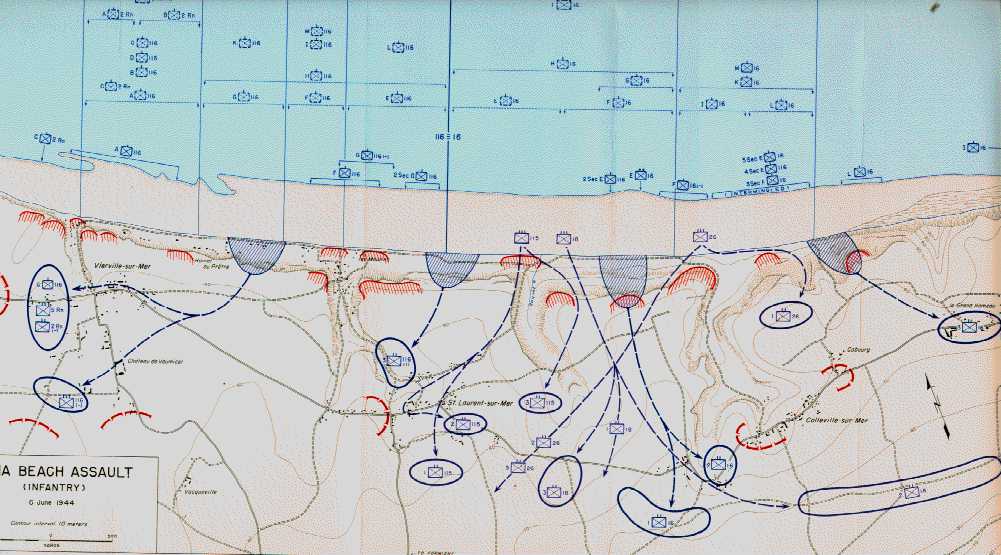
What the destiny seemed to have granted at the Utah beach, it took back at Omaha beach. Just after having abandoned the protection of the peninsula of the Cotentin, the sea had become again shaken. The approach of the 1st division of American infantry had been very difficult. Some ships had sunk during the crossing, bringing with themselves their unlucky soldiers who could do nothing other than drowning. The first platoons that landed on the beach were massacred by an heavy rain of bullets that originated from the coastal defenses, where the 352nd division of German infantry commanded by General Dietrich Kraiss was fortified. Though it was not an elite unit, it was incomparably superior to the 719th Division, composed for the largest part from old soldiers, that would have had originally to defend the region attacked by the V American Army. The alternation had happened only after an inspection of Rommel during the month of May. The laxity of the troop and the insufficiency of the defenses had so disgusted him that the substitution of the men had been nearly immediate.
This way, for the obstinacy of an anti-Nazi general who, however, continued to do his own duty of soldier, the Americans had to face a well superior resistance than the estimated one. Only an element seemed to countersign all the survived veterans' testimonies about that first tragic moments. They remember with imperishable horror how the sea was red of the blood of the soldiers who had preceded or followed them and how the backwash accumulated little by little the dead bodies on the waterline. Some among these veterans are not ashamed of saying that they trembled for the terror. Yet, nobody stopped there. The men continued to land, to race, to step over the dead fellows, to look for that any tiny shelter that the naked beach could give.
If the infantry was in crisis, well more serious it was the situation for the support armored units. Among 60 DDs tanks that had to support the first units of invasion, 24 disappeared into the sea. Others reached the land only for the stubbornness of Lieutenant Colonel Rockwall that refused to send the rest of his own tanks to the massacre and let the LCTs run aground allowing the tanks to go out on the beach shooting directly against the German defenses. It was only a momentary survival, because also among these tanks the almost totality was destroyed by 88mm grenades of antitank guns, expressly wanted by Rommel after the prophetic inspection. The Americans didn't know this element although they had thought about the possible opposition of the coastal artillery batteries. In proximity of the Point of Hoc (or Hoe for the Anglo-Saxon historiography), it was displaced a mysterious battery of 155 mms pieces , as feared as that of Merville. It had a natural defense that was reputed invincible. It was at the top of a cliff of several tens of meters that was practically perpendicular to the sea. The 2nd battalion of the American Rangers trained for months on the cliff of the island of Wight and it had been seen how a well trained unit could climb a wall of rock of that type, at least in theory. In the practice, the action cost the life of nearly 20% of the Americans that, once arrived up to the top and conquered the German bunkers, realized that the 155 mm guns were only trunks of tree. The real weapons had been moved elsewhere and for the largest part they would have been destroyed that morning while they were still on their the transfer carriages.
At Gold, Juno and Sword, the controlled Anglo-Canadian soldiers would have surprised the American allies. The army that had had only defeats (with the exclusion of the few victories in North Africa) catapulted itself out of the landing ships with an impetus that overwhelmed everything. Certainly, the 716th division that defended the beaches had not the same quality of the German men who were at Omaha beach, but the British advance was unbelievable. In the forenoon of the D-Day, they widen their own zone of influence up to the coastal region of Arromanches to West and up to St. Aubin to East. The town of Courseulles that had to be conquered in the first hours of the landing incredibly resisted, but the Canadians didn't take care of it. They overcame the urban agglomeration and assaulted the hills that divided Bayeux from Caen. When the sun reached its apex above the horizon, the 4th American division had joined the airborne troops in the zone of S.te Mère Eglise and the British troops were at few kilometers from the first houses of Bayeux. Only at Omaha Beach the invasion was extremely slow. The American patriotic epic, reproduced subsequently in the Hollywood's movies, tells that only at midday of D-Day a small unit of men had left the beach under the command of General Cota by opening the road through the grids of barbed wire with the explosive transported for hundreds of meters from brave men of the Engineer Corp under the hostile fire of the German machine-guns.
While the action was proceeding frantic on the beaches, the German Command was pervaded by an unreal sense of resignation. Rommel knew about the attack in Normandy only at 6.30 AM when the Americans at Utah beach were walking on the French ground. He left again immediately for the front giving up the meeting with Hitler, now useless. Von Rundstedt maintained an extremely prudent behavior. He didn't employ in fight his best troops and the armored forces that remained wisely hidden in the woods of the high Normandy intimidated by the American air supremacy. In four points on five, the Allied troops had created strong bridgeheads well beyond the beaches, where Rommel would have had to stop them. According to the fears of the "desert fox", the battle for France was lost by now, because the Anglo-Americans could use their great mobility and the unlimited supplies that had been accumulated in Great Britain. Yet, the German soldiers resisted with great success against the hostile efforts of breaking the front at Omaha Beach and the Allies were threatened to be pushed back into the sea. Then, what did it prevent a more stronger German reaction in those so crucial hours? Probably, the absolute lack of conviction of the officers who had to command the counterattack. Von Rundstedt was for tradition against Hitler, Rommel had become so after the beginning of the war against the Soviet Union and many others with him. It seemed that they hoped a victory of the Allies. Maybe not in a conscious way, because they fought vigorously against the invaders, but very probably in their unconscious, when they had to consider what was the minor evil for Germany, Hitler or the defeat against the Allies, many among them thought that the latter choice involved some indisputable attraction and the following attack against the Führer would have confirmed this hypothesis.
At midday on the D-Day, the world was still unaware about what it was happening on the beaches of Normandy. Certainly, the population knew some news from the Radio, either in Germany either in the Allied countries, but it could not know how the invaders were acting, neither if the Atlantic Wall was really insuperable as Hitler's propaganda had promised. Few time after 12 AM, Winston Churchill in front of the English Chamber of the Communes members spoke for a briefing about the military operations in progress. When he was young, he had been an appreciated war reporter and he risked in 1899, when he worked for the "Morning Post" in South Africa, to be shot by the Boers after having been captured. That day too, he knew to bewitch his audience with his own words. He spent more than twenty minutes by singing hosannas for the British troops in Italy that the day before had freed Rome, now declared open city. It was necessary a direct question to get the following laconic answer: "Operation Overlord continues according to the plans." Churchill's sentence was only partly true.
The Allies had made great progresses during the forenoon but the situation at Omaha Beach was still worrisome. Besides, with the return of Rommel on the French ground, it seemed that the Germans were shaken from their apathy out. The 709th division of German infantry of General Dollmann counterattacked on the Merderet and for more than two hours between 1 PM and 3 PM, it seemed possible that the Americans were repulsed toward Utah Beach, then despite high losses, the paratroopers of 82th and 101th American division maintained the contact with the infantry and they let the counterattack fail definitely. General Kraiss guilty supposed the failure of the landing at Omaha, an error that would have been fatal for the whole right side of the German defense. He moved his own reserves to East in order to cover his own side from a possible attack from British troops that continued to advance in direction of Bayeux. This allowed the Americans to break the front near the road to Colleville, where some strong and lucky officers, let LCT 30 and LCI 54 run aground, saving the soldiers and the means from facing the hostile fire directly. The advance on that beach was slow and paid with the life of thousand of American soldiers. Firstly, it was conquered the zone of the dunes in proximity of the first line of German bunkers, then thanks to an additional sea bombardment of the US Navy they arrived to the hills beyond the shore and from there the way out was definitely opened. Only the missing of some backup forces prevented them from an ulterior advance.
Paradoxically, the greatest danger for the operation Overlord came right in the region of the Orne, where Allied victory seemed to be firmer. The German 21st armored Division, located near Caen and with 127 Panzers Kw4, had originally received the order to free the zone to the left of the river. German Colonel Oppeln, commander of the 22nd armored regiment of that division, probably because of an initiative of his, re-read the received order by interpreting it under the light of the new tactical situation that he could see with his own eyes. Rather than protecting Caen and what remained in the hands of the Germans, he crossed the river Orne on the only city bridge still standing after the bombardments of the morning and attacked in direction of Bièville. The Canadian troops were surprised by the presence of so many panzers and they preferred to halt their own advance and to fortify while waiting for reinforcements. Only a pair of kilometers more to West, the 192nd regiment of the Panzergranadieres of the 21st Armored Division completed an in-depth movement that allowed to reach the sea near Luc-sur-Mer, separating in two part the British invasion troops. At 6.00 PM, the German troops, exhausted by the enormous effort done during the afternoon halted and remained on defense. In the zone, both factions were too in open order on the territory to protect their own back areas and they patiently waited for the reinforcements promised by their own superiors.
At the beginning, it seemed that the Germans got them with more promptness. Hitler, woken up toward midday and informed about the invasion, was convinced that the movements in Normandy were a bluff to protect the real invasion that would have happened at Calais. So, he forbade to use the 15th Army that had to protect the Channel. However, he allowed the move of the Panzer Lehr and the 12nd SS Armored Division. Rommel got these reserves during the late afternoon and at that time, on almost all the beaches everything was calm. In fact, the beaches were in the hands of the Allies who were ready to deploy the Mulberry and to start the landing of the follow up divisions, that is 29th and 90th American Division and 51st and 7th British Armored Division . The Germans had few time to exploit this disorganization that still tormented the Allies, then everything would have been lost. This way, at 9.00 PM the journey of the Panzer Lehr started. That unit would have had to counterattack at dawn and to disperse the hostile troops around Caen. The unit's movement is told from the veterans as an odyssey. The sky was dominated by the "Typhoons" fighter-bombers that under the guide of illuminating rockets destroyed at random the German tanks that in column on the roads had serious difficulties to find a shelter. The foreseen counterattack at dawn didn't happen for the whole day on June 7, granting one more day to the Allied reinforcements to come from Great Britain.
Likely, the attack would not have served in any case. Also not existing any precise figure on the exact number of men and means landed on the D-Day, recalling the number of the divisions involved during the day of the invasion, it can be conjectured that on the D-Day there were at least 155.000 Allied soldiers on French ground. The targets foreseen from the original plan had not been reached, rather in the positions around Omaha Beach, the conquests were limited to few kilometers of sandy ground. Caen was still in German hands and with it, its vital airport. Cherbourg was powerfully defended and it would never have granted intact its own port facilities. Nevertheless, the Atlantic Wall had been forced in five points and, more important element, the whole Free World knew that the Democracies very vituperated by Hitler had began their own march on the European continent. The biggest result of "Overlord" was the new hope of the populations of the occupied nation. It was proved in the following months from the increasing anti-German feeling that increased the number of the partisan formations beginning from the French maquis that on June 6 1944 knew, despite every lie of the Nazi propaganda, they were not alone in their fight for Freedom.
Sources: "D-Day, June 6, 1944: The climactic battle of World War II" by Stephen E. Ambrose, Ambrose-Tubbs, Inc; "World War II" by Raymond Cartier; "World War II, illustrated chronology of 2194 days of war" edited by Cesare Salmaggi and Alfredo Pallavisini, Arnoldo Mondadori Publisher.
Previous part of the article
Top of Page
|