The Allied preparation
The Anglo-American Supreme Command had several doubts. The weakness of the
enemy was not known but rather perceived. However, the fear of a failure paralysed
those people who had to give the official order of invasion. A defeat would have
meant the delay sine die of whatever project of intervention to help the Soviet
Union and Roosevelt's pretension to get an unconditional surrender from Germany
would have had to be abandoned in favor of a peace agreement.
The principal questions of the Allies were exactly the same the Germans had:
where and when the attack would have had happened. In 1943, the COSSAC had been
created (Chief of Staff Supreme Allied Commander) that had got its own name from
the office of its commander, English General Frederick E. Morgan. This organism
had the assignment to organize the invasion and, as only directive, "do it as
soon as possible." The defects of the COSSAC were essentially two. Indeed, the
assignment that had to be dispatched was as grandiose as few resources the organ
had to complete it. The initial plan foresaw a specific attack with the employment
of only 3 divisions for the conquest of a large port in Northern France, through
which to let land on the territory the immense resources available in the United
States. Secondarily, Morgan had to obey to the CCS (Committee of Chief of Staff)
to which he had to submit whatever initiative he wanted to undertake, with the
risk to find some unjustified vetoes.
This situation lasted for several months up to January 1944 when it was created
the SHAEF (Supreme Headquarters Allied Expeditionary Forces), whose command was
entrusted to General Dwight Eisenhower, while Morgan had the office of deputy
commander. It had been lost one year only to establish what structure had to command
the invasion and what its powers were. Where and When had not been yet established.
Almost immediately, Eisenhower provided a term for the mission: June 1 1944. The
date was a prolongation of the original term that had been on May 1. The American
general pretended an additional month to be sure to have a great availability
of forces to proceed. In fact, in the first months of 1944 there was a decrease
of the threat of the German U-bootes against the convoys that crossed the Atlantic
ocean. Even the ships Queen Elizabeth and Queen Mary could transport a division
a time and effect two Atlantic crossing a month.
All Allied commanders, especially Montgomery, had judged 3 divisions as particularly
insufficient for the main attack and, therefore, the number had been increased
to five plus three airborne divisions. To do so, it was canceled the contemporaneity
of the operation Anvil that was the invasion of South France, in Provence. The
figure of men needed for the attack was directly proportional to the difficulties
provided from the select zone: the East coast of the Cotentin and the beaches
of the Calvados in Normandy. Two other hypotheses had been analyzed and then discarded:
the Pas de Calais and Brittany near Brest. The latter one because it was too far
from English air bases that would have had to guarantee the tactical support during
the invasion, the former one because of the immense fortifications that had been
built around the port of Calais. Being the Pas de Calais the briefest way toward
the Ruhr, the OKH had seen it as the most logical zone for an attack. Even Hitler
had this opinion and he also tried to force the Allied decision by positioning
right in that area the attack bases of the tele-guided V-1 bombs and of the V-2
rockets. Instead, the zone of the Calvados had been expressly excluded by the
Abwehr (the German secret services) because it was considered too impervious.
The choice of the SHAEF had not been simple. Caen, with his small port was
designated as a strategic point of the whole operation. Cherbourg in the north
of the Cotentin was surely a better prey thanks to its exceptional naval structures,
but it had the fundamental disadvantage to have been powerfully strengthened and,
therefore, an amphibious action against that position was not discussed. Normandy
had two important advantages: it was protected against the Atlantic storms from
the peninsula of the Cotentin (we will see subsequently for what reason the crossing
of the Channel had to be the calmest possible) and it was exactly on the point
of union of the German divisions that had to defend the territory. The order of
attack would have been the following:
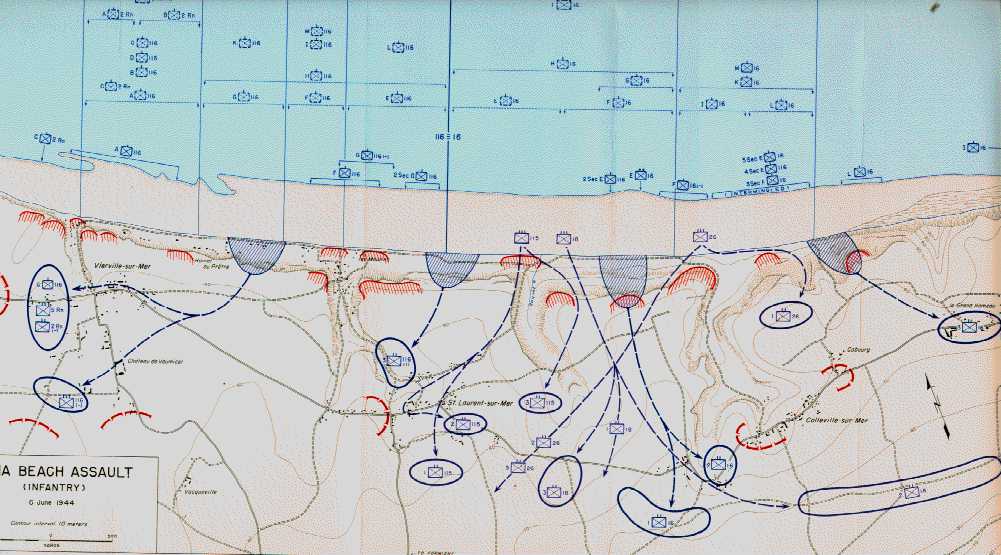
- at La Dune de Valleville and la Madelaine on the East coast of the Cotentin
(area Utah) the 4th division of American infantry supported by 82nd and 101st
American Airborne Division that landing near S.te Mère Eglise and S.te Mère du
Mont would have divided in two parts the coastal road that connected Cherbourg
to Carentan, preventing that the German forces arriving from the port could threaten
the landing.
- between point Hoc and Port en Bessin in Western Calvados (area Omaha) the
1st division of American infantry.
- between Arromanches and the river Seulles (area Gold) the 50th division of
British infantry.
- in front of Courseilles sur Mer (area Juno) the 3rd division of Canadian infantry.
- between Lion sur Mer and the River Orne (area Sword) the 3rd division of British
infantry that would have been supported by the 6th British airborne division that
had the assignment to attack the zone across river Orne and to defend to death
the bridge denominated Pegasus, the only sure way to cross the Orne.
To have decided a date and a place for the invasion and to have predisposed
the order of battle it didn't mean that Allies knew how to effect the invasion.
The previous amphibious operations (the attack in North Africa, the landing in
Sicily, at Salerno and Anzio) were not comparable to what the Allies had to do
in Normandy. In Africa, the French army of Vichy had opposed a symbolic resistance,
while in Sicily the soldiers of Mussolini were too demoralized to be a true danger.
At Salerno and Anzio, the Wehrmacht, more experienced after the preceding attacks,
had seriously threatened letting fail the landing. The SHAEF, so, set as necessary
condition for the success that the attack had the maximum surprise factor. To
achieve such a result two ways were followed, a tactic and a strategic one. On
tactical level the Allies opted, unwillingly, for an extremely limited bombardment
that would have involved a large number of casualties among the divisions that
would have conducted the first attack, but it would also have guaranteed that
Germans didn't discover the operation until the troops were in proximity of the
French ground.
This decision was particularly difficult for the English commanders. While
the American divisions were nearly totally inexperienced and so mostly unaware
of the danger they had to face, the British divisions, being tested under enemy
fire, (i.e veterans from Africa's campaigns), knew very well the destruction and
the death to which Great Britain had been forced for four years because of the
terror bombardments of the Luftwaffe. The possibility was hypothesized even to
attack with troops of only one nationality in order to avoid that the possible
panic could be propagated more quickly, increased by the acridity, often joky
but some times serious, existing between English and Americans. At the end, the
risk that the serious losses could reset the impetus of the assailants it was
judged, however, inferior to the danger of an announced invasion.
On the strategic level, the secret of the D-Day (where the D is still for Day.
In fact it's pointed out the "day" of the action) was kept by organizing the biggest
operation of counterespionage that the war history had ever seen. Denominated
conventionally "Fortitude", it drew advantage from the great successes gotten
in the preceding years from the British Intelligence Service. The German code
system produced by the cryptography machine called Enigma had been deciphered
and the Abwehr had not realized it. In this way, the Allies could know with enough
sureness what the movements of the German troops were and, at the same time, they
could give wrong information to the counterpart that didn't recognize them as
such because that information was written in such a way to be perfectly conform
with the communications created by Enigma. The net of German spies in Great Britain
was also broadly discovered and it had been decided to involve those hostile agents
in a game of betrayals and deceptions that it had to serve for the cause of the
Western Democracies.
Fortitude had been organized essentially in two sections. The first one involved
that interesting details were given about the possibility that the invasion took
place in Norway. To inculcate into the enemy such a conviction, a large net of
elderly English officers was organized, who for whole April and May 1944 produced,
from Scotland, a lot of radio communications among divisions and army corps existing
only thanks to the imagination of the English Intelligence. This first part of
the deception was so effective that to the date of the D-Day, 9 German divisions
were in Norway instead of being on the French ground. The second part of the plan
was more difficult. With the name in code of Fortitude South, it had to let the
Wehrmacht believe that the attack would have run over the region of the Pas de
Calais. The same methods used in Scotland could not be utilized there because
of the air surveillance of the Abwehr over the English coastal regions. At least
part of the troops had to be real ones and therefore the 1st Canadian Army, with
bases in England, was the fulcrum of this "bad joke". Others 2 armies were added
to it (3rd American Army, really existing, but displaced in the United States
and the 4th British Army that didn't had a man!). To the infantry an incalculable
number of armored forces were added that were mostly constituted from vehicles
made by plastics or rubber, built on purpose for deceiving the air surveillance!
The real winning card was, however, that the command of the presumed invasion
was given to General George Patton. In the Wehrmacht, Patton was considered the
better man of the Allies and his new role was considered a logical action for
an imminent attack.
The impetuous temper of Patton, who felt himself excluded from the action,
threatened several times the secretiveness of the plan, but it also contributed
to feed the legend of his following ride in France, perhaps a consequence of those
months of "purgatory" to which he had been forced. To confuse in a definitive
manner the ideas of the Germans, the Allies accented enormously the air raids
over Southern France. During the night between May 26 and 27 that region of the
republic of Vichy was nearly destroyed from hundreds of bombardments. The sad
result was more than three thousand victims among the inhabitants of the cities
of Nice, Saint-Etienne, Chambèry, Amiens, Marseille, Avignon, and Nimes, but also
a strengthening of Fortitude South that shows us how the Allies arrived to sacrifice
anything in order to guarantee the success of operation Overlord.
Everything had been done. The men for the invasion had been trained, the secret
had been maintained and at the beginning of April 1944, the invasion was ready.
Correctly, it would be better to say that it would have been ready if the SHAEF
had had enough ships to transport all the divisions of the first attack. They
were not "ships" in the common sense of the word, because the Royal Navy and the
U.S. Navy had completed huge moves of troops across the Atlantic Ocean, as we
have already remembered and they were not even transport boats of large dimension,
since they already existed and had been used during the previous landings: the
LSTs (landing ships with the flat fund that served for crossing sea over long
distances. Difficult to drive and very slow, they had been one of the reasons
for which Normandy was chosen. In fact, that land was protected from the strong
Atlantic storms from the peninsula of the Cotentin.) and the LCTs (boats of small
dimensions in comparison to the LSTs, 33 m against 60 m, that completed the last
part of the journey toward the attack beaches). The greatest problem consisted
to provide a mean of transport suitable for the attack against an enemy fortified
on the beaches. During the landings in Africa and Italy, the Allied soldiers had
been forced to jump from the edges of the LCTs, but this was not a problem, because
the defenders didn't have a defensive apparatus worthy of being called such.
In Normandy, instead, a different solution was necessary. There were two main
issues:
- the soldiers had to run up to the beach, and then get a shelter as soon as
possible
- they had to be supported from armored vehicles even in the first minutes of
the invasion that otherwise would have been transformed in a disaster.
The former problem got an American solution thanks to the so-called "Higgins
Boat" that had their name from their genial builder. They had small dimensions
(only 11 m). They were similar to the LCTs, but they had a large anterior port
that had to be opened at the moment of the landing, becoming a ramp from which
the men could exit at high speed. They would have been the protagonists of the
landing.
Instead, the latter problem was resolved in Great Britain, with the invention
of the DDs tanks. They were armored vehicles with double propulsion (Double Drive)
that were made impermeable thanks to a covering made by cloth . In this way they
could cross by floating several hundred meters of sea and reach the beach where
they restarted to move in the traditional way. It was right to have an enough
figure of these vehicles that the definitive date for the beginning of the landing
operations was postponed from May 1 to June 1.
Nevertheless, it existed a further danger for the success of the operation
Overlord. It consisted in the possibility that the divisions initially employed
didn't succeed in conquering a large port in a reasonable time. In this case,
the enemy would have had enough time to reorganize and to counterattack. The English
engineers were able to overcome that danger with the preparation of artificial
floating harbors denominated Mulberry. The system was essentially simple. The
floating benches, called Whales, were towed up to the place where the port structure
had to be displaced and then anchored to the seabed with four pillars, which could
move up and down according to the height of the tide. The connection with the
land was assured from mobile gangways and the protection from the open sea was
got by sinking some old ships (Gooseberries) and with artificial breakwaters (Phoenix).
Although in the reality these little masterpieces of naval engineering worked
only for two weeks, since either the American Mulberry either the English one
were seriously damaged by an Atlantic storm, they served to guarantee an continuous
influx of vehicles and men in that brief period that was one of the most difficult
of the campaign. As far as it concerns the fuel supply, it was constructed a clever
system denominated Pluto (Pipe-Line-Under-The-Ocean) that served the allied troops
up to the conquest of port structures more efficient than the Mulberries that
could host ships only up to 10.000 tons.
Previous part of the article - Next
part of the article
Top of Page
|