|
Basilica of St. Paul Outside the Walls |
||
|
To previous page: Mission Profile |
To next page: St. Sebastian |
|
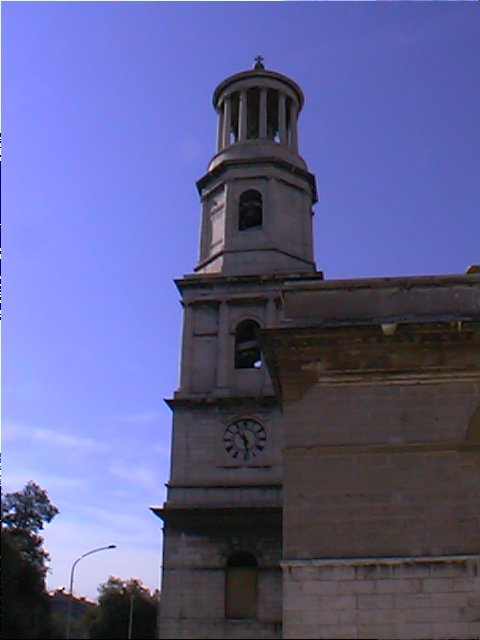
Arrival at first objective. Rendezvous at Bell Tower. 1045, all companies assaulted St Paul's and Company "A" will rendezvous at Bell Tower at 1100.
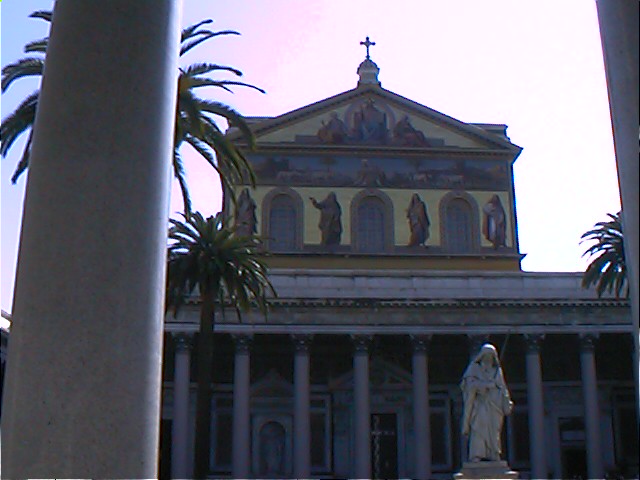
Facade of St Paul's Outside the Wall The beautiful gold background provides a hint of the beauty that is to come when you visit the inside of the church.
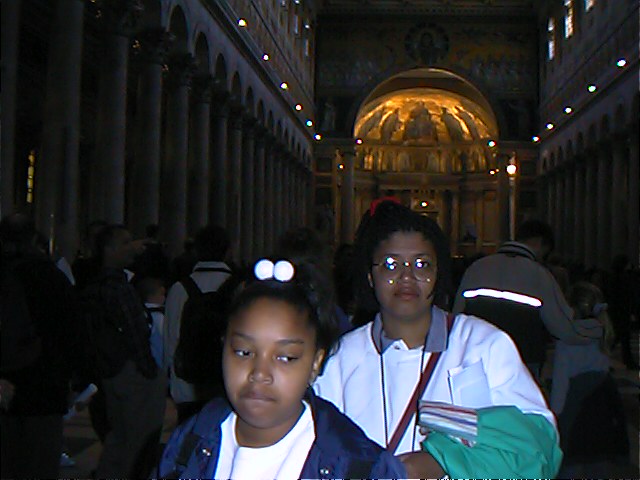
Joy and Katherine and the apse mosaic in the background.
Detail of the Nave and Apse. When in Italy, you have to always look up at the ceilings. They are sometimes masterpieces in their own right. | Time: 1028
Briefing held by Company Commanders on total mission objective. Group held prayer service. Company Commanders broke out their respective troops and carried out battle plan. St. Paul was put to death by beheading with a sword, around 64-67A.D. during the persecution of the Emperor Nero (54-68). His body was taken by a devout and wealthy Christian family and buried outside the city walls, this was the law for Christians at that time. This practice loaned this church part of its distinction. Devotion to St. Paul grew rapidly and soon many of the the faithful were coming to his tomb. A small shrine was eventually built over it and the crowds of visitors soon outgrew the facility. In 324, the Emperor Constantine (306-337), a convert to Christianity, built a basilica over the Apostle's tomb. His body was placed in a bronze sarcophagus with a marble slab over it with the words "PAULO APOSTOLMART" inscribed on it. Pope Sylvester I consecrated the basilica on November 18, 326, the same day he consecrated St. Peter's in the Vatican. St. Paul's body is now buried under the confessio (a chamber beneath an alter containing the body or relics of a saint) at the front of the middle nave. The number of visitors soon required a bigger church and in 386 the Emperor Valentinian II began plans for a new one to be built (the emperor was now closely affiliated to the church and took on projects such as as the building of churches.). It was completed during the reign of Emperor Honorius between 395 and 423. In the 9th century, it was enlarged and modified. It remained basically the same until in 1823 when the roof caught fire and destroyed most of the basilica. It was rebuilt in the same design as the original and completed in 1854 when it was consecrated by Pope Pius IX who will be beatified later this year. This church is considered to be an excellent example of what an early Christian basilica was like. Of special interest are the portraits of the popes high on the wall of the nave, the statues of the apostles and the mosaic in the apse. The artwork in the nave was done in 1220 and miraculously survived the fire of 1823. |
|
| ITCAGW Home Page previous page: Mission Profile | Mission
Cover Sheet
next page: St. Sebastian |
|