Basilica of St.
Sebastian |
||
previous page: St. Paul |
next page St. John Lateran |
|
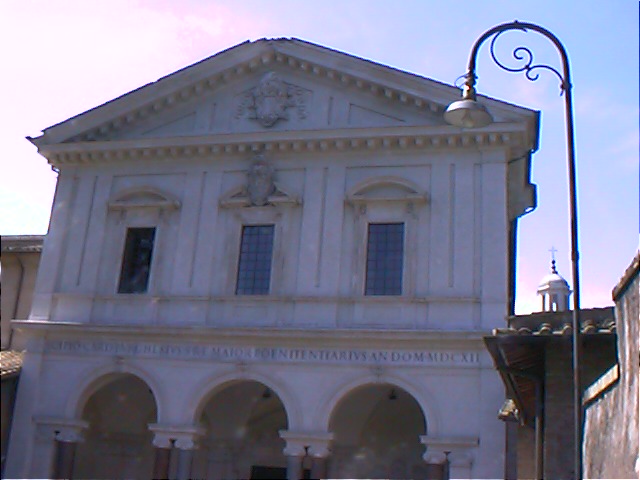
External View of St. Sebastian's Note: This was one of the longest walks on the tour, and I was a little tired when we got there. There was also a service going on inside and they didn't allow any picture taking. Here are a couple of shots from the walk.
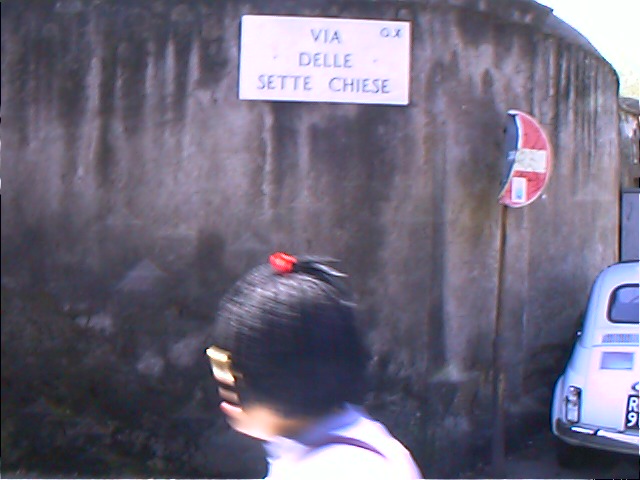
Joy walking down the Street of the Seven Churches (via della Sette Chiese). When I saw that sign, I though all seven churches we would visit were all down the same street. Boy, was I ever wrong!
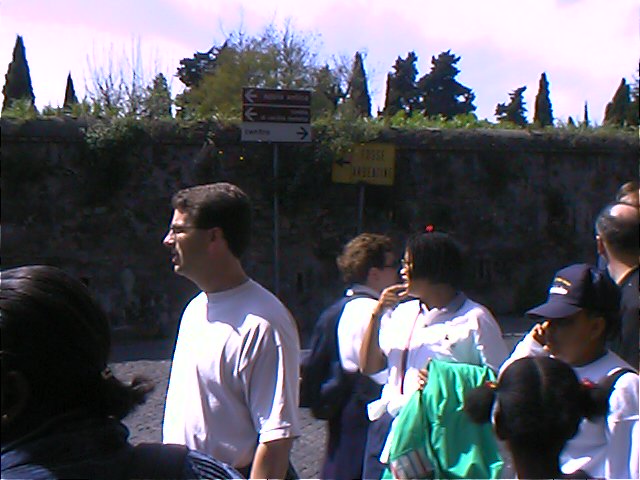
A sign pointing the way to the Cemetery (on the bottom) and the church. Yes, that is Joy and Katherine.
| The Basilica of St. Sebastian is at the
entrance to the catacombs named in his honor. The catacombs were
simply a Christian underground cemetery. Unlike the pagans of the
time, the Christians would not cremate the bodies of the dead but rather
dug out tunnels and buried their dead in niches that line these
underground tunnels. The Christians would com to the catacombs
often to pray for their dead and to celebrate with a meal their brother
or sister that was now entering life in heaven.
St. Sebastian is a martyr of the fourth century. He was a soldier in the court of the Emperor Diocletian (284-305), one of the most hostile emperors to the Christian faith. The law required for any Christian soldier to renounce their faith or be killed. Sebastian held fast to the faith and paid the ultimate price. Tradition tells us that he was tied to a tree and shot through with arrows, which is the pose with which he is commonly recognized. Miraculously he did not die, but was thrown into a Roman gutter after his failed execution. His fellow Christians drew him out of the sewers and he eventually died in their company and was brought to this catacomb for burial. This catacomb is important to us because during a particularly aggressive persecution of the Christians in the 3rd century, the bodies of Peter and Paul were brought here for safe keeping. The Emperor Constantine built this church in their honor, and it was originally called the "Basilica Apostolorum". Of interest are a statue of the dying St Sebastian over his grave, a wooden sculpture of the saint on the roof and the high altar containing the head of St. Fabian, another martyr. |
|
| ITCAGW Home Page previous page: St. Paul | Mission
Cover Sheet
next page St. John Lateran |
|