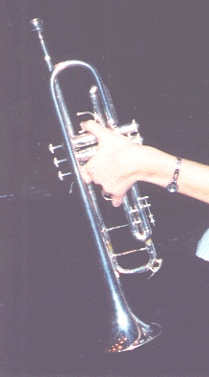
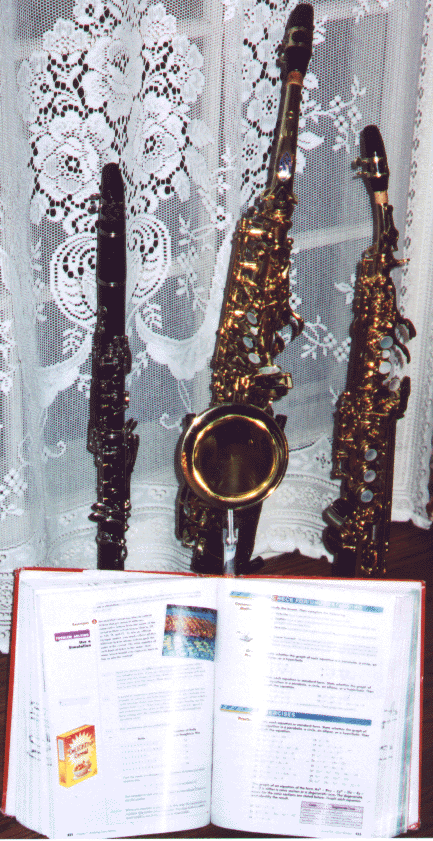
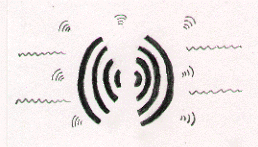
Trigonometry has a large effect on music. One example of that is in sound waves, which are caused by various motions of air molecules produced by a sound from an instrument. Most of the vibrations in air are moving in a back-and-forth manner. These back-and-forth vibrations mean that the sound waves are moving both away and towards the source of the sound. This movement is considered quite regular and can be expressed in function form with t equaling the time that the pressure at a certain point varies. This function is: p(t) = A sin (Bt+C). A is equal to the volume of the note heard and B is the frequency produced by a note.
Another trigonometry funtion that has an effect on sound waves includes a tuning fork and an instrument sound. This involves the force with which a tuning fork in hit compared to the sound produced by an instrument. If the tuning fork is struck so that the sound produced is exactly the same as the one made by the instrument then the following can be assumed: f(t) = A (sin (Bt+C) + sin (B2*t+C)). B2 stands for the tuning fork's frequency. This formula and the first one together are usually used to help tune intruments. If a player is in tune, B2 and B should be very close. This is yet another example of how music relates to math. If your ear wasn't that good and you couldn't hear the pitch differences, you could use math to figure out if your instrument's pitch is off or not. |