Label Design
First Day of Issue
Introduction into Service
Registration Sequence Numbers
Postal Usage
Registration of Commercial Mail
Express Mail
Postage Dues
Commercial Usage of FD Labels
Late Usage
Commemorative Issues
Stamp Week 1993
7th Conference of Israeli Philatelists
8th Conference of Israeli Philatelists
Following the alterations to the design of the Trial label (see proof),
and towards the commencement of a regular service, the Philatelic Service
produced a design of a new label. Besides a change in graphics and coloring,
there was an additional substantial change, important from postal history
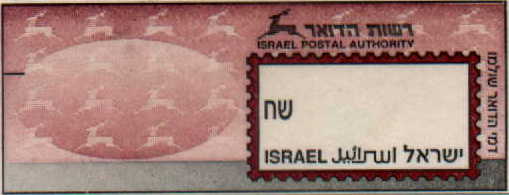
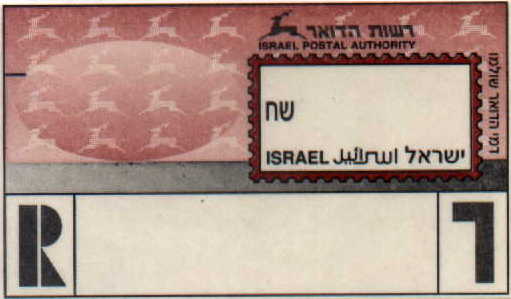
perspective. There were to be two types of labels: a Regular Type (Figure 1) and
a Registered Type (Figure 2). The registered was similar to the regular in
width, but was 12mm higher - allowing for imprinting of the registration
running-number, at the bottom section of the label. This will bring to end the
long service of the blue & white registration stickers, that were in service
for over 43 years. The registered label will be a stamp + postmark +
registration sticker: three postal entities in one item!
The label
design was by ???
|
|
| Figure 1: Regular label - Size 68x26 mm | Figure 2: Registered label - Size 68x38 mm |
Public Notice no. 111/91 dated 8 Dec. 1991, announced the forthcoming new issue of Massad Labels. According to the announcement the Philatelic Service was going to issue "full sheets" (referenced herein as "strips") and FDC as follows:
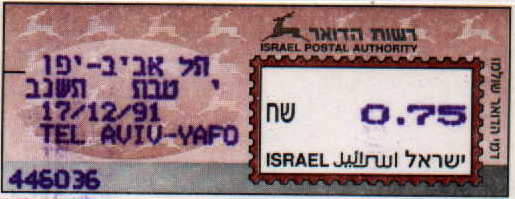
A regular label with the regular Inland Rate of 0.75 NIS (in strips of 10). (Note: Label size was 68x26 mm, see Figure 3).
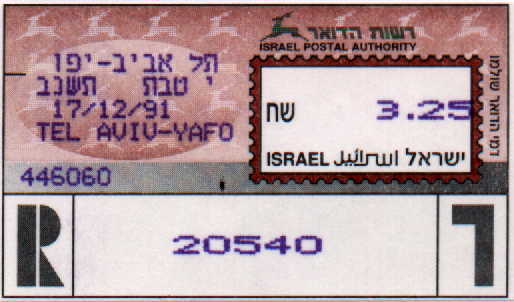
A registered label with the Inland Registered Rate of 3.25 NIS (in strips of 6). (Note: Label size was 68x38 mm, see Figure 4).
An official FDC of the regular label with the regular Inland Rate of 0.75 NIS.
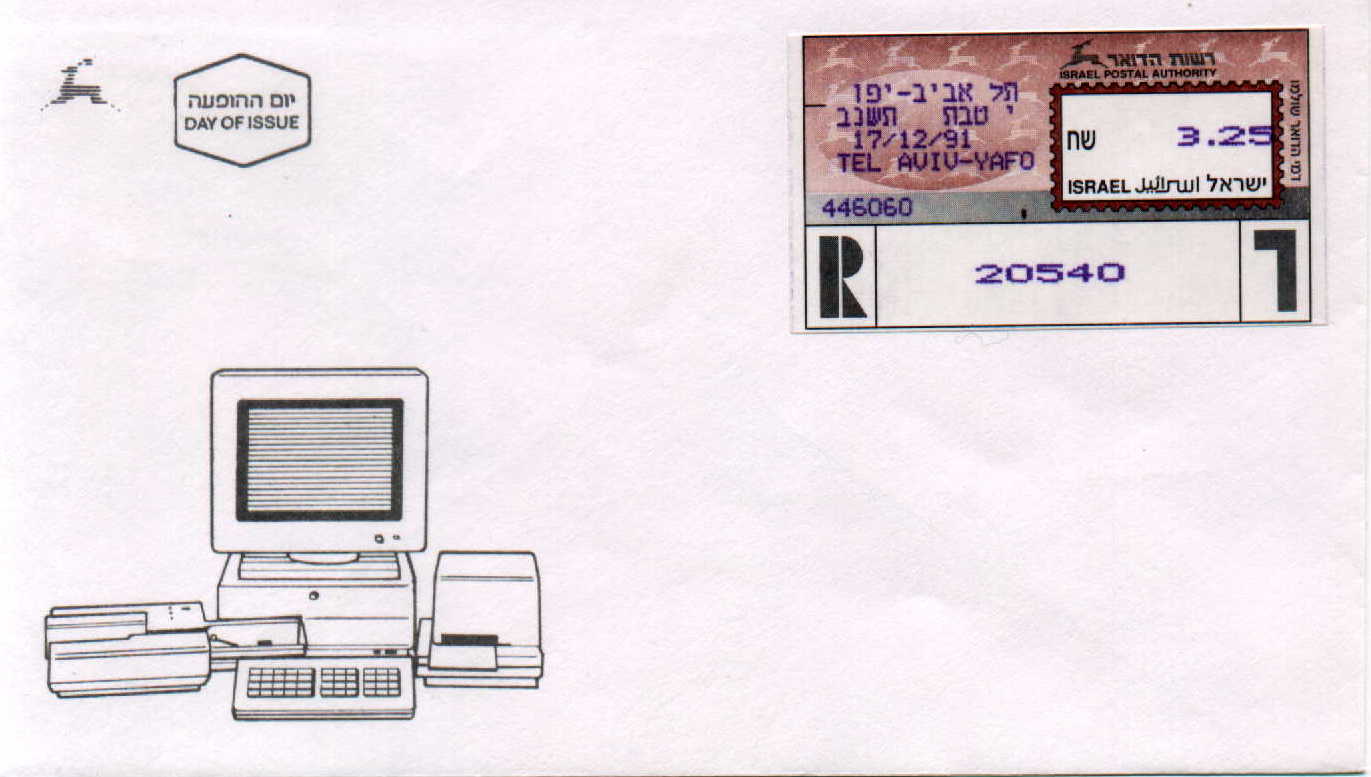
An official FDC of the registered label with the Inland Registered Rate of 3.25 NIS (See Figure 6).
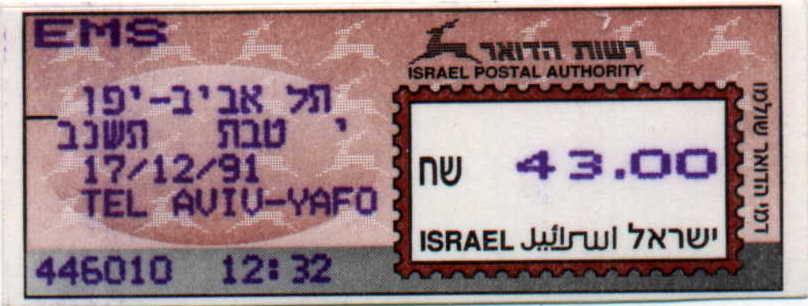
An official FDC with a label imprinted for EMS Postage abroad, with the rate of 43.5 NIS (Note: The EMS label exists also in mint).
The notice also indicated that three terminals were to start service on 17 Dec. 1991 at the Shontzino Branch, Tel-Aviv. The notice emphasized that the Philatelic Service would provide labels imprinted by only one terminal, and that collectors requiring imprints from the other two terminals were to forward their orders directly to the branch manager.
The three terminals that operated at the Shontzino Branch were no. 446010, 446036 and 446060.
It
is important to mention that the EMS label was different not only by the special
imprint of the "EMS" characters (observed only from the 446010
terminal), but also due to the fact that it was the only label that had a time
imprint (Figure 5). This characteristic was added to all types of labels only
during MM/YY.
 |
 |
|
Figure 3: Regular label, Terminal 446036 |
Figure 4: Registered label, Terminal 446060 |
 |
|
Figure 5: EMS label, Terminal 446010 |
 |
|
Figure 6: Official FDC |
The sale of the labels produced by the Philatelic Service on the FD of service was suspended on 31 Dec. 1991 (Public Notice 126/91, dated 23 Dec. 1991).
Public Notice no. 80/921 dated 15 June 1992, announced the expansion of the computerized services to additional branches. The service was to start during the second half of July. It was mentioned that due to installation scheduling constraints no exact days of activation could be provided, and that the actual commencement of services could slip to the first half of August. The notice contained a list of 9 branches in Tel-Aviv and one in Bene-Beraq.
Table 1 lists the observations of the commencement of service in the first 10 branches:
| Date | Branch | Address | Terminals | Comments |
| 2 Jun 92 | Bene Beraq | 75 Rabi Akiva St. | 500050 | See (1), (2) |
| 27 Jul 92 | Hadar Dafna, Tel-Aviv | 41 Shaul Hamelech Bvd. | 432011, 432029, 432037, 432045, 432053, 432061, 432079 | |
| 30 Jul 92 | Yad Eliyahu, Tel-Aviv | 23 La-Guardia St. | 413017, 413025, 413033, 413041 | |
| 8 Aug 92 | Merkezet Tzafon, Tel-Aviv | 108 Even Gvirol St. | 417011, 417029, 417037, 417045, 417053, 417062, 417079, 417087, 417095, 417100 | |
| 8 Aug 92 | Hahashmonaim, Tel-Aviv | 121 Hahashmonaim St. | 423012, 423020, 423038, 423046, 423054, 423062, 423070, 423088, 423096, 423101 | |
| 6 Aug 92 | University, Tel-Aviv | 67 University St. | 429018, 429026,429034, 429042, 429050 | |
| 10 Aug 92 | Beit Hamiyun (Sorting House), Tel-Aviv | 135 Hahagana St. | 450019, 450027, 450035, 450043, 450051 | |
| 13 Aug 92 | Rabi Akiva, Bene Beraq | 75 Rabi Akiva St. | 500034, 500050, 500076, 500092, 500107, 500123 | |
| 18 Aug 92 | Geula, Tel-Aviv | 36 Geula St. | 403012, 403038, 403046, 403054, 403062, 403070 | See (3) |
| 24 Aug 92 | Beit Hataasiyanim, Tel-Aviv | 29 Hamered St. | 478017, 478025, 478033, 478041 |
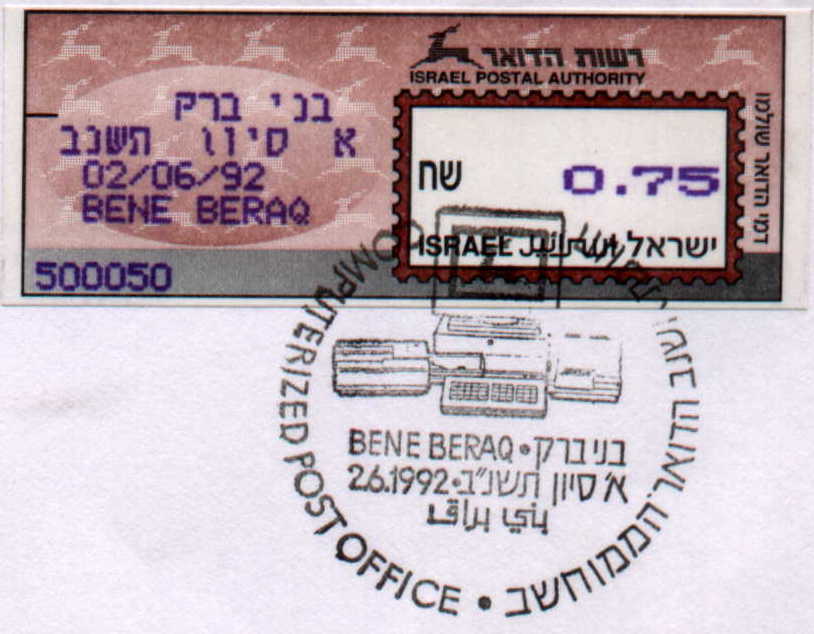
(1) Special commemorative postmark exists for the activation at the Bene Beraq - Rabi Akiva Branch (Figure 7).
(2) Service was for only one day. Continuous service recommenced on 13 Aug 92.
(3) In all Tel-Aviv branches the city inscription was in Hebrew and English was "Tel Aviv-Yafo". In Geula Branch the name "Yafo" was missing (both in Hebrew and in English), an omission that was corrected on 31 Aug. 92 (Figure 8). Additional varieties of partially printed city name exist (See additional details in Terminal Print Varieties)
 |
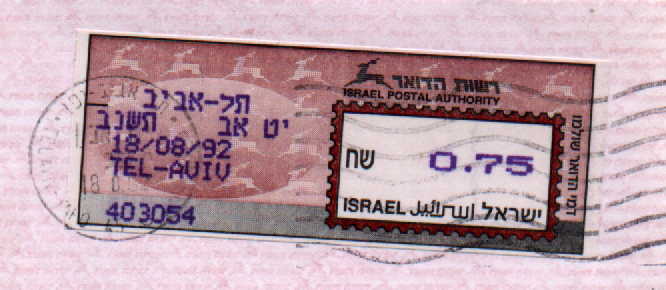 |
| Figure 7: FD of service at Bene Beraq Rabi Akiva Branch - Commemorative Postmark | Figure 8: FD of service at Geula Branch. Notice inscription "Yafo" is missing, and additional same day cancellation by Tel-Aviv sorting machine |
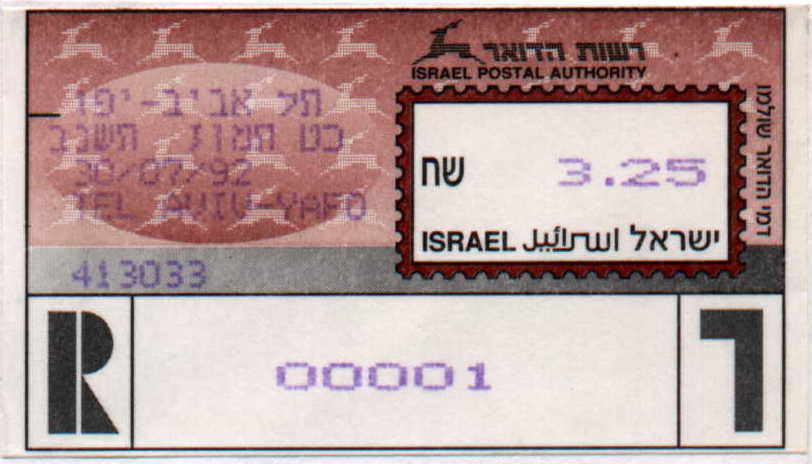
Each terminal had its own run of registration numbers. Hence the registration number "00001" is not unique, but "00001" from a specific machine is unique (Figure 9). The clerk would print (if requested) a payment receipt that had the following information: Branch name, City, Terminal #, Date, Time, Payment received (see Figure 10, the payment receipt for the label purchased in Figure 9).
|
|
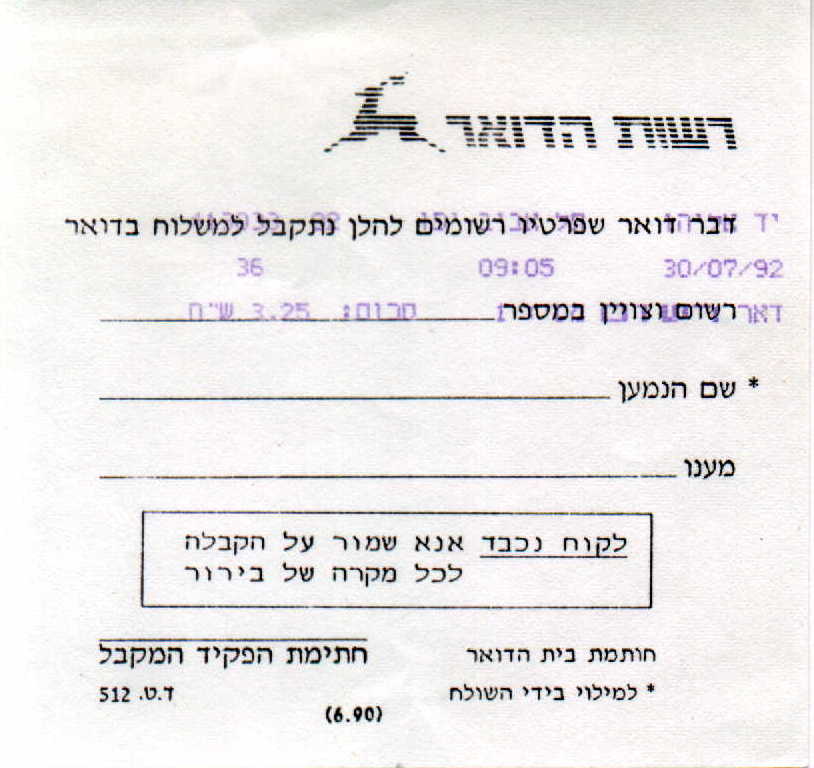 |
| Figure 9: First-Day registration label. Produced at Yad-Eliyahu Branch, Terminal 413033 (Unique) | Figure 10: Purchase receipt |
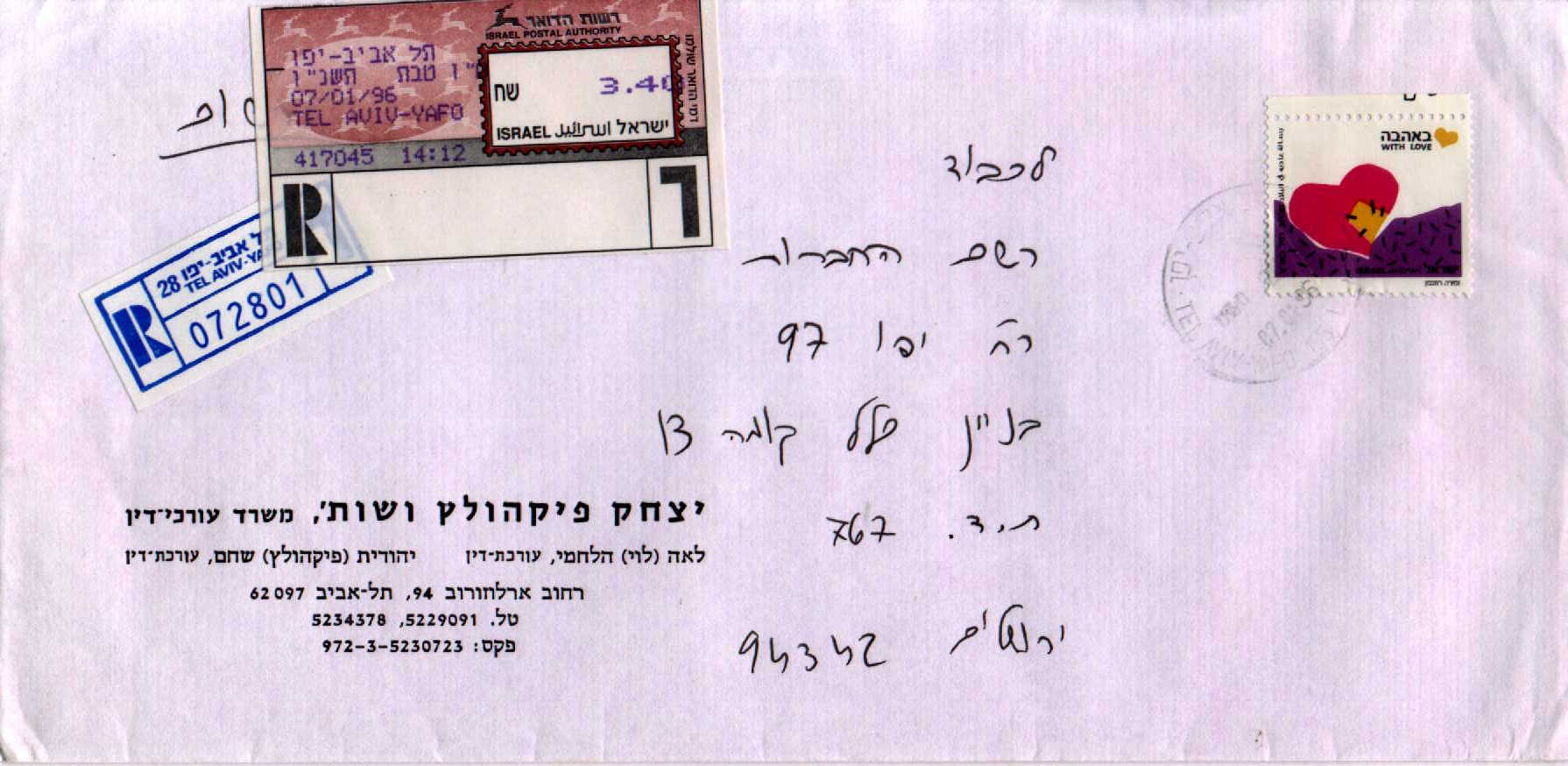
The postal clerks in the various offices required time to adapt to the new system, and so did many of the day-to-day users (e.g. secretaries, office mailing clerks etc.). The fact that a new method was employed to conduct registration of letters, resulted in interesting specimens of registered commercial letters, not all in accordance with the new procedure. Table 2 summarizes different cases observed in a study of a lot from the 1995-1996 period (i.e. 4 years after introduction of the new registration process), that exemplify the difficulty of changing old habits.
| Case ID | Description | Sample |
| A | Using a Regular Type Massad Label with the old registration sticker | Figure 12 |
| B | Using a Registered Type Massad Label (w/o registration number imprint) with the old registration sticker. | Figure 13 |
| C | Using a Registered Type Massad Label (w/o registration number imprint) - but adding a registration number in handwriting. | Figure 14 |
| D | Two registration numbers - on the old sticker and on the new Massad label. | Figure 15 |
| E | Covering of the old registration sticker with the Massad Registered label. | Figure 16 |
| F | Removal of an already affixed old registration sticker. | Figure 17 |
| G | Erasing of an already affixed old registration sticker . | Figure 18 |
| H | Printing a Massad label with the registration surcharge and using it in addition to a regular stamp. | Figure 19 |
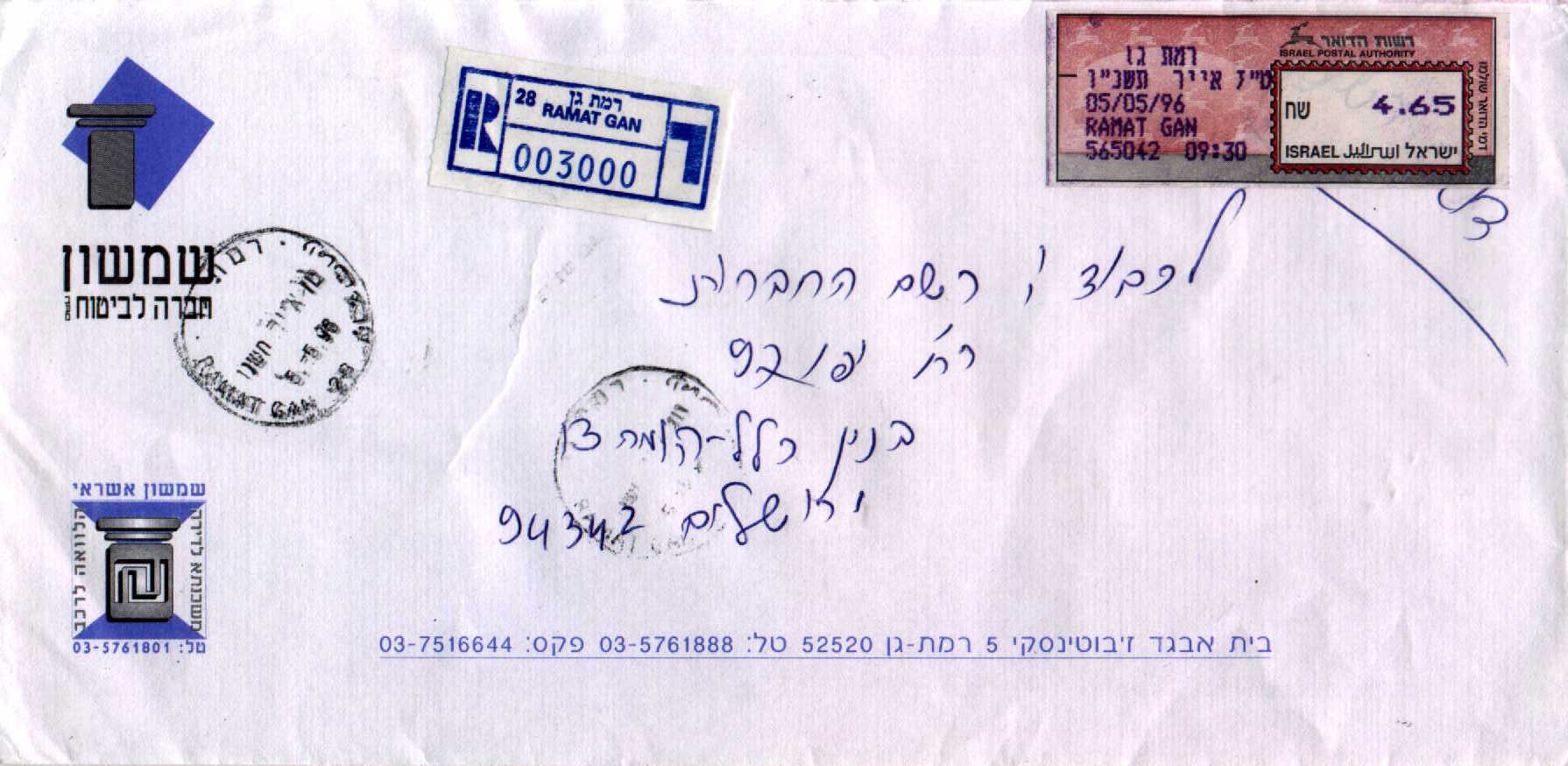 |
| Figure 12: Using a Regular Type Massad Label with the old registration sticker |
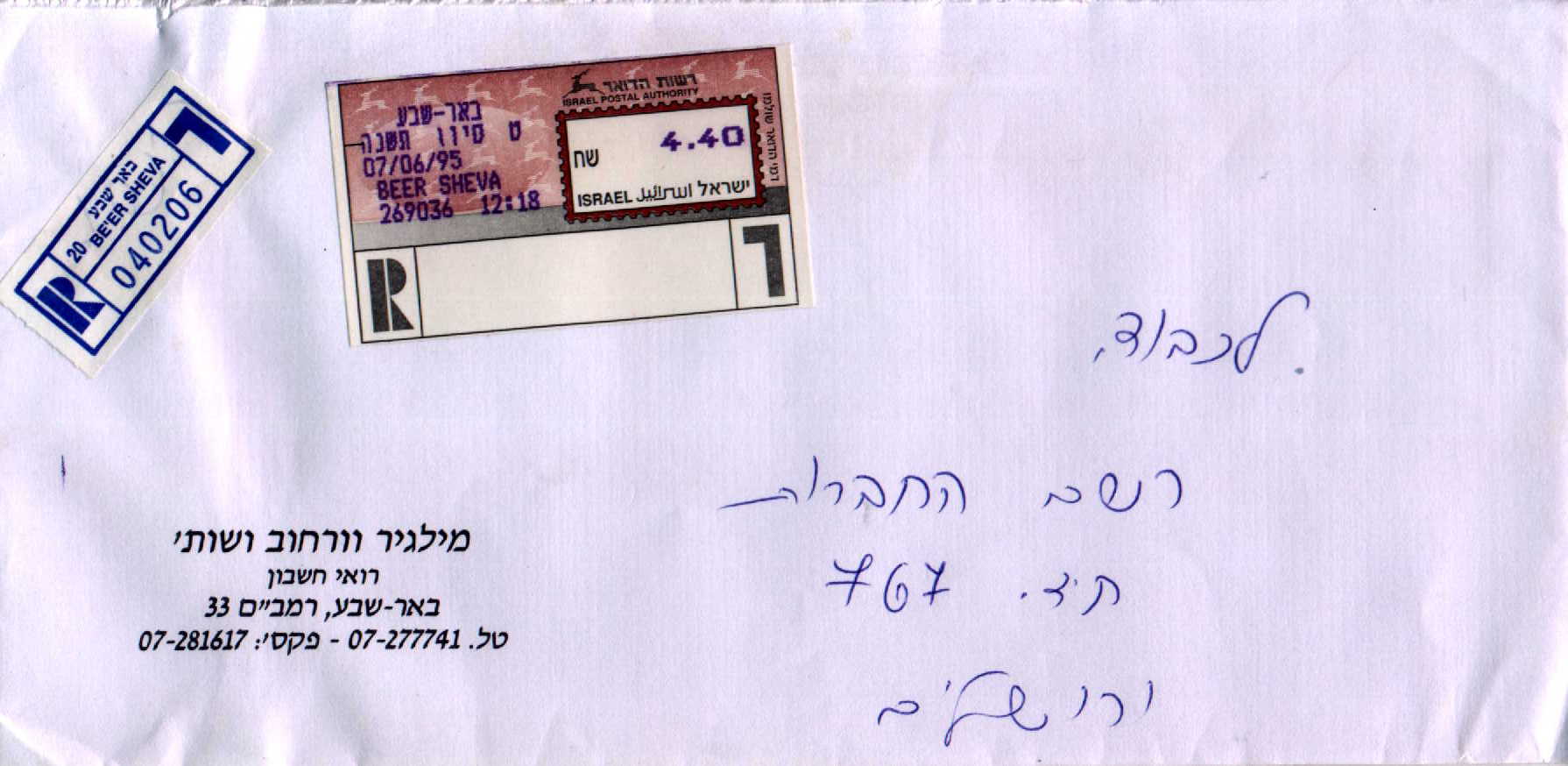 |
| Figure 13: Using a Registered Type Massad Label (w/o registration number imprint) with the old registration sticker |
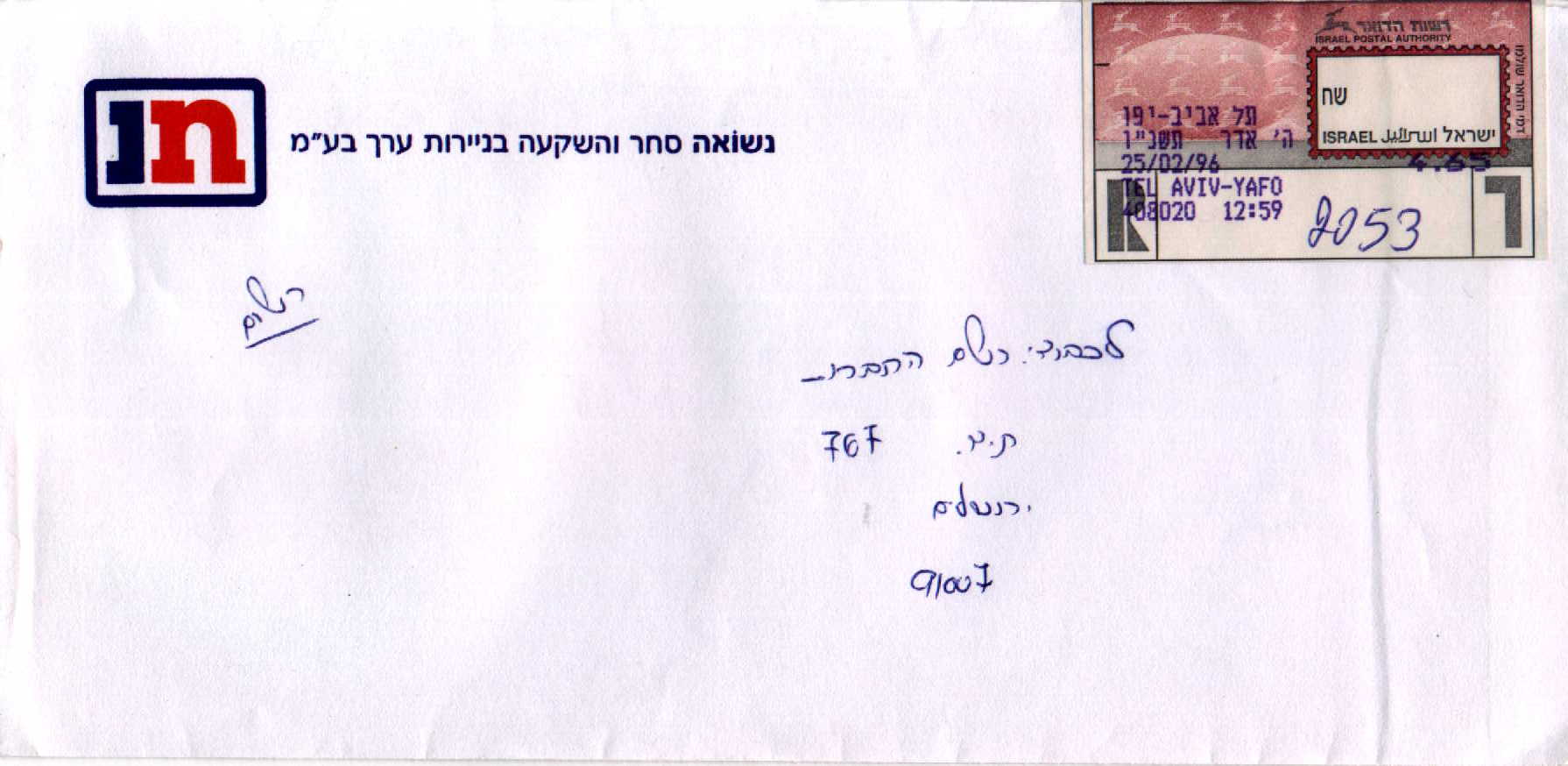 |
| Figure 14: Using a Registered Type Massad Label (w/o registration number imprint) - but adding a registration number in handwriting |
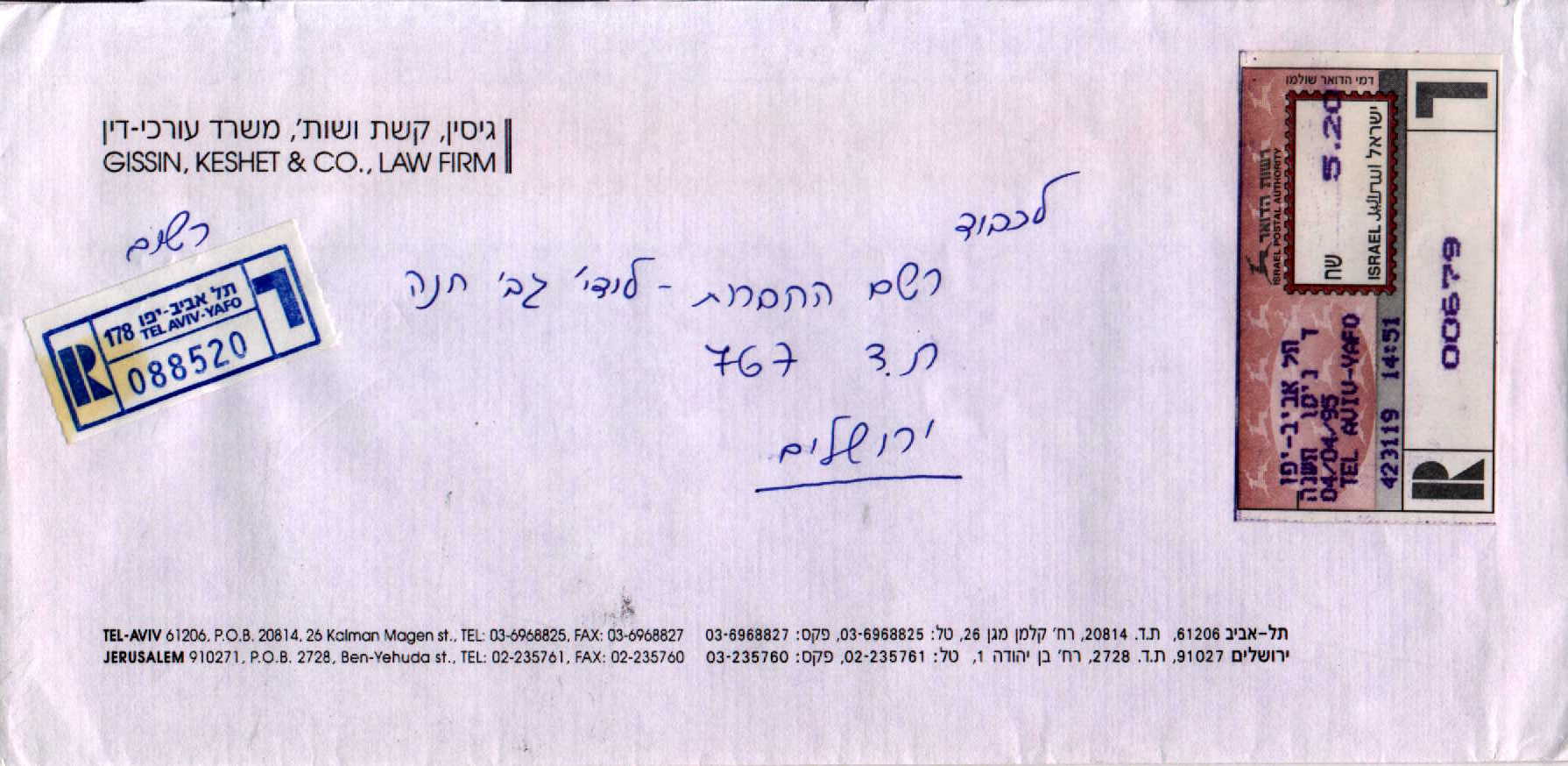 |
| Figure 15: Two registration numbers - on the old sticker and on the new Massad label |
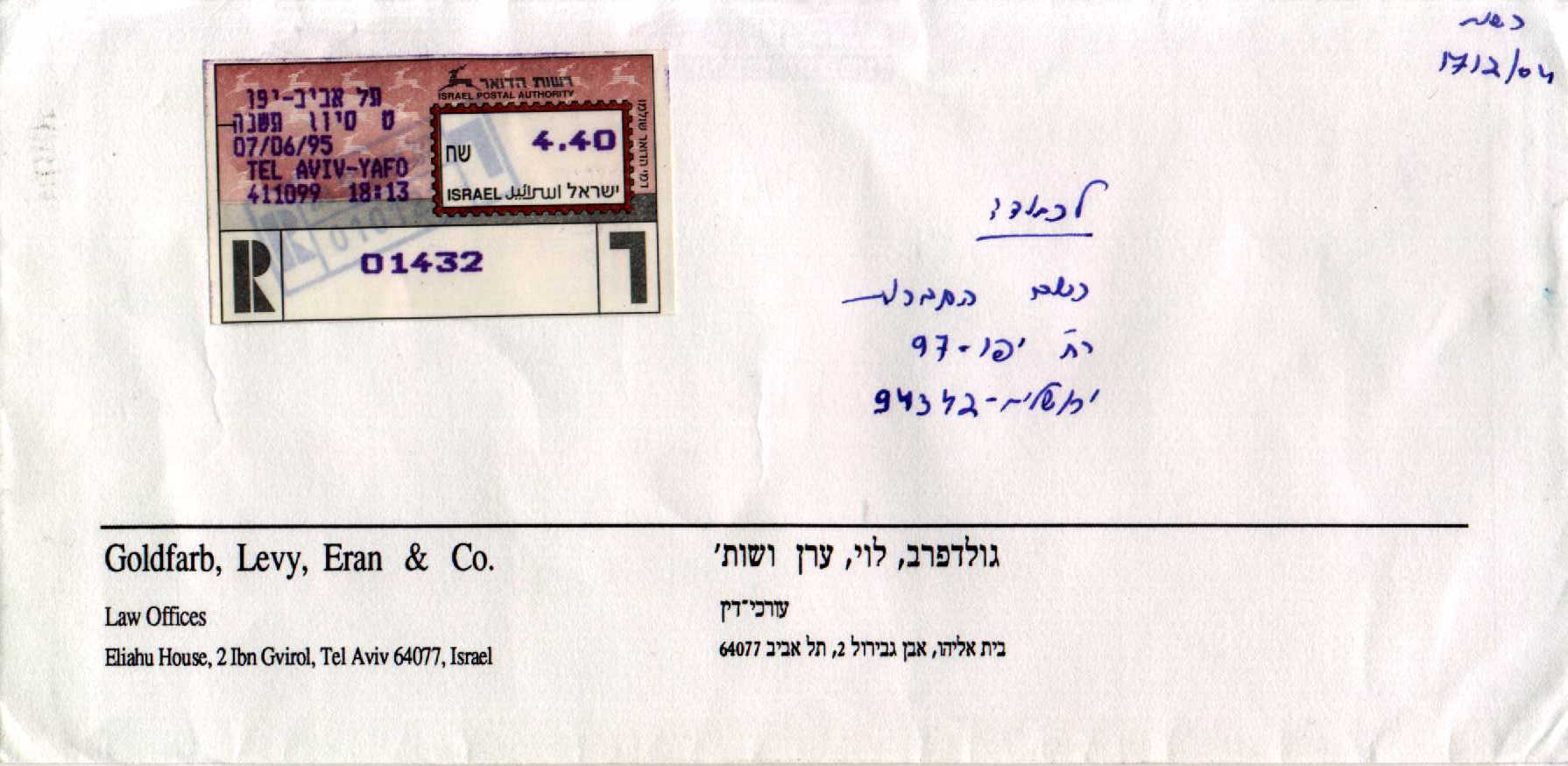 |
| Figure 16: Covering of the registration number on the old registration sticker |
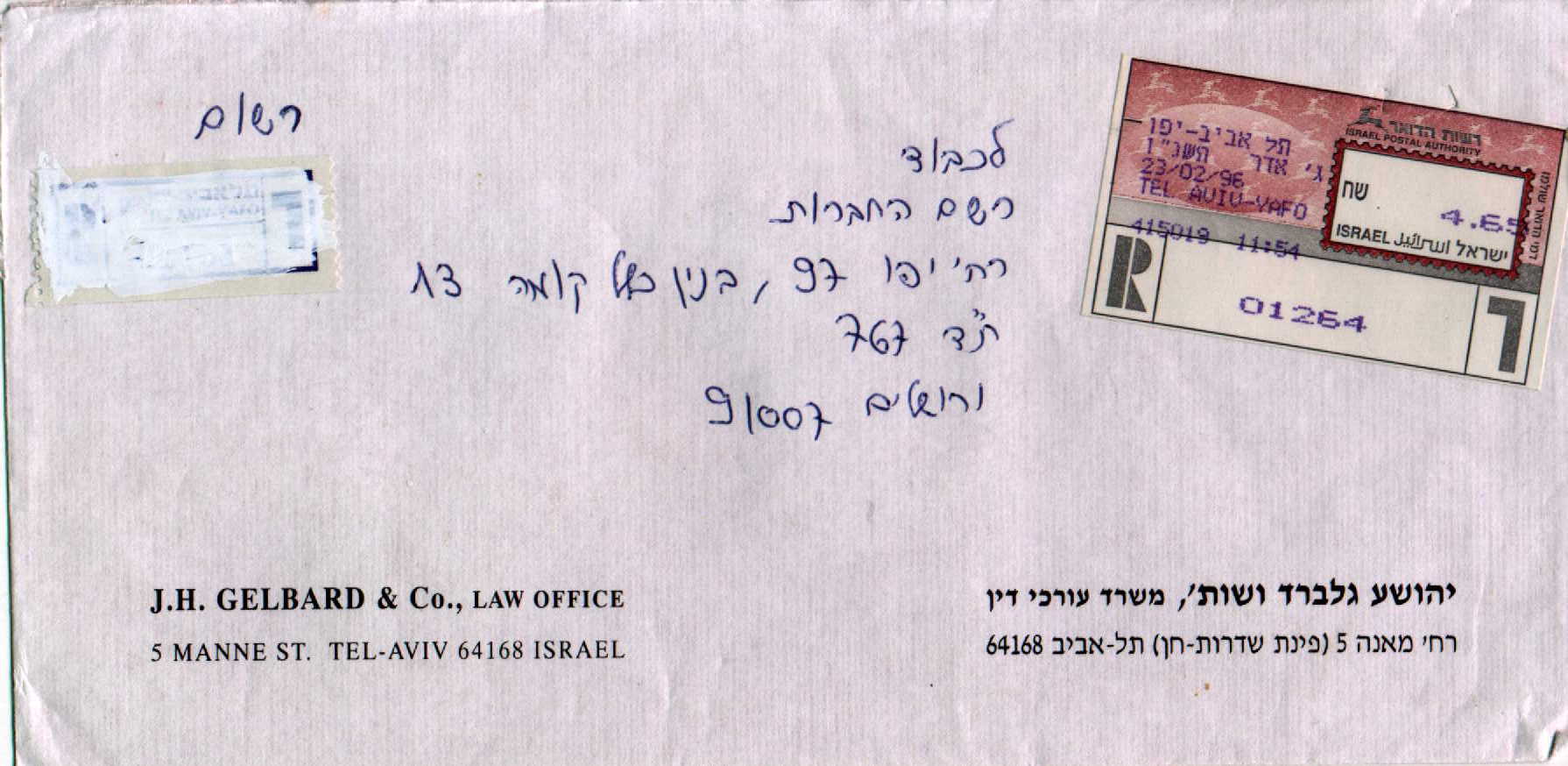 |
| Figure 17: Erasing of an already affixed old registration sticker |
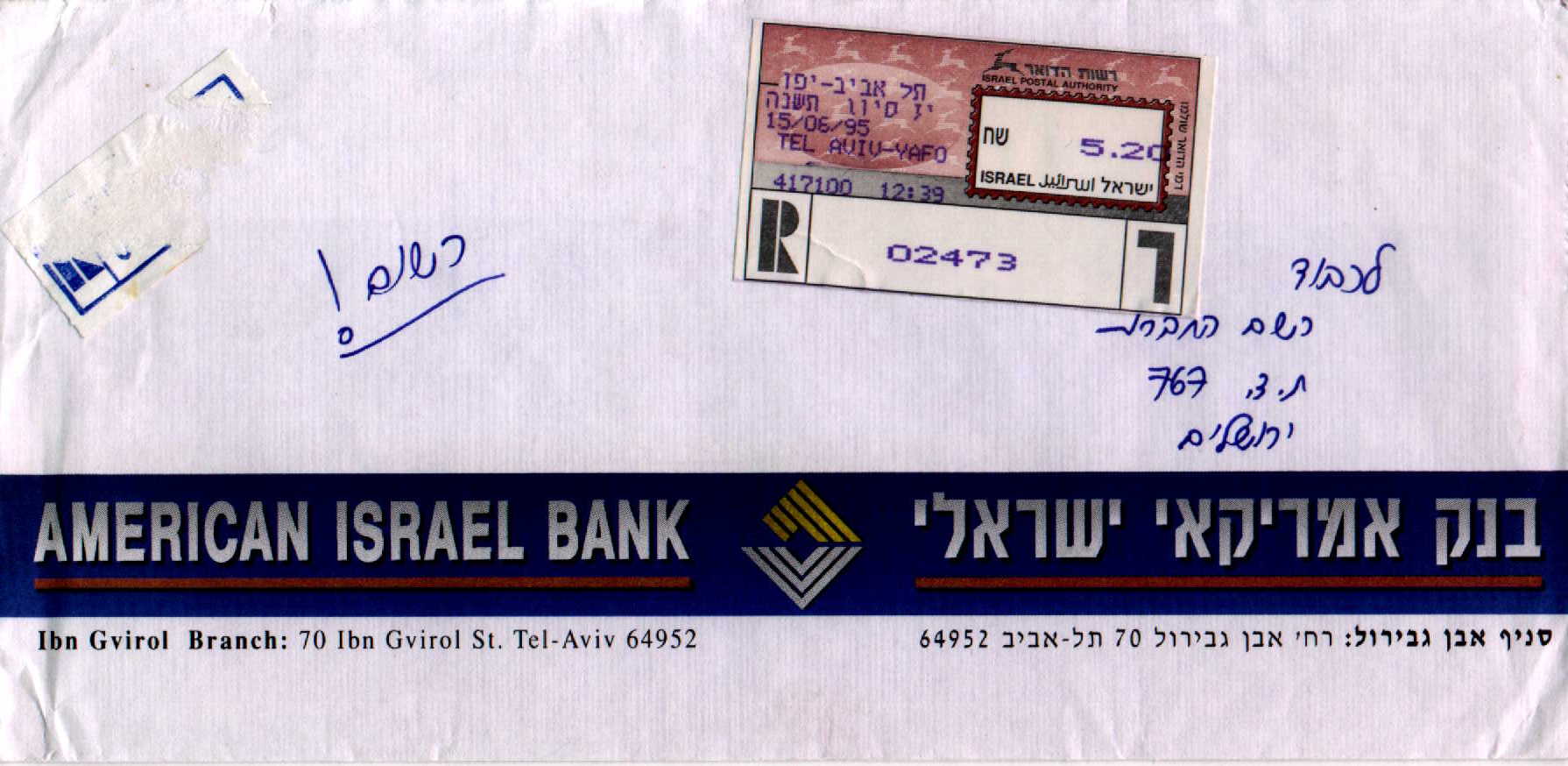 |
| Figure 18: Removal of an already affixed old registration sticker |
 |
| Figure 19: Printing a Massad label with the registration surcharge and using it in addition to a regular stamp |
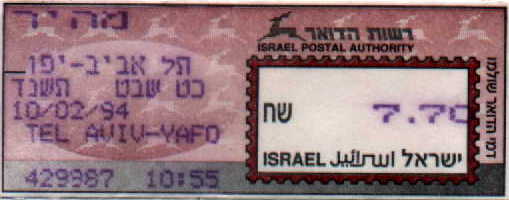
For Express mailing the Massad system would imprint the word "Mahir" (= Express) at the top left side of the label. Figures 20 & 21 display to examples of Express Labeling - with wide font and with narrow font.
 |
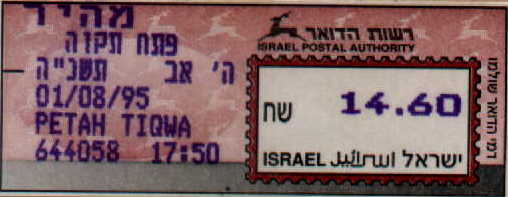 |
| Figure 20: Mahir - Wide Font | Figure 21: Mahir - Narrow Font |
Massad Labels were also used for payment of Postage Dues. Following are two examples posted from Beer Sheva. A regular label that was affixed on the face of the card (Figure 22) and a registered type label that was affixed on the back-side of the card (Figure 22).
 |
 |
| Figure 22: Postage Dues - Regular Label | Figure 23: Postage Dues - Registered Label |
Commercial Usage of the FD Label
Severe instances were observed, in which labels printed on the FD were found on commercial letters sent out several days after 17 Dec 91 (FD). In some cases the labels were glued to the cover, without pealing-off the supporting back-side paper. In the following example (Figure 24), the circular cancellation is from 27 Dec 91, 10 days after the FD of issue. It is assumed that this strange usage is due to lack of supply of registration surcharge stamps (3.25NIS) at the post office branch, and an initiative by a postal clerk to use some FD Massad Labels that were distributed to branches (a normal procedure for issue of new stamps), to fill in for the short supply.
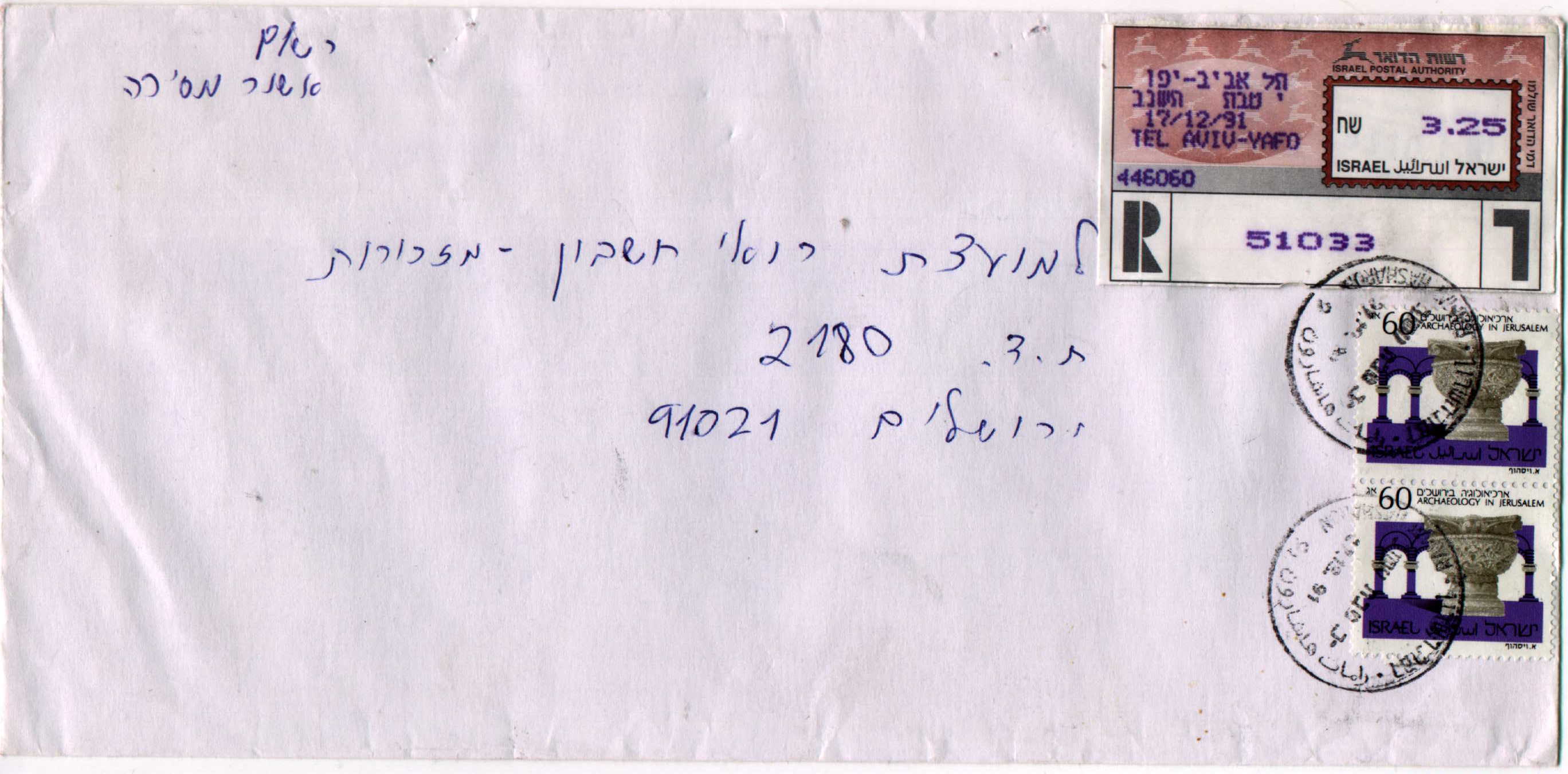 |
| Figure 24: Commercial Usage of FD Label |
The usage of the 2nd Definitive Series was discontinued as of 22 Oct 96, which is the FD of the 3rd Definitive Series. However, several instances that the old label was used for postage, beyond the official last date were observed. This can be probably attributed to shortage of supply of the new type label. Figure 25 displays a Mahir label from Bet Shemesh, imprinted 5 weeks after discontinuation of the 2nd Series. Notice that the format of printing is that which was in effect from 22 Oct 96 and onward, including the large point text "Biyul" (Hebrew for franking).
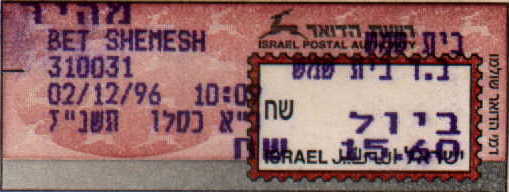 |
| Figure 25: Late Usage |
Stamp week took place from 9 Dec 93 until 15 Dec 93. This issues includes 6 different imprints (one per day, excluding 11 Dec 93 - Sabbath). The issued values were 0.85 (Inland), 1.30 (Europe), 1.60 (USA) and 3.85 (Inland Registered).
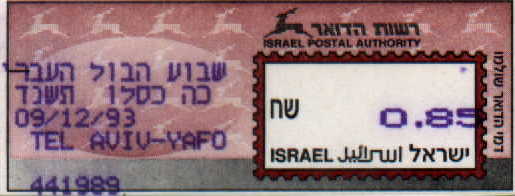 |
| Figure 26: Stamp Week - 9 Dec 93 |
7th Conference of Israeli Philatelists
The issued values were 0.85 (Inland), 1.30 (Europe), 1.60 (USA) and 3.85 (Inland Registered).
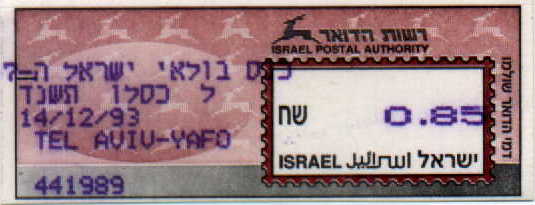 |
| Figure 27: 7th Conference of FIP |
8th Conference of Israeli Philatelists
The issued values were 0.90 (Inland), 1.40 (Europe), 1.70 (USA) and 4.10 (Inland Registered).
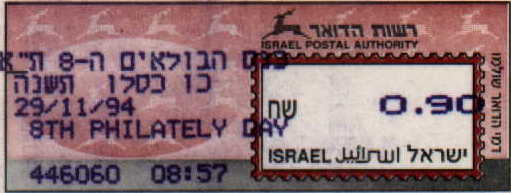 |
| Figure 28: 8th Conference of FIP |
Acknowledgements
1) Nahum Sharshevsky - For listings of initial activation of Massad Terminals
2) Alon Cohen - For samples of commercial use and multiple observations