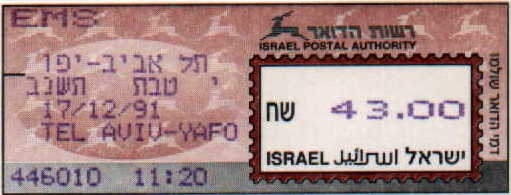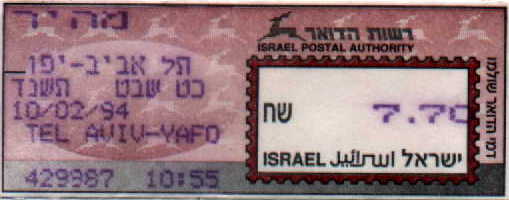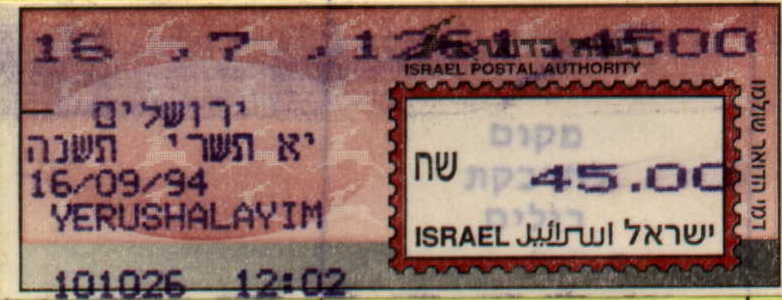
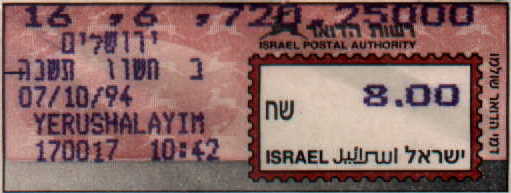
Note: Characters printed at the top of the label are a printing error. See also Variety G
Introduction:
Machine Imprint Varieties
Information
Display Varieties
Variety A: Without and With
Time
Variety
B: Without and With Greshayim
Variety C:
Text Alignment
Combinations of Varieties A, B
and C
Locality
Name Varieties
Variety D1: Tel Aviv
Variety D2: Beer Sheva
Variety D3: Petah Tiqwa
Variety D4: Rishon Leziyyon
Printer Characteristic Varieties
Variety E: Font and Spacing
Variety F: Ink Varieties
Other Varieties
Variety G:
"Strange Numbers"
Paper Type Varieties
Introduction: Machine Imprint Varieties
The study of Massad Label Machine Imprint Varieties uncovers a large domain of possibilities. The machine imprint is practically a postmark, bearing a locality identification (Place, Branch number & Terminal number), as well as a date and time of imprint. Thus from a postal history perspective, each of the imprint varieties can be considered as a different postmark, and it is therefore interesting to study and record the difference between these postmarks, and when each of these postmarks was in actual use. The fact that the postmark was computer-printer generated and not as a result of stamping of a type-set or rubber-cast postmark bears no significance. On the contrary, it is a reflection of the introduction of new technology, into an existing system of postal services.
The varieties presented in the following paragraphs are classified into four sub-categories. The first category is titled "Information Display Varieties" and displays the difference in imprinting, irrespective of the place where the imprint took place. In a sense it can be considered as a tutorial to the domain of Massad Imprints. The second category, titled "Locality Varieties" presents the study of the different imprints of the locality names. The third category, titled "Printer Characteristic Varieties" includes font and ink color varieties. The fourth and last category "other Varieties" includes the "oddities".
Variety A: Without and With Time
During the
early stage of the Massad System operation, the date was imprinted only on EMS
and "Mahir" (i.e. Express) labels. The regular and registered labels had no date imprint.
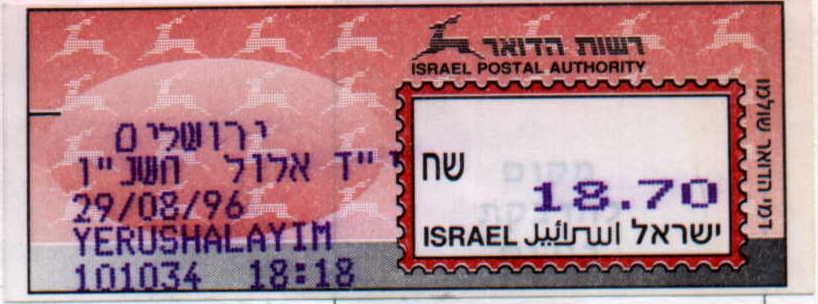
Time imprint on other types of labels are observed as early as September 16th,
1994, from a Jerusalem Post Office Branch (figure 1). It should be noted that
all new changes to software printing format, were tested by the Massad System
Team first in Jerusalem, and only after a trial period were released to other
localities in Israel. This created an overlap period during which certain
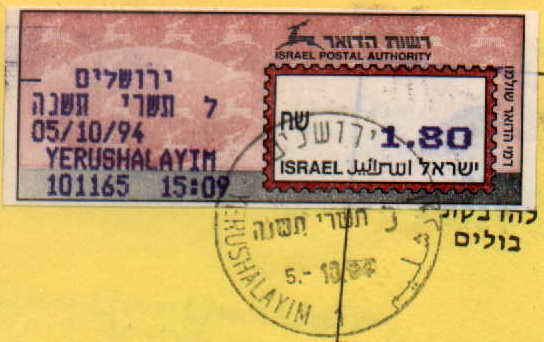
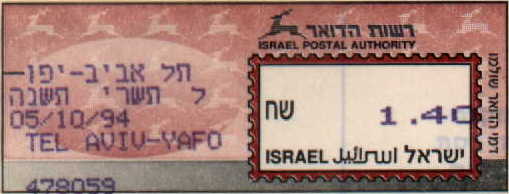
terminals were using the new format and printing with date (Figure 2a) whereas
other terminals were still using the old format without the date (Figure 2b).
|
|
|
| Figure 1: Variety A2 "With Time" -
September 16th 1994: Earliest observed date with time imprint on regular and registered labels. Note: Characters printed at the top of the label are a printing error. See also Variety G |
|
|
|
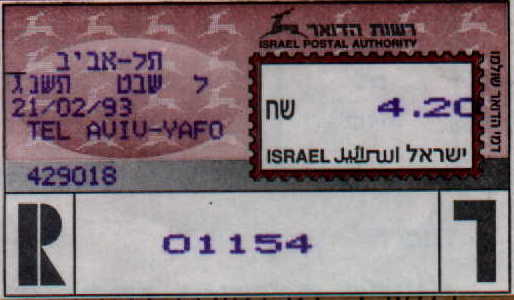
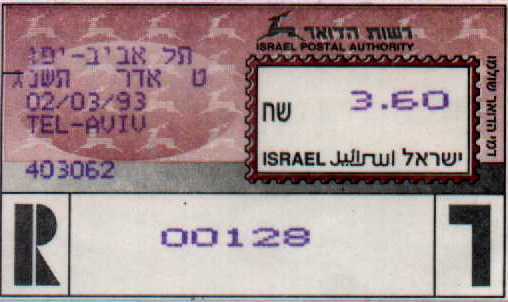
| Figure 2a: Variety A2 "With Time" - Overlap period: Label from Jerusalem with "Time" printing | Figure 2b: Variety A1 "Without Time" - Overlap period: Label from Tel-Aviv without "Time" printing (also latest observed date of A1 Variety) |
Variety B: Without and With Gershayim
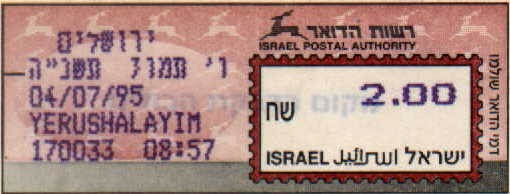
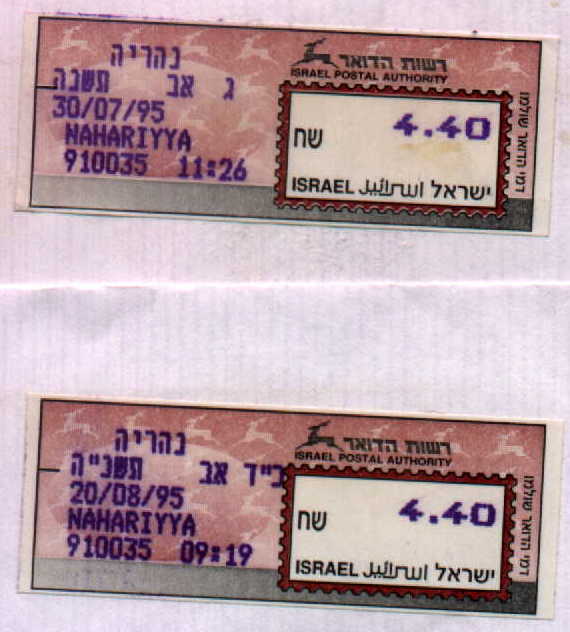
During the early stage of the Massad System operation, imprinting of the Hebrew date was without Gershayim (Hebrew for quotes). The system was changed to incorporate Gershayim into the Hebrew text, sometimes during the the month of July 1995. The first observation of this change is on a label imprinted in Jerusalem on 4 Jul 95 (Figure 3). The earliest observed example from Tel-Aviv dates from 30 Jul 95 (Figure 4). A pair of labels from Naharriya terminal 910035 display the difference in the appearance of the text before incorporation of Greshayim (30/7/95) and after (20/8/95; Figure 5). The fact that the the terminal in Naharriya continued to print without Gershayim after the terminals in Jerusalem and Tel-Aviv already transitioned to this new form of imprint, is another example of the gradual process used to introduce new software versions and printing formats in the Massad System.
 |
 |
| Figure 3: 04/07/95 Earliest observed date of incorporation of Gershayim (Variety B2) | |
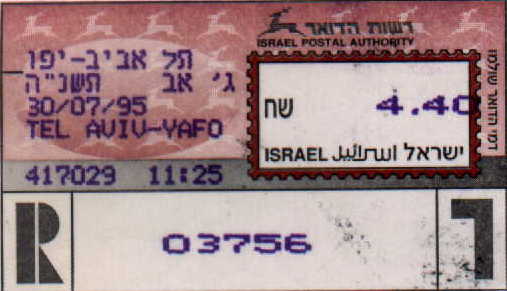 |
Figure 5: Gershayim Transition - Two samples from Terminal 910035 in Nahariyya - Variety B1 without Gershayim and Variety B2 with Gershayim |
| Figure 4: 04/07/95 Earliest observed date of incorporation of Gershayim (Variety B2) |
There exist three possible combinations of Variety A (Without & With Time) and Variety B (Without & With Gershayim) as depicted in the following table:
| Time Variety | Gershayim Variety | Earliest Observation | Latest Observation | |
| 1 | A1 Without Time | B1 Without Gershayim | 17 Dec 91 (FD) | 5 Oct 94 |
| 2 | A2 With Time | B1 Without Gershayim | 16 Sep 94 | 30 Jul 95 |
| 3 | A2 With Time | B2 With Gershayim | 4 Jul 95 |
The observed transition period of introduction of the A2 With Time Variety is from 16 Sep 94 until 5 Oct 94. The observed transition period of introduction of the B2 With Gershayim Variety is from 4 Jul until 30 Jul 95. Thus from the data presented in the table above it is possible to make an approximation of the duration of the system software change process, which was probably around one month. It is important to note that these are only observed dates, and that the actual dates might be different (i.e. the transition period could have been longer).
Variety C: Alignment Varieties
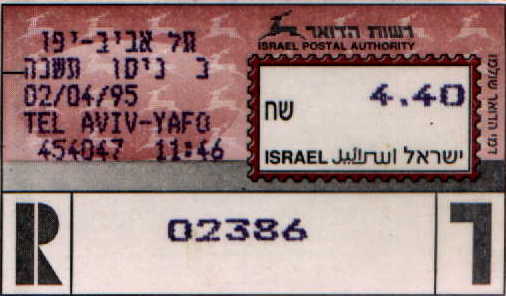
Various varieties of text alignment exist, and that is common to many localities. In the following study of labels that were imprinted in Tel-Aviv one can observe six different left alignment varieties. The identification and classification of the alignment variety is executed by examining the left edge of the imprint. In the fully aligned variety (Variety C0, Figure 5) all lines are aligned to the right of the insertion stop mark (Note: This is the 3mm black bar that is printed 9mm down of the top-left corner. Its purpose is to indicate to the postal clerk the strip insertion limit, that will result in centered imprinting on the label area).
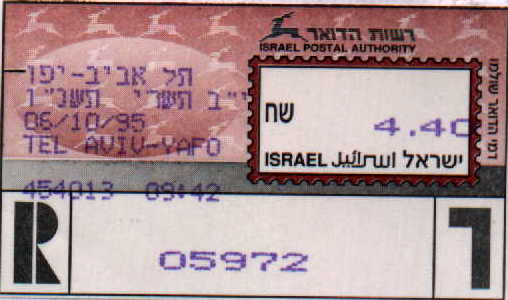 |
| Figure 6 - C0 Variety |
In Variety C1a (Figure 6), one line (the second from the top) is offset a single character to the left. In a similar fashion, in Variety C1b (Figure 7) the fourth line is offset one character to the left.
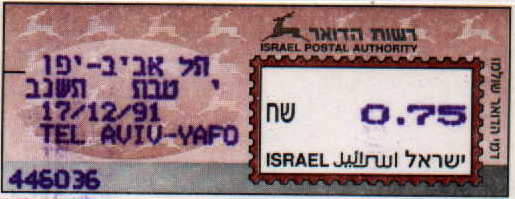 |
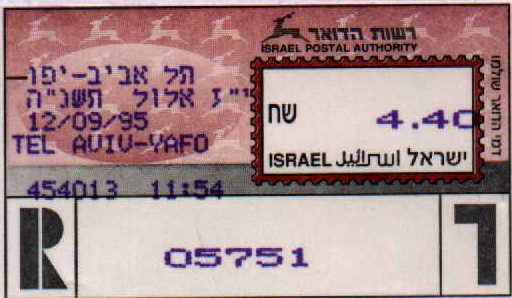 |
| Figure 7 - C1a Variety | Figure 8 - C1b Variety |
Variety C2a (Figure 8) has two lines which are offset (the second and the fourth) and in Variety C2b the second and the third lines are offset (Figure 9).
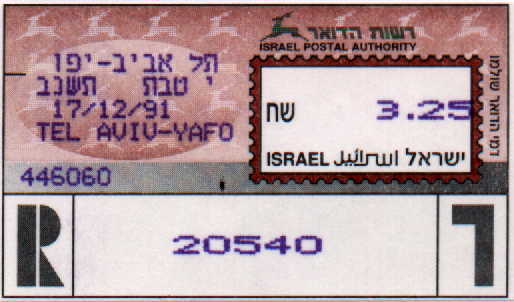 |
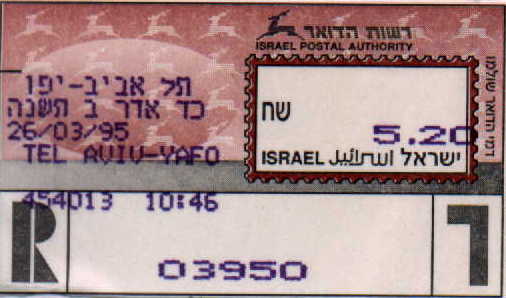 |
| Figure 9 - C2a Variety | Figure 10 - C2b Variety |
In Variety C3 (Figure 10) three lines are offset to the left.
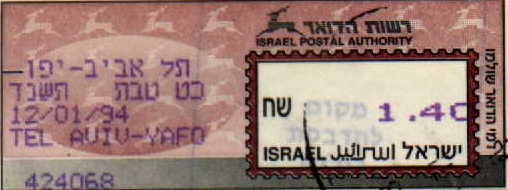 |
| Figure 11 - C3 Variety |
Since the alignment is a system setting that is controlled by software, it is interesting to know the time period during which these varieties were available. In a study of over 200 labels imprinted in Tel-Aviv, the author observed that varieties C1a and C2a appear till January-April 1993. Varieties C2B and C3 appear till June- July 95. Varieties C1b and C0 appear only as of 4 Jul 95 and onward. These earliest and latest know dates of these varieties are summarized in the following table:
|
Alignment |
Earliest Known Date | Latest Known Date |
| C1a | 17 Dec 91 | |
| C2a | 17 Dec 91 | |
| C2b | 11 Jan 93 (1) | 30 Jul 95 |
| C3 | 14 Feb 93 (1) | 18 Jul 95 (1) |
| C1b | 12 Sep 95 (1) | |
| C0 | 4 Jul 95 |
Notes:
(1) Observed date. The real date is probably later.
The conclusion derived from this data is that there were probably two system software updates, each resulting with a new pair of varieties. The first was probably in early January 1993. The second was as of early Jul 95. Additional supporting evidence corresponding to the second update comes from the fact that the terminals which were imprinting variety C1b were found to have imprinted variety C3 prior to the change, and similarly, terminals which were imprinting variety C0, were found to have imprinted C2b prior to the change.
Combinations of Varieties A, B & C
There are a total of twelve known combinations of the varieties of A (Time), B (Gershayim) and C (Alignment), as summarized in the table below. The various images of these variations are included in different sections of this page, and can be viewed by means of the hyperlink provided in the "Sample" column.
| No | Time Variety | Gershayim Variety | Alignment Variety | Availability | Sample |
| 1 | A1 Without Time | B1 Without Gershayim | C1a Line 2 offset | 17.Dec.91 - 25.Feb.93 (1) | Figure 7 |
| 2 | A1 Without Time | B1 Without Gershayim | C2a Lines 2 & 4 offset | 17.Dec.91 - 21.Jan.93 (1) | Figure 9 |
| 3 | A1 Without Time | B1 Without Gershayim | C2b Lines 2 & 3 offset | 11.Jan.93 (2)- 5.Oct.94 | Figure 13 |
| 4 | A1 Without Time | B1 Without Gershayim | C3 Lines 2,3 & 4 offset | 10.Feb.93 (2) - 5.Oct.94 | Figure 11 |
| 5 | A2 With Time | B1 Without Gershayim | C1a Line 2 offset | 17.Dec.91 - ??? | EMS |
| 6 | A2 With Time | B1 Without Gershayim | C2a Lines 2 & 4 offset | 17.Dec.91 - 1.Mar.93 (1) | (3) |
| 7 | A2 With Time | B1 Without Gershayim | C2b Lines 2 & 3 offset | 8.Mar.93 (2) - 5.Oct.94 | Mahir |
| 8 | A2 With Time | B1 Without Gershayim | C3 Lines 2,3 & 4 offset | ??? - 5.Oct.94 | (4) |
| 9 | A2 With Time | B1 Without Gershayim | C2b Lines 2 & 3 offset | 5.Oct.94 - 30.Jul.95 | Figure 10 |
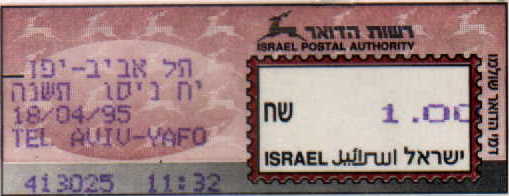
| 10 | A2 With Time | B1 Without Gershayim | C3 Lines 2,3 & 4 offset | 5.Oct.94 - 30.Jul.95 | Figure 12 |
| 11 | A2 With Time | B2 With Gershayim | C0 Zero lines left offset | 30.Jul.95 - 21.Oct.96 | Figure 6 |
| 12 | A2 With Time | B2 With Gershayim | C1b Line 4 offset | 30.Jul.95 - 21.Oct.96 | Figure 8 |
Notes:
(1) Observed date. Actual date could be later.
(2) Observed date. Actual date could be earlier.
(3) These varieties were possible for EMS & Mahir frankings only. Observed.
(4) These varieties were possible for EMS & Mahir frankings only. Assumed,
but not yet observed.
 |
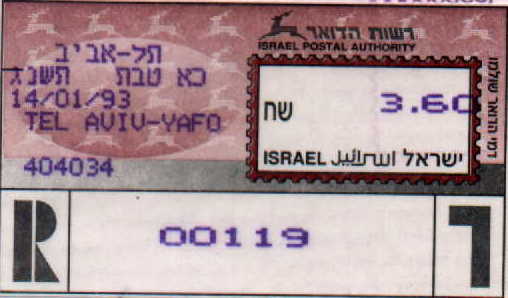 |
| Figure 12 - Combination no. 8 (A2,B2,C3) | Figure 13 - Combination no. 3 (A1,B1,C2b) |
Variety D1: Tel Aviv, Tel Aviv-Yafo
The correct imprinting of the name of the city should be "Tel Aviv-Yafo". There are 3 known varieties in this domain, as summarized in the following Table:
Note: The third column presents the known timeframe that the variety was "active" in the specific branch, according to investigation of various lots and collections. This is by no means an official and exact figure, and the author encourages correspondence with additional data, that will help map the phenomenon with greater precision.
| ID | Inscription / Observed terminals (dates) |
Sample |
| D1a | Missing Yafo (Hebrew and English) Observed appearances: 403 Geula (18 Aug 92 - 31 Aug 92 (Note no. 1)) |
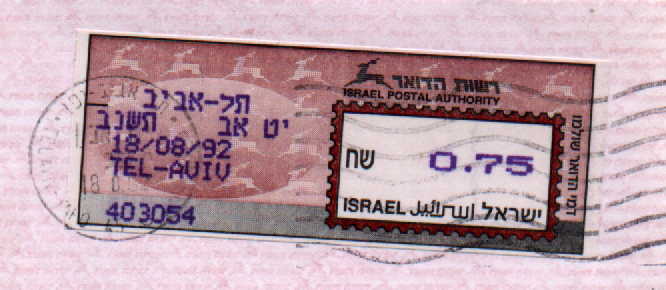 |
| Figure 14: Variety D1a - Missing Yafo (Hebrew & English) | ||
| D1b | Missing Yafo (in Hebrew) Observed appearances: 404 King George (14 Jan 93 - 24 Jun 93) 429 University (22 Jan 93 - 4 May 93) 430 Even Gvirol (18 Jan 96 - 22 Apr 96) |
|
| Figure 15: Variety D1b - Missing Yafo (Hebrew) | ||
| D1c | Missing Yafo (in English) Observed appearances: 403 Geula (8 Feb 93 - 20 Dec 93 (Note No. 2)) |
|
| Figure 16: Variety D1b - Missing Yafo (English) | ||
Notes:
(1) According to a collector's report the lack of "Yafo" in the
inscription was remedied on 31 Aug 92. However, examining variety D1c, it seems
that the error was corrected only in Hebrew.
(2) "Yafo" in English was probably added sometime during 1993. Exact
date unknown.
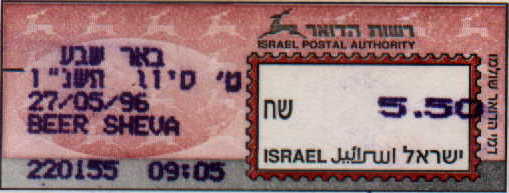
The observed varieties from Beer Sheva are without hyphen (Variety D2a) or with hyphen (Variety D2b).
 |
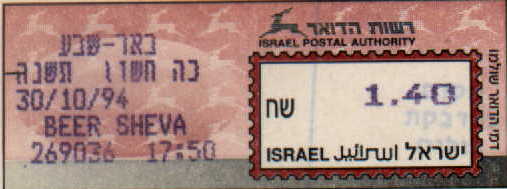 |
| Figure 17: Variety D2a - Without hyphen | Figure 18: Variety D2b - With hyphen |
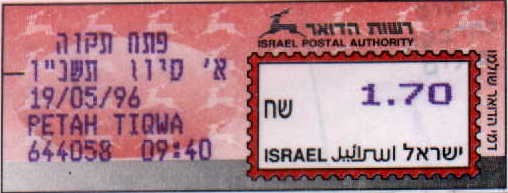
The observed varieties from Beer Sheva are without hyphen (Variety D3a) or with hyphen (Variety D3b).
 |
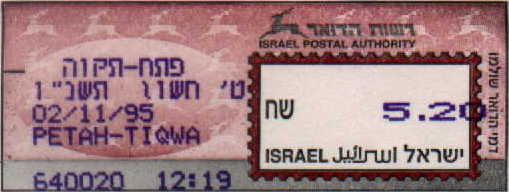 |
| Figure 19: Variety D3a - Without hyphen | Figure 20: Variety D3b - With hyphen |
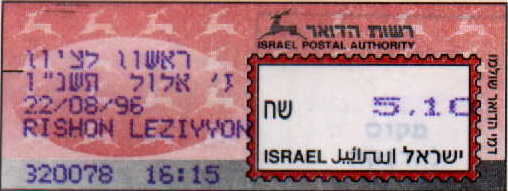
The observed varieties from Rishon Leziyyon are one which the Hebrew locality name is written in full (Variety D4a) and one in which the locality name is written in short-hand "Rashlatz" (Variety D4b).
 |
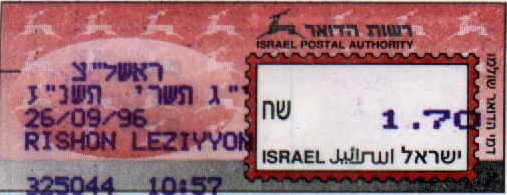 |
| Figure 21: Variety D4a - "Rishon Leziyyon" | Figure 22: Variety D4b - "Rashlatz" |
Printer Characteristics Varieties
Two font types are known: a wide font (Figure 23) and a narrow font (Figure 24). The wide font exists since the system introduction, whereas the narrow font was observed on labels as early as 28 Nov 93. Notice that in the wide font there is a line of spacing between the fourth and fifth lines of text. A third font was observed as early as 28 Sep 96, just a short time before the introduction of the new type of label (light blue background). The difference between the second type font and the third type font is noticeable by comparing characters such as "Mem-Sofit" and "Tav".
|
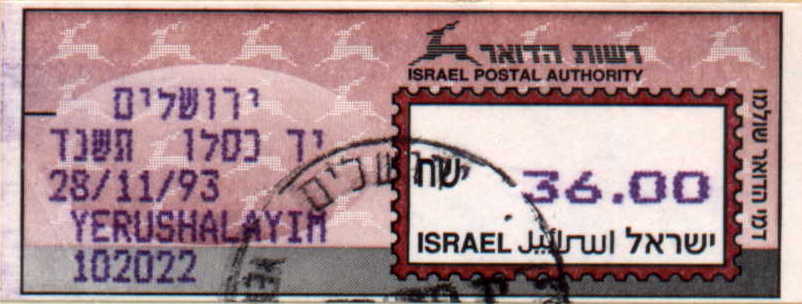 |
| Figure 23 - Wide Font: Earliest observed date - system introduction 17/12/91 | Figure 24 - Narrow Font: Earliest observed date 28/11/93 |
|
|
|
|
Figure 25 - 3rd Font Type: Earliest observed date 29/08/96 |
|
Two known types of ink color are known. The common and more popular one is violet-blue. The other type is more blackish in tone. The differences can be observed by comparing Figures 24 & 26.
|
|
|
Figure 26 - Black Tone Ink Type |
Several instances of the imprint depicted in Figure 27 have been observed. The is no clear explanation to this phenomenon at this time. It could be a result of a software bug, or printing of a control sequence from the printer mechanism. This is still under investigation.
 |
| Figure 27: "Strange Numbers" |
Throughout the period of service of the Second Definitive Series, there were several printings of Massad label strips. The differences are noticeable by examining the color shade and the presence (or lack of) cyclometer numbering. The brown printing has two sub-varieties: without and with cyclometeric numbering. The red shade has been observed only with cyclometeric numbering. Another characteristic of the red printing is that the adhesive-supporting paper was yellow, whereas for the earlier brown printing it was white.
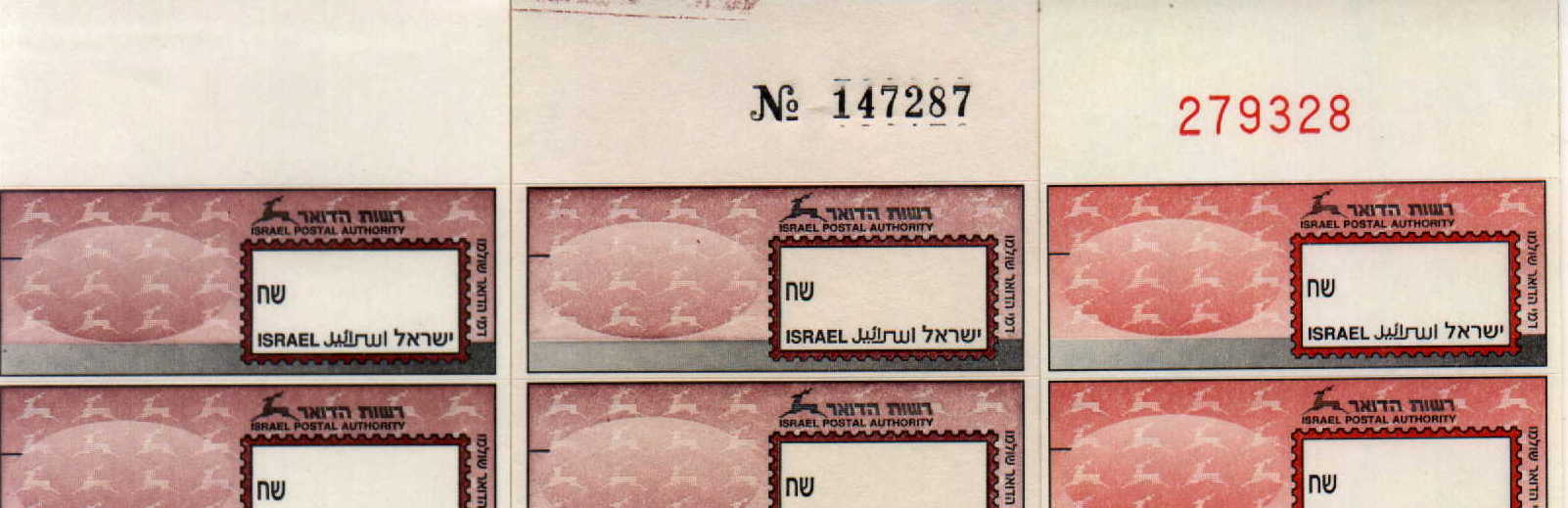 |
| Figure 3: Three paper type varieties - Regular labels |
For the registered labels there exist similar paper type varieties. However, one noticeable difference for the brown registered is that the cyclometric numbering is different than that of the regular label (the letters "No" are missing).
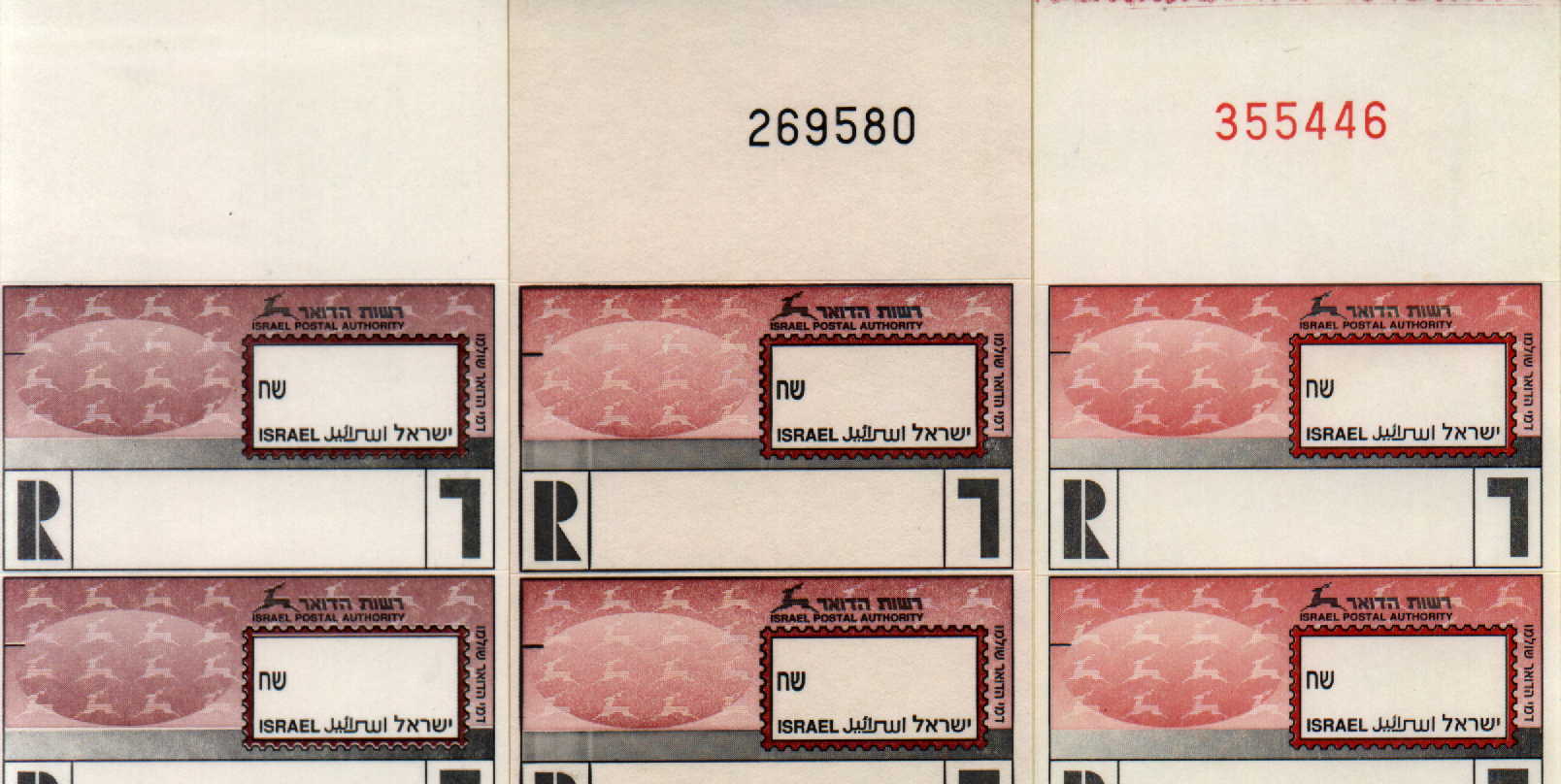 |
| Figure 3: Three paper type varieties - Registered labels |