In SIP Journal Vol. LIV #3, June 2003, in an article titled "Massad Labels - A Summary: Part 1: "Forerunners and Experimental Issues", I presented the interesting phenomenon about the printing of the "Beit-Hakerem" labels which I named "Late Night". This phenomenon was based on three observations: 1) The fact that there were labels that the imprinted time of production was very late at the night of June 17th, well beyond normal working hours of postal clerks. 2) That the serial number of the imprinted stamp didn't correlate with the chronological order of the printing, and that 3) Labels from the 102048 machine were found that had an imprinted date of 18.Jun.91, i.e. the second day of service, with a time imprint from the afternoon hours (see details in the original article, especially Figures 6-8). I also presented a theory trying to explain this phenomenon.
A short time after the article went to press, I had an unexpected opportiunity to meet members of the staff of the Massad Team, who were present during the first day of the "Beit Hakerem" trial service. During an interview with them, I found that my theory was wrong, and was provided with the facts from first hand. The following paragraphs present the solution to the "Late-Night" mystery, and reveal a yet un-noticed variety of the "Beit-Hakerem" labels.
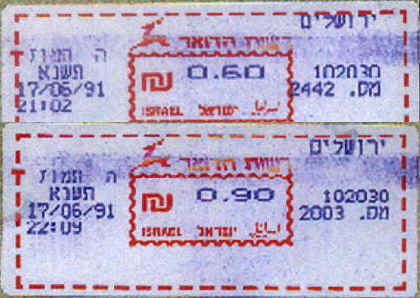
According to the members of the Massad Team, that were present at the "Beit-Hakerem" branch on the first day of the trial service - June 17th, 1991, the large volume of orders, and the fact that there were less printers than Massad Terminals, was the reason for which the printing of the labels continued until the very late hours of night. The setting of a terminal ID was flexible, hence it was possible to enter the numbers 102030, 102048 & 102056 at each of the terminals, and direct its printing to either of the printers that were available. Hence at a certain point in time it was possible to print from two terminals labels carrying the same terminal ID 102030 - on two different printers! A closer look at two of the figures presented in the previous article (Figures 6 & 7) shows that the printing of these two labels , both carrying terminal ID 10230, is slightly different. Placing one on top of the other, we can observe setting-width varieties of various characters. For example, the "Mem-Sofit" character (last letter in "Yerushalayim" - top-right corner) and the zeros in the terminal ID number.
|
|
| Comparison of two different printings of "Terminal ID 102030": Type "A" (Top label): "Mem-Sofit" is narrow, zero is wide; Type "B" (Bottom label): "Mem-Sofit" is wide, Zero is narrow |
Are these two types of
printings available also for the 102048 & 102056 terminals? What is the
earliest hour for which printings from "Type A" and "Type B"
exist for each terminal ID?
Collectors are encouraged to look in their collections and report findings to
the author at: Evyatar Chelouche, P.O.Box 67,
Reut 71908 Israel, or by e-mail: [email protected]