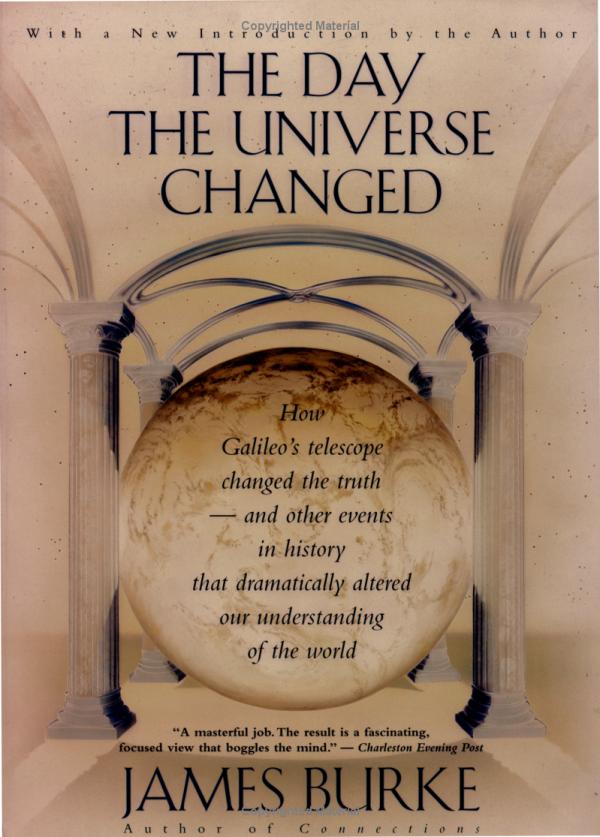
This is one of my favorite books. It was also a series hosted by James Burke on public television. This is the second time I am reading this book.
The book starts off with the foundations of Western thought, when the Ionian Greeks applied logic and geometry to better understand the world around them.
Each chapter is in chronological order but jumps ahead to certain points in time when a discovery or invention drastically changes the body of knowledge known to man, which subsequently changes man himself. This makes the book very interesting, because although history is a subject which some find less than interesting, the reader never gets stuck in any one time period for long.
The emphasis of the book is on the events, thought processes, and the state of the body of knowledge at the time before the major shift in knowledge takes place. It does not necessarily spend much time in exploring all the effects of each shift.
James Burke is a very interesting author, check him out. "The Day The Universe Changed" and "Connections" were featured as documentaries on public television. I would love to see a book like this that tracks down major shifts in Eastern thought.
Here are the chapters, time periods and discoveries discussed in the book :
Chapter 1 1000 BC the Ionian Greeks combine logic and geometry, laying the foundation for Western thought
Chapter 2 The end of the Dark Ages after Greek knowledge is rediscovered in coquered Arab territories "belief can only come through understanding"
Chapter 3 Measuring the world around them, perspective painting and new maps new grid lines help Captain Columbus on his way.
Chapter 4 The late 15th century, where Gutenberg's printing press causes one of the greatest change in human knowledge.
Chapter 5 The late 17th century where Newton sets the universe in predictable, mechanical motion.
Chapter 6 The late 18th century where the Industrial Revolution begins.
Chapter 7 The 19th century, where statistics are applied to help fight disease ( where people become numbers ).
Chapter 8 The late 19th and early 20th century where social Darwinism and philosophies cause great strife and change in the modern world.
Chapter 9 Einstein, relativity and uncertainty destroy the cause and effect view of the universe, which ruled since the time of the ancient Greeks.
Chapter 10 The final chapter is very interesting and should be continued in another book. It deals with the relativistic nature of science, using topics in the book and how the body of knowledge has progressed.
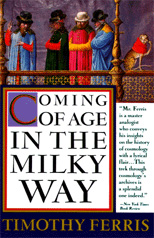
This is the second time I am reading this book. It is definitely one of my favorites.
It is divided up into 3 sections - 1. Space 2. Time 3. Creation
Section One is excellent. It is a brief history of Astronomy. I found the relationship between Tycho Brahe and Kepler so interesting, it has inspired me to read further about these two astronomers. I will be reading "Tycho and Kepler" in the near future.
Section Two is short but also excellent. After reading a few books on science history, I am really starting to get an idea of how much progress science has made in such a short time. It was too long ago that many people believed that the earth was a mere 6000 years old ! ( and I bet you can still find some people who believe that ) This date was deduced by counting all the 'begats' in the bible.
Section 3 tackles some very grand ideas. It is not overbearing, and I bet it will encourage most readers to want to learn more. Subjects include Quantum Mechanics, Grand Unified Theories, Symmetry and the role of the observer. We just may be the universe looking back at itself.
I purchased this book used for $7 many years ago.
It will always be in my little book collection, it is a real 'keeper'.