
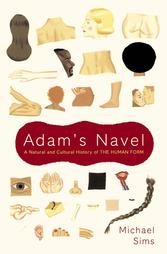
I was looking forward to reading this book. After the first chapter however, I knew it was going to be a disappointment. You see, I am one of those people who believe they can tell if a movie is good or not by just watching the trailer. It is my intellect which sometimes sits on my shoulder yelling 'keep an open mind' that spurred me on to reach the end of "Adam's Navel."
From the very beginning, I started to wonder is the author suffered from ADD. Hey, did I tell you about this model I am building ? It is impossible to find a logical connection between all the factoids. It seems as if the author just did Google searches on each body part, and then tried to squeeze what he found into a coherent chapter. This alone was enough for me to not recommend this book, but what put it over the edge were the liberal feminist views which the author allowed to take the wheel for awhile, and more often in the last few chapters.
True, I have learned a few tidbits to mildly impress peers while in the cafe, but I can not recommend this book.
I do think this is a great idea for a book, and would like to see it done by a more accomplished author.
In the very begining of the book, the author warns the reader that this book is not about God, but about information. The reason becomes quite clear after reading the first few pages.
The book is divided into 3 sections, one for each scientist. He asks a few pertinent questions from each - Edward Fredkin, Edward O. Wilson, and Kenneth Boulding.
A quick note here, the reason why I bought the book because Edward O. Wilson name appeared in the contents. He is in my opinion, one of the most interesting science writers I know of.
The author basically has a scientific view on life, but is a bit unsettled by the meaning of it all - if there is any. He conducts mini- interviews with each scientist and tells the reader his own thoughts along the way.
The first scientist is Edward Fredkin, who believes the universe can be thought of as a supercomputer. It sounds a bit ridiculous at first, but as he explains his grand idea of it all, it starts to seem plausible. He is not suggesting the computer looks like our home pc with dials and buttons of course, it is simply a metaphor to help explain how information is the building blocks of reality and the 'universal computer' tracks and computes every event.
The second scientist is Edward O. Wilson. Although a reductionist in practice, his trail leads to a more holitic view. Wilson's take on how the universe operates is based on DNA (which is information). His remarkable insight on how genes are protected and passed on to the next generation serve as the anchor for his 'theory of it all'. In short (very short), natural selection has led the way for the most intelligent species that we know of to pass along science and culture, which he belives is and should lead the way to a better, if not final to the question on life and it's meaning. (Once again I would like to say, if you enjoy science and have not read anythng by Edward O. Wilson, you are truly missing out !)
The last scientist to be interviewed is Kenneth Boulding. Boulding is very interesting in his own right. He started out as an economist, but has since become a sociologist and philosopher. His view on the information revolution leads him to belive that the human species and the world around them are becoming a giant 'superorganism'. Seeing how communications and computers are connecting the world, it wasn't too much of a leap for me to accept this. Where it may lead to I am not sure, we may become more empathetic to one another at live in a much more peaceful world, or end up in a totalitarian society where individualism is erased.
As you can see the scientists are not really in search of God per say, but are searching for how the universe operates. I believe Einstein took the same approach. Personally, I have always felt that the best way to answer all the tough questions is through science, not religion. Something remarkable is happening, life is battling against entropy. Lets study it for a better understanding and how to nuture it.
Read this book !
a measure of the unpredictability of a message


