|
The Long Journey to Pagadian
First of 2 parts

The regional transfer from Zamboanga
City to Pagadian Cityis fraught with problems and
possibilities.
By Joy Magdayao
The mood is
upbeat in Pagadian City.
In the 113th
Regional Development Council hosted by Pagadian City’s Samuel
Co, the local government unit went all out to sell the city by
the sea. Guests were booked in a local hotel, treated to a
sumptuous dinner at the city hall grounds, and the meeting
itself was held at the spanking new Pastoral Diocesan Center
in Balangasan. Driving in to the venue, participants were met
by a school band and dancing teen-agers garbed in colorful
Subanen attire.
The expensive
welcome for the governors, regional directors, and several
mayors was designed to overcome the negative propaganda
generated by the transfer of the regional offices from
Zamboanga City to Pagadian City, a move that would dislocate
thousands of employees and their families who had dug their
roots deep in the City of Flowers.
In a powerpoint
presentation during the RDC meeting, the provincial government
of Zamboanga del Sur was quite forceful in underscoring the
idea that Pagadian City was more than ready to be the next
regional center of Zamboanga Peninsula.
The case
for Zamboanga
But while there
is an air of excitement over the impending transfer of the
regional seat, there is much gnashing and wailing on the other
end.
In Zamboanga
City on January 15 this year, the Roman Catholic Church, local
businessmen, city government officials led by Mayor Celso
Lobregat and Vice Mayor Isabel Climaco, and a smattering of
regional employees and their families staged a protest march
cum prayer rally to voice their sentiment against the
transfer. From an expected crowd of 8,000, the actual
turn-out was between two to three thousand. Organizers report
that the night before, text messages made the rounds, warning
of a bombing during the rally. Regional directors wisely
stayed away from the event, amid reports that Malacanang had
sent its spies to monitor the event.
The opposition
to the transfer centered on one emotional theme: that a
relocation would unnecessarily break up families as parents
are forced to work in Pagadian City, leading to tremendous
emotional burden and loss of family cohesion and closeness.
Corollary to
the psychological impact is the financial burden of
maintaining two kitchens. Speakers at the rally, mostly
children, said their parents already had loans on their homes
and therefore could not afford to rent another house in
Pagadian City. A research made by the Development
Administration Committee (DevAdCom) of the Regional
Development Council IX in 2001 reveals that “about 3,097
government employees in Zamboanga City have already availed of
housing loans with a total loan amount of P504.75 million.”
The DevAdCom report concludes that “transferring to Pagadian
will strain the budget of the affected employees since they
will have to rent in Pagadian and to pay their loan
amortization at the same time. Thus delinquents (payments on
loan) may probably increase.”
Other speakers
at the rally also said they loved their schools, and would not
care to enroll in another. Zamboanga City is home to top
educational institutions like the Ateneo de Zamboanga
University and the Western Mindanao State University, and
Catholic stalwarts like Pilar College and Claret School.
But it is not
only family ties and excellent education that are an issue in
the regional transfer. The DevAdCom study names several
negative factors: one, the high financial cost of transfer for
80 government offices, many of which already own their
buildings in Zamboanga City. According to the Regional
Executives Association of Western Mindanao (REAWISMIN) in a
report it made in 2002, the total cost for a regional transfer
is P1.512 billion.
“The bulk of
these costs go to renovating the office buildings in Pagadian.
Other costs include shipping the office and personal
properties of employees, rental of offices in Pagadian, as
well as freight and fare of all the regional officials,
employees, and their families,” said the REAWISMIN.
Second,
operating cost is expected to be higher in Pagadian City.
Flight fares for Manila from Pagadian, for example, cost 15%
more than the Manila-Zamboanga route. Supplies and other
materials necessary for operations are shipped to the ports of
Zamboanga City, Cagayan de Oro, or Cebu, which are then
transported to Pagadian City by land or by sea. Thus, selling
price of these materials is also comparatively higher.
Third, predicts
the REAWISMIN, some officials and employees would decide to
resign or seek early retirement rather than transfer to
Pagadian City. In both cases, the exit would mean expensive
re-training and capability building for new hirees. This
would also mean that the government will have to pay off
retirees who have been in the service 20 years or more.
The transfer
would also have an impact on Mindanao investments, warns the
DevAdCom. President Arroyo has been aggressively pursuing
economic relations within the
Brunei-Indonesia-Malaysia-Philippines East Asean Growth Area (BIMP-EAGA),
and transferring would mean reduction of a “substantial
capacity of government that implements the confidence-building
and investment climate enhancing measures” because it is
Zamboanga City which “can best provide the support in
fostering closer ties with the other countries in the growth
area.” An investor from Kota Kinabalu, for example would take
more plane rides to go to Pagadian City, passing through
either Zamboanga City, Cebu, or Davao City. Another investor
whose business would be based in the industrial and commercial
center that is Zamboanga City would be required to travel to
Pagadian City to get “some documentary imprimatur.”
Fifth, the
existing sea and air facilities in Zamboanga City are superior
to that of Pagadian City. Therefore, the movement of goods
and services in the former is more efficient.
Sixth, a
transfer would mean re-deployment of military personnel tasked
to provide security for the regional government, when they are
sorely needed in protecting the peninsula’s “back door.” The
situation is worsened by the presence of lawless elements in
Basilan and Sulu. “To transfer the regional center will
necessitate a re-distribution of the military, manpower,
logistics not only in Region 9 but the whole of Mindanao,”
says the DevAdCom report.
Probably the
biggest argument against the regional transfer is the location
of Pagadian. When Executive Order 429 was issued by former
president Corazon Aquino in 1990, Pagadian was the
geographical center of Region IX then known as Western
Mindanao and which included the provinces of Misamis
Occidental, Lanao del Norte, and the cities of Marawi, Iligan,
Tangub, Ozamiz, and Oroquieta. Eleven years later, after
Basilan and Marawi voted to be part of the Autonomous Region
of Muslim Mindanao (ARMM), President Gloria Macapagal issued
Executive Order No. 36 which renamed Region IX as Zamboanga
Peninsula and identified its composition as follows: the
provinces of Zamboanga del Norte, Zamboanga del Sur, Zamboanga
Sibugay, and the cities of Dapitan, Dipolog, Isabela, Pagadian,
and Zamboanga. The four other cities (Iligan, Tangub, Ozamis,
and Oroquieta) are now made part of Region X. A regional
transfer in effect would merely move offices from one end of
the peninsula to the other, and not to a strategic center.
To further
complicate matters, in between the eleven years, another
president, Fidel Ramos, issued Executive Order 325
reorganizing the Regional Development Councils (RDCs) on April
12, 1996. The implementing rules and regulations (IRR) of EO
325 defined the areas of responsibility of the RDC and
identified Zamboanga City as the regional center of Region
IX.
Compromise
Despite the
difficulties, Zamboanga del Norte’s Gov. Rolando Yebes
believes that it is the best time for the transfer. “Zamboanga
City has enjoyed the benefits for so many years. While it has
developed, other provinces in the peninsula have been left
behind. The displacement of some personnel (because of the
transfer) is real, but that is part of the sacrifice
required in public service.”
He offers a
compromise. “The regional offices should be placed in
areas where they are needed most,” he tells Zamboanga
Agenda. “I would prefer that some be retained in Zamboanga
City, others be placed in Zamboanga Sibugay.”
Yebes himself
is openly lobbying for the regional offices of the Department
of Agriculture and the Department of Tourism to be built in
his turf, which has a land area of 720, 594 hectares, or 38.6%
of the total land mass of the peninsula.
“The DA
should be placed in Zamboanga del Norte because my province is
the biggest in terms of agricultural land area,” explains
Yebes. As for tourism, it is Dakak Resort and the Rizal
Shrine, both in Dapitan City, which are top tourist
destinations in the peninsula.
And to make the
suggestion more attractive, Yebes makes a proposition. “The
provincial government of Zamboanga del Norte will foot 50% of
the construction bill for the offices and the dormitories for
regional employees.”
Zamboanga del
Sur’s Governor Aurora Cerilles quickly nips the proposal in
the bud. “That is illegal,” Gov. Cerilles pointedly
told President Gloria Arroyo, when the latter brought up the
subject in one of her recent visits.
“All the
regional offices should be in Pagadian City,” Cerilles
told the RDC, “except for the three departments - Trade and
Industry, Labor and Employment, and Tourism.” The three
were exceptions named in the Memorandum Circular issued last
November 2004 by Undersecretary Renato Ebarlo by authority of
the President to immediately effect the transfer.
“The law is
plain and simple. There is only one regional center. Let us
not confuse the people,” said Cerilles. “The law has
been there for quite some time. It is the right time now that
Pagadian should be the regional center of Region IX.”
Cerilles is, of
course, protecting the economic future of Pagadian City. The
transfer would mean an influx of government employees and
their families, creating a market base for goods and services
in the new center.
Exodus
The move to
Pagadian City began last year with 7 government agencies; it
continues this year with 22 more, including the Department of
Health, the Department of Education, and the Department of
Interior and Local Government. The three agencies are
expected within the first quarter. They will be temporarily
assigned in various locations, while the Regional Center is
still to be funded and constructed.
So far, no
regional director has resigned from his post in connection
with the transfer. Most of them have already visited their
temporary offices and are making preparations for the move.
Mayor Samuel Co
promises to reduce the strain of the transfer by providing “necessary
assistance … such as free rentals; free installations of
water, electricity and telephone lines for the regional
office; a special privilege to affected regional employees to
own residential lots; special scholarship grants for their
college dependents and many other forms of assistance.”
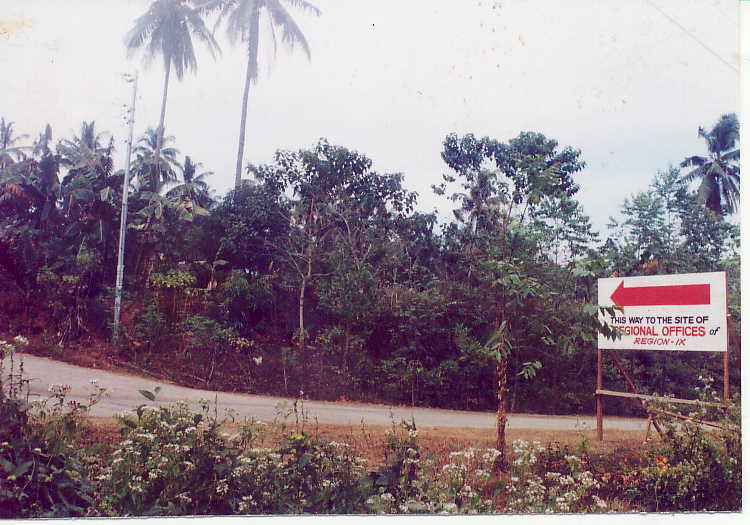
For starters,
he has allocated 1 million pesos for clearing of the
12-hectare 20 blocks regional center complex situated in Brgy.
Balintawak.
For Pagadian
City, the transfer of the regional offices has taken all of 15
years. As Cerilles sees it, “There is yet a long journey to
undertake in the process of development.” For now, this
journey, long may it be, has become Pagadian’s well-spring of
possibilities.
HOME |