
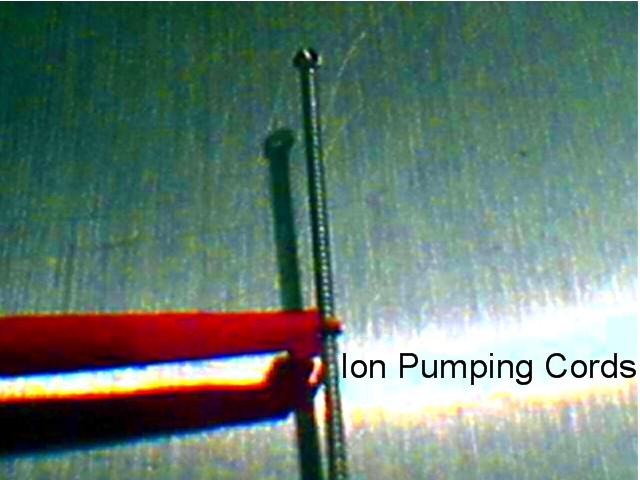

The Ion Pumping Cords of today have altered little from Manaka's first pair. They are basically a copper wire attached to a clip on each end with a diode placed somewhere inbetween to restrict the current flow in one direction. The thought being that if one area of the body is in a state of excess, another will naturally be depleted and it is possible to hasten the balance of these areas. Polarity. Yin Yang Theory 101. Many of todays great thinkers in the acupuncture world have broadened our understanding of ion pumping cords. Try looking up Miki Shima, Kiiko Matsumoto, Stephen Birch, Yukimichi Seki, for starters...
Secondly, the misinformation out there about this particular subject is staggering. For the most part acupuncturists do not understand the physics of electricity enough to grasp the dynamics of electrotherapy. Just as an electrical engineer would surely shrug their shoulders when asked what the Ming Men fire was all about, so too, an acupuncturist would most likely not know a cathode from anode, or the difference between electron flow and conventional current. (Unfortunately, I have two text books on electicity, each one lables the cathode exactly opposite the other! So, maybe editors do not understand electrical components either.)
Acupuncturists simply take the research that is available to them and expect that if they purchase a piece of equipment from a catalogue that it should behave like the devise that they have been studying. In some cases I am quite sure that the frustrated clinician must throw away their cords believing that the technique or entire Japanese system simply does not work. This is a shame. I have known a few instructors at my school who have recommended simply switching the cords around or "reversing the polarity" if they did not seem to be working correctly the first time. While I believe that there CAN be a rare case where someones particular energy may respond better to a treatment by swithing polarities, I am more inclined to think the fault may lie with the construction of the cords themselves. The observation that switching the cords around will indeed bring about results is a testament to both the theory and to my teachers.
So, we have a variety of explainations from western and Asian acupuncture sources as to how these work. These often differ somewhat from each other. We have english documents translated from Japanese that can cause even more discrepances. We then have poor editing, bad typos, and people attempting to either explain something they themselves do not understand, or switch the modality of their explaination mid-way. I understand why this is so. Diodes and micro clips are not often used in the same sentence as Qi, or even bioelectricity. Just try and ask your local electronics supply house, "which germainium diode would best be used to regulate a bodies natural electrical current?" and see what kind of response you get. Most likely, "Oh...are you from Boulder?"
Thirdly, and possibly most importantly, the companies that currently make ion pumping cords seem to care very little about consistency with the research, with other companies, or within their own products from cord to cord. This coupled with exceedingly cheap materials makes me wonder how anyone gets results.
Technical difficulties:
Many sites and texts I've read simply stumble over the issue of which direction the energy is flowing. One better known source states that they "allow the flow of electrons to move in one direction only. From the black to the red clip." She got part of this right. The cords should be thought of more properly as electron pumping cords as ions cannot move through a solid like copper. It is electrons that are moving (jumping shells) not ions through the wire. However the flow of electrons through a diode travels from cathode (-) to anode (+). Manaka's cords, from the Japanese literature, (thanks to my Japanese speaking friends) connect the black clip to the anode and not the cathode. (more on this later.)
I have seen numerous texts, catalogues, and web pages state incorrectly that ions flow through the cords.
I can easily forgive this misunderstanding, Manaka chose to call them ion pumping cords and not electron pumping cords. Unfortunately a very well known, often quoted, acupuncture author has been stuck on this nomenclature and has therefore taken the posistion that they do not work because "there is no such thing as ion pumping cords." While this technically may be correct. Ions do, however, flow through the body and are effected by the presence of negatively charged electrons. It it therefore more accurate to say they are pumped BY the cords THROUGH the body. The ion pumping cords should not be dismissed due to poor naming.
Another source, this one a web page, states that "the electrons can only flow from the anode to the cathode inside the diode and this is why they (the cords) work as a polarity" device. Again he got the electron part right, only it is NOT the electrons that flow from anode to cathode: it is the conventional current. Thats right, it all gets even more confusing as conventional current flows from positive to negative and electrons flow from negative to positive -kind of . (This is a gross simplification that one could write volumes on...many have.)
Yet another source tells us that there is a "unidirectional flow from the black clip to the red." At this point you may ask, "a unidirectional flow of what? Electrons? Conventional current? Ions? Qi?" See what I mean? An acupuncturist shouldn't really have to juggle these apples and oranges so much as just know how to tonify with the red end and sedate with the black, without worrying about their equipment. Or maybe you like knowing how to smelt the ore to make your needles.
