 |
|
|
|
|
|
|
|
|
|
|
|
|
|
|
|
|
|
|
Ion Pumping Class 101...or more ugly overheads? |
|
|
|
 |
|
|
|
Here are a few things I can share with you about the mechanics and theory of Ion Pumping Cords. I am not an electronics genius by any stretch of the imagination, I am an acupuncturist. So, bear with me if you know all this already, and if you find this useful and it helps you to better understand and want to use Ion Pumping Cords, please order them from me to show your gratitude for my efforts! |
|
|
|
 |
|
|
|
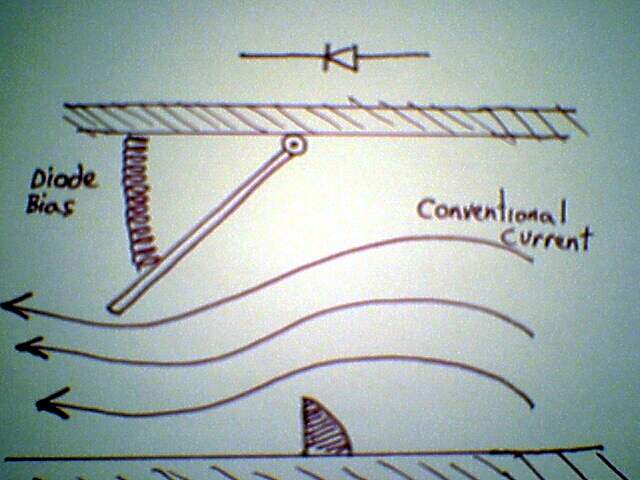
Slide one please...So, what the heck is a diode to an acupuncturist? Let me put it simply. The symbol at the top of this picture stands for a diode to an electrical engineer. It allows the passage of current in only one direction. The drawing to the left is a common way to conceptualize a diode, with the diode bias "spring" being the amount of resistance a particular diode has to the current. It is interesting to note that only one company whose diodes I checked were consistant from pair to pair. Numbers ranged anywhere from .124 to .501 and too frequently .0F (not working.) |
|
|
|
|
|
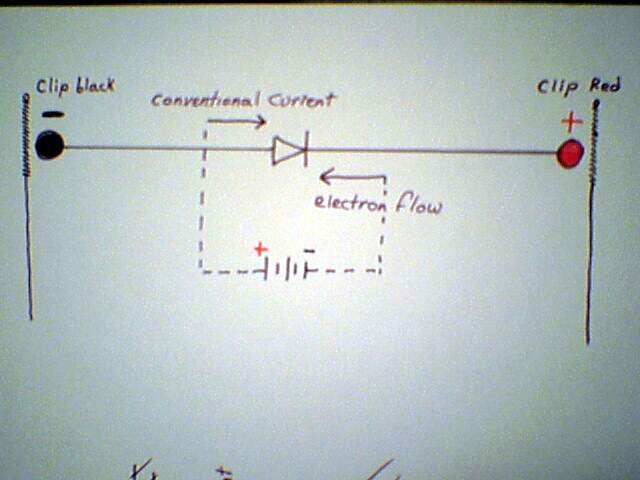
Slide two please...Thank you. This chart shows the placement of a diode in the middle of a wire stretched between two needles with a red clip on one end, a black on the other. Notice the battery symbol underneath depicting conventional currents flow from positive to negative and the electron flow from negative towards positive. Also note that on the pumping cords this tendency will seem backward to the battery image with conventional current (if you can actually call bioelectricity conventional current) flowing from the black clip towards the red, and the electron flow moving from the red clip towards the black. How can this be? It has to do with what is called the skin battery, and how electrically charged different areas are in comparison to one another. |
|
|
 |
|
|
|
|
|
|
All tissues have varying electrical potentials between different parts and these tend to remain constant. Areas of bone repair, for instance, are more negatively charged compared with other areas. On the skin, the surface tends to be more negative than directly underneath. In an area of trauma/pain, positively charged ions rush towards the surface of the skin. This voltage change over the site of healing wounds lends support to the idea that healing is partly controlled by electrical signals and that its manipulation might influence wound healing. As far as the pumping cords go, picture two main things happening: 1) The theory of positively charged ions moving from the area around the black cliped needle through the skin towards the area of the red one (think of sedating the excess and placing this qi in an area of defeciency) 2) The negatively charged electrons moving through the wire that cause #1 to happen (think of yin supporting yang.)
There is also an electrical potential that occurs within a single needle itself. Once inserted into the more positively charged area of the dermis, the needle tip becomes more negative and the shaft more positive relative to each other. This polarity may also be effected by the acupuncturists very fingers touching the needle. (One way to eliminate this variable is to use a plastic coated needle like a Seirin, touch only the coated needle head and place the clip on the shaft.) You can see that there are quite a number of theoretical variables at play here. Manaka himself found that the cords seemed have no effect whatsoever when the subject was placed in a Faraday chamber, that is, an area free of electromagnetic radiation. This implies that the very magnetic fields of the earth are influencing the cords independently from the bioelectricity of the patient or practitioner. |
|
|
|
this site is under construction...... |
|