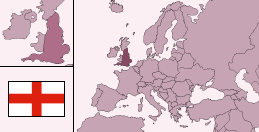
Since the start of the 1990s, the professional football
in England and elsewhere has gone through a fantastic transformation.
Player salaries were increased, television contracts gave revenues,
many football stadia were restored, the profile of commercial
sponsorship and merchandising was grown and the clubs made a start
on the stock market. Newspapers devoted pages for the economics of sports.
Football's significance is also social and cultural. The welfare produced by football
may be higher than the revenues from the professional level.
Articles by Rottenberg, Neale, and Sloane address economic implications of the
structural features of the markets in which professional sports teams operate. The
study will provide an overview of the historical development of English football as
a business. Moreover, we will proceed to the determinants of player compensation,
the earnings of superstars, the production function and, in the end, to the
manager's role.
The following table deals with the main part of the Economics of Football:
In the future, the broadcasting companies will operate increasingly as a channel through which revenues are carried
from the public to the football clubs. The clubs, as monopoly owners of the property rights in 'brand' identities will
achieve to produce enough profits to meet the requirements of the shareholders and other investors. Moving slowly down to the
league hierarchy, any rents resulting from the sale of broadcasting rights will be expanded and passed on to players as an influence
of 'arms race' competition.
References
Dobson, S. M., and Goddard, J. A., 2001, " The Economics of Football ", Cambridge: Cambridge University Press.
Neale, W. C., 1964, " The Peculiar Economics of Professional Sports ",Quarterly Journal of Economics, 78, 1-14.
Rosen, S., 1981," The Economics of Superstars ", American Economic Review, 71, 845-858.
Rottenberg, S., 1956, " The baseball Players' Labor Market ", Journal of Political Economy, 64, 242-258.
Sloane, P., 1971, " The Economics of Professional Football: The Football Club As Utility Maximiser ", Scottish
Journal of Political Economy , 17, 121-146.
THE RECOMMENDED LINKS ARE THE FOLLOWING:
Deloitte and Touche (big accountancy firm) and Soccer Investor (small consultancy)
both produce publications and reports on football economics and finance. The websites are:
Therefore, we should point out that in the following search box, we can submit keywords, and
it transmits your search simultaneously to several individual search engines and their databases
of web pages. Within a few seconds, we get back results from all the search engines queried.