Click on this image to come back to the index from a subpage.
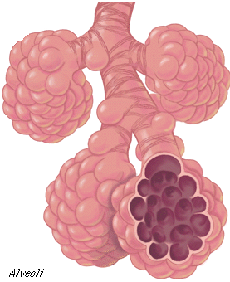
Click on this image to go to the alveoli page.
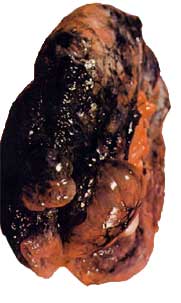
Click on this image to go to the respiratory disease page.
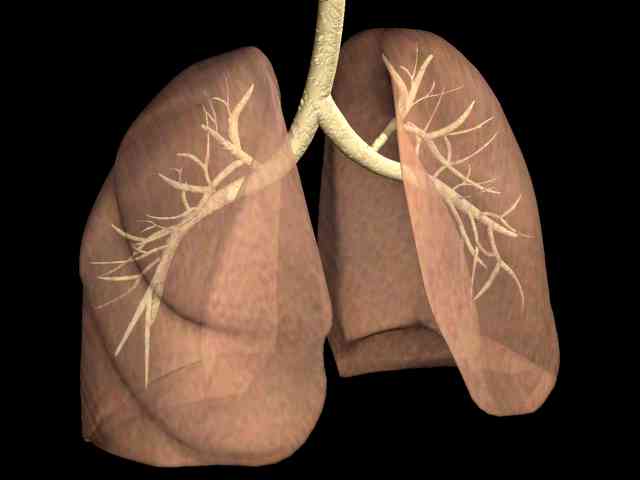
Click on this image to go to the lung page.
<bgsound src="moonlit.mid" hidden=true autostart=true loop=infinite>
The Respiratory System
Ventilation - Inhalation and Exhalation
The human respiratory system is a complex arrangement in which respiration occurs, which is the process of inhaling oxygen and exhaling carbon dioxide. As the lungs possess no muscle tissue, it is more of a storage compartment for the air rather than anything else. In fact, the process of inhalation is, for the most part, controlled by the diaphragm and supported by the intercostales externi muscles.
As a person takes a breath, the normally curved diaphragm contracts to straighten and pulls downward to expand the chest cavity (ribcage) and displace the abdomen. This allows for a larger thoracic volume, which forces air into the lungs. While in rest, a human breathes an average of 10 to 18 times per minute, with each breath lasting roughly two seconds. During times of physical stress, accessory muscles of the respiratory system are used (sternocleidomastoid, platysma, neck strap muscles) to aid in inhalation.
Exhalation, on the other hand, is generally passive. The diaphragm and chest muscles relax involuntarily, and the lungs recoil until the air level is equalized. If exhalation is forced, however, intercostales interni and abdominal muscles are utilized to forcibly 'push' the air out.
The process of ventilation (inhalation and exhalation) is controlled by the autonomic nervous system, which includes the brain stem, medulla oblongata, and pons. This system measures the amount of carbon dioxide in the body system, and determines how much oxygen is required relative to the amount of carbon dioxide.
Air Travel
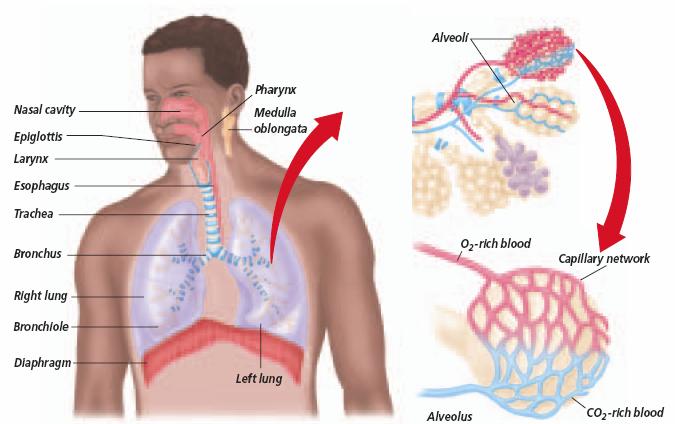
The main function of the respiratory system is to allow for air travel. Thus, the system has a long line of organs through which the air moves. During inhalation, air travels through the nostrils to the nasal cavity, then from there to the pharynx, larynx, trachea and finally the chest cavity. From the cavity, air is branched into the bronchi, and branched again into the alveoli. During exhalation, air moves from the alveoli to the nostrils, going through each of the previously mentioned organs in respective order. As the air the nostrils take in is far from pure, the body has a system to remove bacteria and other substances from the air before reaching the lungs, in order to prevent infection. The first defense is nose hair, which prevent the majority of large particles from entering any further. The second line of defense is the mucus found in the nasal passage, which traps bacteria and other small particles. The nasal passage also warms the air to prevent injury to the lungs. Therefore, the nose should be favored over the mouth for breathing whenever possible.
Gas Exchange
Gas exchange is one of the most vital processes that the respiratory system undergoes. Gas exchange regulates the acid-base balance of the body, which prevents respiratory acidosis (too much acid) and respiratory alkalosis (too much base). After inhalation, gas exchange begins at the alveoli, which are tiny air pockets found inside the lung. By diffusion, oxygen travels from the alveoli to the pulmonary capillaries found along the lining of the alveoli. At the same time, carbon dioxide travels from the capillaries to the alveoli air pocket. This results in oxygen filled blood in the pulmonaries, and carbon dioxide in the lungs. Exhalation then takes place, and the carbon dioxide is expelled into the atmosphere. An average adult's lungs will intake 250 ml of oxygen and expel 200 ml of carbon dioxide every minute while resting.
Circulation
The heart also plays a part in the respiratory system. The heart pumps blood to the pulmonary trunk from the right ventricle. From the pulmonary arteries (branching from the trunk) the blood is carried along the airways to the alveoli. After gas exchange, the blood travels back to the heart through the pulmonary veins. The lungs are essential for healthy blood, as they add and remove chemical messages from the blood as it passes by, as well as removing any potential blood clots. Because of this, blood from all parts of the body are circulated through the lungs roughly every minute.
Formation
During pregnancy, the respiratory is inactive. After birth, the system immediately starts up, cleansing itself of fluid and beginning the cycle of respiration. If a child is born premature, the respiratory system will likely fail, as the alveoli of the lungs usually have not fully developed.
How to Keep Your Respiratory System Healthy
Many things harm the health of the respiratory system, and the majority of them are preventable. The most obvious and easiest way to keep your lungs healthy is to not smoke. Cigarette smoke disables the cilia, which is the first line of defense the respiratory system has against infection. Cigarette smoke also destroys numerous lung tissue. The second thing you can do is to be aware of lung hazards. Avoid air pollution, secondhand smoke, and potential hazards at work, such as coal, raw cotton, and chemical vapors. Also, if you have asthma, avoid anything that might trigger it. Fungi, viruses, and bacteria also cause many issues with the respiratory system. Therefore, regular vaccination is essential for prevention of disease, especially if you are in a high risk category.
Bibliography
Webb, Frances, Eleanor Whitney, and Linda DeBruyne.
Health: Making Life Choices
.
Columbus: McGraw-Hill Companies, 2000.
Biggs, Alton et al.
Biology: The Dynamics of Life
. Columbus: McGraw-Hill Companies, 2004.
Wikipedia: The Free Encyclopedia
. (18 November 2006): 5 pp. On-line. Internet.
18 November 2006. Available: http://en.wikipedia.org. 18 November 2006.
A.D.A.M. Incorporated
. (18 November 2006): 2 pp. On-line. Internet. 18 November 2006.
Available: http://www.adam.com/ 18 November 2006.