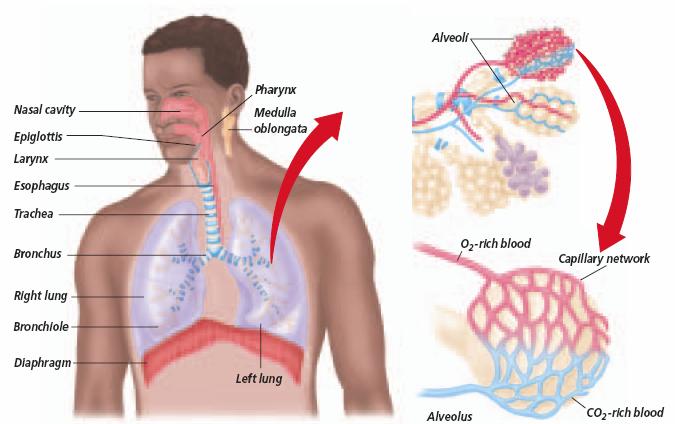
The lungs are the largest of the organs involved in human respiration, and they are also the most important. Without the
alveoli found within a lung, respiration could not take place. The lungs of humans(and mammals in general) is just about a mass of alveoli.
A network of capillaries found on the lining of the alveoli transports blood in and around the lungs.
Respiratory Functions
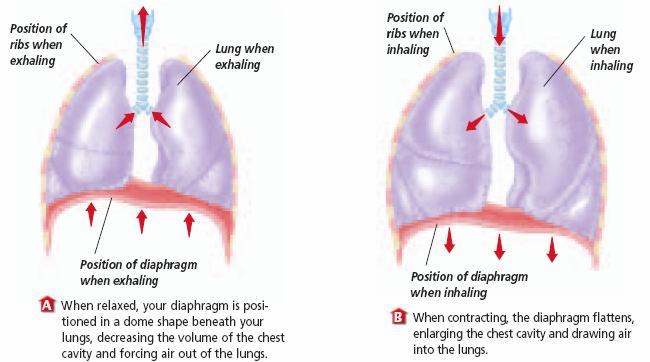
As stated earlier, the lungs do not possess any muscles. Therefore, they cannot draw air themselves. Rather, they are
dependent on the diaphragm and supporting chest muscles to do this for them. As the diaphragm contracts to increase thoracic volume and
decrease pressure, air flows into the lungs, where it is then sent to the alveoli. After the alveoli oxygenates the blood, they fill the lungs
with carbon dioxide, which is released into the atmosphere as the diaphragm relaxes.
Miscellaneous Functions
The lungs also serve purposes outside of respiration. They remove blood clots which may form in veins, and they regulate
the chemical messengers and substances found in arterial blood. Furthermore, the lungs serve as insulation for the heart, absorbing any
potential shock that might be generated.