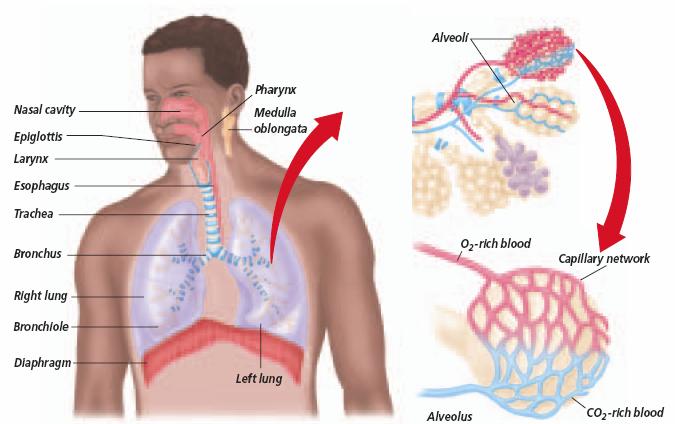
Present in only the lungs of mammals, the alveoli are semi-spherical, hollow
structures in the lung responsible for the exchange of oxygen and carbon dioxide
from the blood.
Structure
There are roughly 300 million alveoli in a human lung. Each is made
up of both an extracellular matrix surrounded by capillaries and an epithelial layer.
The walls of the alveoli are made up of cells that form the wall structure and those that
lower the surface tension of water by secreting surfactant. These are called type I and type II,
respectively. Each individual alveoli is very small, with a .2 mm diameter and walls as thin as .2
nanometers.
Pulmonary Gas Exchange
Pulmonary gas exchange is the transfer of oxygen from the alveoli to the surrounding blood
vessels, and the transfer of carbon dioxide from those blood vessels to the alveoli. This process does not require energy
because it utilizes passive diffusion. Carbon dioxide and oxygen are the most vital and predominant
gases exchanged, but several other trace gases are exchanged as well. This entire process is accomplished in about
75% of a second.