E
DUCATIONHistory 1500s-1863
The 1500s brought a fierce era of competition amongst leading western European countries. This quest for power and economic wealth over another had already brought the leading nations in Europe, such as England, Spain, and Portugal to Asia and Africa, setting up trade and even minute colonial types of agreements with some countries and peoples in those continents. With the European discovery of the "New World" by Columbus in 1492, the Americas became the new Treasure Island.
Until the 1600s, Europeans did not set up permanent colonies in the Americas and usually just extracted resources. The first permanent colony of Europeans was in 1607 in Jamestown, Virginia (Jordan, Jr,
Online), by the Virginia Company of London. To build up the new colony, labor was highly needed. At first poor Englishmen were brought in as indentured servants. In 1609, "nineteen Africans are shipped to Jamestown, Virginia, on Dutch Ships, as indentured servants" (NPS, online), who "served their masters for seven years and were then freed to establish their own livelihood and households"(McCray, Online). Servitude in America at first, was not past on from generation to generation, as the case in Africa and Europe and "it lacked the racist notion that whites were masters and blacks were slaves" (PBS, online).More European colonies were set up in the Americas. The need for more labor was brought upon by the newly established plantation system of growing crops such as sugar, tobacco and later cotton, which demanded extreme rate of labor. Native Americans were first in line for the work force, but diseases brought on by Europeans such as small pox had killed many and others flied. Plantation system was to bring big profit in the market place, therefore many more Africans were brought to work. Africans have from the beginning resisted this move to the Americas even if their slavery was temporary (swagaa.com,
online).The first permanent slave was an African man who was referred to or called "John Punch". He like many in the first colony of Virginia tried to escape from his plantation but he was "sentenced to "serve his said master or his assigns for the time of his natural life." He was made a slave." (PBS,
online). As the reason for colonizing Africa, the English assumed their Christianity gave them the right to enslave everyone that was a non-Christian. That at the time included most to all the Africans brought to America as well as the Native Americas, neither peoples even spoke English to covey what they believed in.In 1641, "Massachusetts Bay and Plymouth were the first colonies to authorize slavery through legislation as part of the
1641 Body of Liberties" (NPS, online). Virginia followed in 1662, going one step further in determining that anyone born to a slave would also become a slave, all who were not Christians in their native land would be counted as slaves. This mixed the issue of race to slavery.
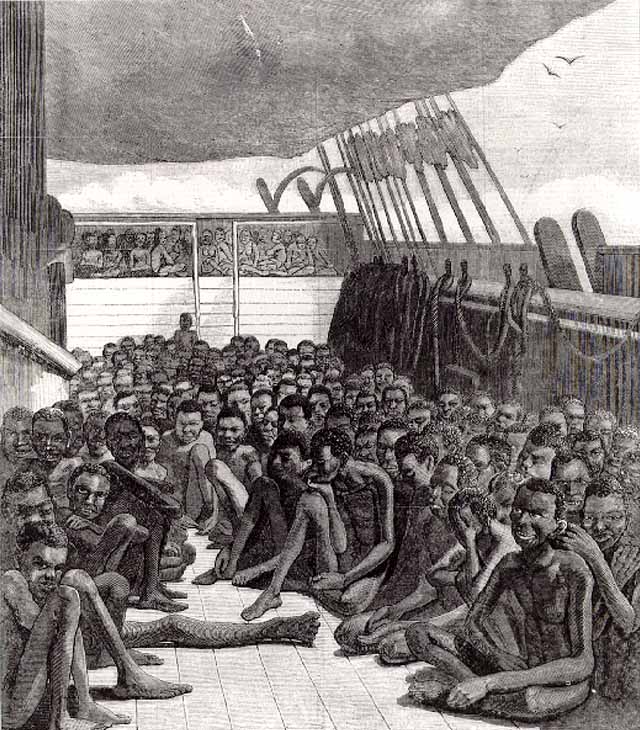
(
picture from PBS.com)As the number of permanent colonies grew in the 1700s and so did the market for slaves. The
triangular slave trade brought over 12 million Africans to the Americas by the 19th century bringing with it the notion that slaves were a commodity like chattel, not human beings. They were to work on even bigger plantations. In some plantations and colonies, African slaves outnumbered their European masters and many tried to run away or escape but the " authorities developed laws to keep the African American population under control. Whipping, branding, dismembering, castrating, or killing a slave were legal under many circumstances. Freedom of movement, to assemble at a funeral, to earn money, even to learn to read and write, became outlawed." (PBS, online). Stricter laws and harder punishments that stripped Africans even more of power followed other revolts.There were now 13 colonies in North America with not only British settlers but also German, Scottish-Irish settlers. They all together sought to get their independence from their "ruler", Britain. Ironically, they themselves had become rulers, masters over Africans living in their colonies. The
American Independence, formed the United States that proclaimed in its constitution "every man in equal". But again, Africans were no longer men in the eyes of the new Americans, they were chattels. In fact, in later years they were to move up from chattel to 3/5 of a man under the compromise of the Northern and Southern states.Differences between Northern and Southern states were evident from the beginning in the new country. The Northern States were settled by a lot of religious group who believed slavery was immoral. They started to organize themselves and organizing blacks and by the 1770s they had started to build the first anti-slavery organization. "The First Quaker anti-slavery society, The Society for the Relief of Free Negroes Unlawfully Held in Bondage, is organized in Philadelphia" in 1775 (NPS,
online). The North was moving towards a more industry related economy with the spawn of industrialization in Europe therefore relied less on slavery. The south however, still a heavy agricultural and plantation economy, depended on the free labor of slaves.In 1789, the French Revolution spawned the first of a series revolt of peoples who were forced to servitude by those who were in power all over the world. The French peasantry took over the rule of the king, Louis XVI, and reinstated rule of the people with "libertee, fraternitee, et egalitee" as the new motto of the nation. (*) This led to the first fully successful revolt of African slaves in Haiti, from 1791 leading to Haiti's independence as a free nation in 1804 claiming victory over Napoleon Bonapart . The revolution in Haiti had become an inspiration by those who heard of it in the United States. By 1804, "Gradual abolition laws are passed in the northern states: Vermont, Massachusetts, New Hampshire, Pennsylvania, Rhode Island, Connecticut, New York, New Jersey" (NPS,
online).(the following is written by me, from my notes and papers from my course
BLKSTUDIES 108 with Profesor Kamara at UMASS BOSTON)The 1800s brought with them a series of Abolitionist groups in the north. Many had thought blacks how to read and write even when it was illegal to do so. The abolitionist movement took many forms throughout its course. It was branched into many organizations and groups that differed in ideology, methods and roots in membership. They separated along the lines of religion, tactics for ending slavery, stands on the constitution and the political course in the country, and off course, race. The leaders of these various groups also took on their difference and addressed their similarities in the public forum as well as in private but they all centered along the key issue of ending slavery.
Perhaps a great place to start as for the big abolitionist movement is with the American Colonist Society, which formed in 1816. Reverend Robert Finley, from New Jersey, came up with the idea of forming an organization that helped free blacks emigrate back to Africa. He thought that black people would never really become an accepted part of American society and they would be better off in Africa, therefore he along with his organization worked to get boats to ship blacks to Liberia. Many in the North and South, even those that weren’t for abolishing slavery, supported the ACS because they saw free blacks in the north, who were reading and writing, as being a treat for slave society in the south by prompting rebellion. Those who wanted to free slaves as well joined the ACS in believing that Africa would be a better place for all black people.
The ACS also won the support of many black people including Paul Cuffey who thought that black people would never receive full rights of citizens in the US therefore had to form their own place in Africa. He took several trips to Liberia with ACS as they transported about 12, 000 black people there.
Many at the time disagreed with the ACS and the idea of emigration. They felt that the black population in America has been out of Africa for generations now and can’t go back to Africa, as America is now their new home. They have worked hard to uplift this country into what it is now and therefore need to stay here to see the benefits of their hard work. These people believed that unlike the ACS, which claimed to be anti-slavery and didn’t do much to end it, they needed to work actively to emancipate the slaves in the south.
The people who opposed emigration were mainly black. They formed in 1817, the National Negro Convention Movement which was a series of meetings in the north that focused on issues of blacks. Many of the leaders were black unlike in the ACS. Even blacks who weren’t against emigration joined the NNC to be part of a black abolitionist group. Henry H. Garnett was one of them, he was the black Christian minister who actually took several trips to Liberia. He was one of the leaders of the NNC, he advocated for a militant approach to ending slavery. The NNC became the first organized black movement in the US.
William Loyd Garrisson, a white man, becomes involved with the NNC. He creates the "Liberator", the first abolitionist paper. He writes in it that the constitution is a pro-slavery document because its writers’ were themselves slave owners. He said in order to abolish slavery, we must abolish the constitution and should work outside the system. Many agreed with Garrison’s view both in the black and white populations.
But Fredrick Douglass, a former slave whose mentor was Garrison, didn’t agree with him. He believed that the constitution is in fact anti-slavery as it proclaims "all men are equal". Douglass believed that we needed to work with the system and change it to accommodate the needs of black people and use it to abolish slavery. Douglass became one of the leaders of the NNC and spoke out against emigration. He believe that by working through the system and also convincing people that slavery was morally wrong, slavery would be abolished.
The Liberty Party of the 1840s agreed with Douglass that the constitution was workable. This political party based in New York was an against slavery because it saw it as a threat not only to humanity but also to the nation’s future. This party later involved into the Free Soil Party and then the Republican Party in the 1850s.
Another organization that agreed with Douglass about using "moral suasion" as a tactic was the American Moral Reform Society. It was based in Philadelphia and tried to persuade many that slavery was condemned by God or at least was morally wrong to commit that kind of crime against human beings.
But despite all efforts of these groups, slavery persisted and things were getting "Dred" for the south and the nation as a whole with laws being passed against blacks that tried to run away whether through the Underground Railroad or individually. Moral suasion wasn’t that appealing as the situations were horrid.
In 1829, David Walker, a black man from Boston, wrote his appeal calling for slaves to rebel against the masters. This prompted many rebellions in the south such as Nat Turner’s rebellion, Denmack Vesa rebellion, John Brown rebellion. These were unsuccessful and in fact led to slave owners cracking down and keeping closer watches on their slaves.
Douglass in the late 1840s couldn’t stand to wait for white slave owners to change their minds and see the wrongs in their ways. He joined Garnett in a militant view of abolition and together, they edited the "North Star", the newspaper Douglass founded in 1847. In it, they called for the immediate end for slavery without any compensation for slave owners. They pointed out that all whites were implicated in the "institutional racist system" because in one-way or another they benefited from it.
Douglass and these many organizations fought slavery in their own ways. But the legal end of slavery didn’t come into 1863 with the Emancipation Proclamation signed by Republican President Abraham Lincoln. The civil war was fought over the expansion to the west and the conflicting modes of production the new western states were to take. As slavery was in the midst of the war, it was used as propaganda for the North to gain support from the huge black population in fighting the war.
Many of these organizations in the abolitionist movement died off after the civil war or continued to fight for civil rights in many shapes and forms.
* in reference to paragraph about french revolution: "liberty, fraternity and equality". * Since what I wrote was from information from my notes from BlkStu108, I am crediting Prof. Kamara for the information and concepts for the notes on abolitionist movements.
|
1500-1863 |
||||
.