TRIBUTE TO BUCK Page 3 of 11
Dad�s father was William Washinton Vivrett, first born of twelve children to Henry and Susan. Henry Jacen Vivrett was born in Wilson Country near Nashville, Tennessee, in 1835. Henry was a farmer and a good one but also an itinerant Baptist Circuit Preacher who help found the Oakland Baptist Church on Big River. An amiable sort � who loved to sing � one anecdote held he more than once closed a sermon by inviting the entire congregation home for chicken dinner no advance notice to his wife, Susan. Warm, cordial and friendly though he was, I�ve often wondered what he thought of his oldest son marrying a Catholic girl.
I�ve traced old Henry back a bit. Two brothers came from Alscon or Alason, a small village in France. This name runs throughout the family for generations. The bachelor brothers came to American before the Revolution and settled in Wilson County, Tennessee, near Nashville, then Obion County, Tennessee on the Mississippi River.
In 1860, 74,000 American frontiersmen came into mid-Missouri. For the most part, they were farmers and Missouri land was not only much cheaper but similar to their beloved Tennessee uplands. Henry Jacen Vivrett was one of them.
Another anecdote about Henry goes like this: As a young farmer he was plowing a field near the Mississippi. It was hot. He heard a steamboat whistle as it prepared to dock. He tied off the mules� reins and ran about two miles to the point where the boat had docked. Henry reached into his overalls, showed the captain his money and asked how far up river that amount would take him. � St. Louis,� the Captain replied. And that�s one account of how Henry married Susan Johnson on July 4,1860, less than a year before the Civil War started.
Old Henry Jacen Vivrett left people in Western Kentucky and Tennessee. One of them, Alascon Vivrett, had sons - - lots of them. There were Jim, who fought for the Union, Dee and Bob. Also there were Cage, Rufus, Tom, and his son Sack. (Sack may not have been quite right but he was strong as an ox). Such names! I�ve heard Dad speak of Cage and of Rufus, who had eight daughters and ruled his farm patriarchal style.
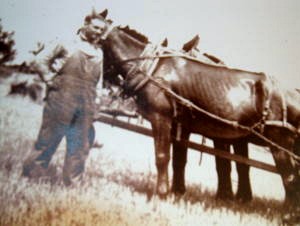
My grandfather William was a stern patriarch too. There was little praise and less affection to spread around. Still Dad stayed home - - on the farm - - a bachelor who worked with mule teams but courted with horses. He loved horses. In those days a young man felt his horse must be fast, high spirited and have redundant four white hocks. Few Missourians owned horseless carriages before 1910. But the Missouri mule was of key importance on the farm.
When he was thirteen Dad went to the World�s Fair; an experience he would never forget. Quite a culture shock for a farm boy named Buck. St. Lous� major claim to fame in 1904 was caskets, shoes and beer. St. Louis was also the fourth largest city in the United States. The glorious Fair - - with its innovations like iced tea, the ice cream cone, the hotdog and Popsicles and its spectaculars like the �Pike� and the ferris wheel with thirty six cars which could hold sixty people each. Twenty million tourists visited this fair for an average of 100,000 per day. What a grand time it must have been!
|