TRIBUTE TO BUCK Page 4 of 11
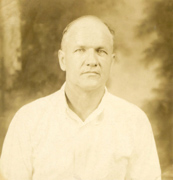
Buck had an agreement with his dad. If he stayed with farming and worked their two farms, one owned and one leased, then someday it would be his. So he farmed. But he was dreamer. The St. Louis and Iron Mountain tracks went by the house and invariably brought at least one adventurer who would hire on for awhile and then move on.
On Sundays, the young men would grow restless, catch a freight with its engine laboring to climb a grade and ride as far south as Poplar Bluff or sometimes into Arkansas; then catch another one home. Dad marveled at the trains, their powerful engines belching smoke, the far-away places the drifters talked about. And he always envied his cousin Sid Boyer, just a little. Sid ran off and became a brakeman, then a conductor for the Missouri Pacific. If a brakeman got hurt, he was immediately unemployed. Not much security there, Dad reasoned, so he worked part time as a brakeman once, but always there was the farm. In 1898 they leased a river bottom farm from Lavina Blackwell of Blackwell, Missouri. To a Missouri farmer, bottom land is the best. Dad loved that bottomland farm and the river that ran through it. Big River then called it, and still do. He told of working in the fields - - getting hot and racing his brothers to the river, diving in clothes and all. But it could be treacherous too and the hill folks had many stories of drownings and under-currents. Still he loved that river as he did his horses and the trains. But most of all he loved the land. He was a boy, working the land, when Orville and Wilbur Wright made history. I asked him once what local people thought about that flight and he responded, �Not much, on way or the other�. Of course it was considerably after the fact by then. Dad was working the land when the Yanks first went �over there� and when they returned in triumph.
But all that changed! In June, 1922, his father, William came to him and announced that he had traded the farm for an apartment building on Wells Avenue, Wellston. By 1920 the close-in St. Louis suburb of Wellston had grown by 22%. The Wellston property consisted of thirteen apartments or flats, but Buck thought it was a bad deal, and he said so. Dad was undone. He felt used and without a livelihood. After thirty-one years of working towards a goal, suddenly there was no farm. All but 40 acres was gone. Then he met my mother. They married in May, 1924. dad was unemployed, had eight grades of education and was thirty-four years old. The stage was set for forty years of doing without.
From then on, times were always hard. In a letter, dated November 3,1924, from St. Louis Dad writes his father that �a lot of poor devils are out of a job but everyone says after the election things will pick up.� But things did not pick up and babies began to arrive.
America had indeed lost its innocence and although Cal Coolidge, elected in the above reference, seemed to represent solid virtues of an earlier era, his leadership was inadequate in a post-war world. Coolidge did not lead. He suggested and withdrew. The post war prosperity was very fragile for the common man. Prosperity seemed more attracted to some areas and some people than others. The �filter down� theory of wealth never seemed to filter down, even then. Soon everything collapsed.
|