|
Requirements engineering processes
-
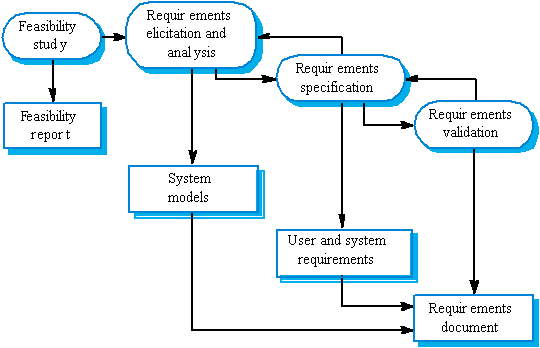
The processes used for RE vary widely depending on the application
domain, the people involved and the organisation developing the
requirements.
-
However, there are a number of generic activities common to all
processes
-
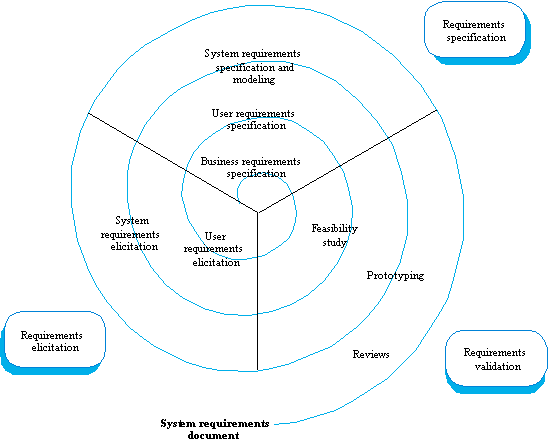
Requirements elicitation;
-
Requirements analysis;
-
Requirements validation;
-
Requirements management
-
The requirements engineering process
-
Requirements engineering
-
-
A feasibility study decides whether or not the proposed system is
worthwhile.
-
A short focused study that checks
-
If the system contributes to organisational objectives;
-
If the system can be engineered using current technology and within
budget;
-
If the system can be integrated with other systems that are used.
-
Feasibility study implementation
-
Based on information assessment (what is required), information
collection and report writing.
-
Questions for people in the organisation
-
What if the system wasn’t implemented?
-
What are current process problems?
-
How will the proposed system help?
-
What will be the integration problems?
-
Is new technology needed? What skills?
-
What facilities must be supported by the proposed system?
-
Elicitation and analysis
-
Sometimes called requirements elicitation or requirements discovery.
-
Involves technical staff working with customers to find out about the
application domain, the services that the system should provide and
the system’s operational constraints.
-
May involve end-users, managers, engineers involved in maintenance,
domain experts, trade unions, etc. These are called stakeholders.
-
Problems of requirements analysis
-
Stakeholders don’t know what they really want.
-
Stakeholders express requirements in their own terms.
-
Different stakeholders may have conflicting requirements.
-
Organisational and political factors may influence the system
requirements.
-
The requirements change during the analysis process. New stakeholders
may emerge and the business environment change.
-
Process activities
-
Requirements discovery
-
Interacting with stakeholders to discover their requirements. Domain
requirements are also discovered at this stage.
-
Requirements classification and organisation
-
Groups related requirements and organises them into coherent
clusters.
-
Prioritisation and negotiation
-
Prioritising requirements and resolving requirements conflicts.
-
Requirements documentation
-
Requirements are documented and input into the next round of the
spiral.
-
Requirements discovery
-
The process of gathering information about the proposed and existing
systems and distilling the user and system requirements from this
information.
-
Sources of information include documentation, system stakeholders and
the specifications of similar systems.
-
ATM stakeholders
-
Bank customers
-
Representatives of other banks
-
Bank managers
-
Counter staff
-
Database administrators
-
Security managers
-
Marketing department
-
Hardware and software maintenance engineers
-
Banking regulators
-
Viewpoints
-
Viewpoints are a way of structuring the requirements to represent the
perspectives of different stakeholders. Stakeholders may be classified
under different viewpoints.
-
This multi-perspective analysis is important as there is no single
correct way to analyse system requirements
-
Types of viewpoint
-
Interactor viewpoints
-
People or other systems that interact directly with the system. In
an ATM, the customer’s and the account database are interactor VPs.
-
Indirect viewpoints
-
Stakeholders who do not use the system themselves but who influence
the requirements. In an ATM, management and security staff are
indirect viewpoints.
-
Domain viewpoints
-
Domain characteristics and constraints that influence the
requirements. In an ATM, an example would be standards for
inter-bank communications.
-
Viewpoint identification
-
Identify viewpoints using
-
Providers and receivers of system services;
-
Systems that interact directly with the system being specified;
-
Regulations and standards;
-
Sources of business and non-functional requirements.
-
Engineers who have to develop and maintain the system;
-
Marketing and other business viewpoints.
-
LIBSYS viewpoint hierarchy
-

-
Interviewing
-
In formal or informal interviewing, the RE team puts questions to
stakeholders about the system that they use and the system to be
developed.
-
There are two types of interview
-
Closed interviews where a pre-defined set of questions are answered.
-
Open interviews where there is no pre-defined agenda and a range of
issues are explored with stakeholders.
-
Interviews in practice
-
Normally a mix of closed and open-ended interviewing.
-
Interviews are good for getting an overall understanding of what
stakeholders do and how they might interact with the system.
-
Interviews are not good for understanding domain requirements
-
Requirements engineers cannot understand specific domain
terminology;
-
Some domain knowledge is so familiar that people find it hard to
articulate or think that it isn’t worth articulating.
-
Effective interviewers
-
Interviewers should be open-minded, willing to listen to stakeholders
and should not have pre-conceived ideas about the requirements.
-
They should prompt the interviewee with a question or a proposal and
should not simply expect them to respond to a question such as ‘what
do you want’.
-
Scenarios
-
Scenarios are real-life examples of how a system can be used.
-
They should include
-
A description of the starting situation;
-
A description of the normal flow of events;
-
A description of what can go wrong;
-
Information about other concurrent activities;
-
A description of the state when the scenario finishes.
-
Use cases
-
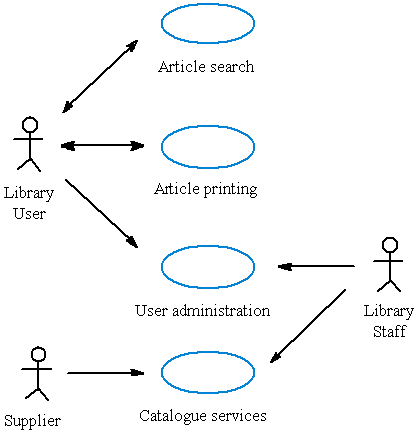
Use-cases are a scenario based technique in the UML which identify the
actors in an interaction and which describe the interaction itself.
-
A set of use cases should describe all possible interactions with the
system.
-
Sequence diagrams may be used to add detail to use-cases by showing
the sequence of event processing in the system.
-
Article printing use-case
-

-
LIBSYS use cases
-
-
Print article sequence
-

-
Social and organisational factors
-
Software systems are used in a social and organisational context. This
can influence or even dominate the system requirements.
-
Social and organisational factors are not a single viewpoint but are
influences on all viewpoints.
-
Good analysts must be sensitive to these factors but currently no
systematic way to tackle their analysis.
-
Ethnography
-
A social scientists spends a considerable time observing and analysing
how people actually work.
-
People do not have to explain or articulate their work.
-
Social and organisational factors of importance may be observed.
-
Ethnographic studies have shown that work is usually richer and more
complex than suggested by simple system models.
-
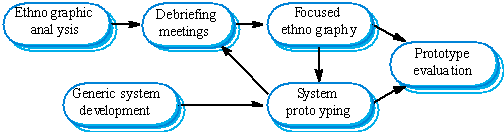
Focused ethnography
-
Developed in a project studying the air traffic control process
-
Combines ethnography with prototyping
-
Prototype development results in unanswered questions which focus the
ethnographic analysis.
-
The problem with ethnography is that it studies existing practices
which may have some historical basis which is no longer relevant.
-
Ethnography and prototyping
-
§
Scope of ethnography
-
Requirements that are derived from the way that people actually work
rather than the way I which process definitions suggest that they
ought to work.
-
Requirements that are derived from cooperation and awareness of other
people’s activities.
-
Concerned with demonstrating that the requirements define the system
that the customer really wants.
-
Requirements error costs are high so validation is very important
-
Fixing a requirements error after delivery may cost up to 100 times
the cost of fixing an implementation error.
-
Requirements checking
-
Validity. Does the system provide the functions which best support the
customer’s needs?
-
Consistency. Are there any requirements conflicts?
-
Completeness. Are all functions required by the customer included?
-
Realism. Can the requirements be implemented given available budget
and technology
-
Verifiability. Can the requirements be checked?
-
Requirements validation techniques
-
Requirements reviews
-
Systematic manual analysis of the requirements.
-
Prototyping
-
Using an executable model of the system to check requirements.
Covered in Chapter 17.
-
Test-case generation
-
Developing tests for requirements to check testability.
-
Requirements reviews
-
Regular reviews should be held while the requirements definition is
being formulated.
-
Both client and contractor staff should be involved in reviews.
-
Reviews may be formal (with completed documents) or informal. Good
communications between developers, customers and users can resolve
problems at an early stage.
-
Review checks
-
Verifiability. Is the requirement realistically testable?
-
Comprehensibility. Is the requirement properly understood?
-
Traceability. Is the origin of the requirement clearly stated?
-
Adaptability. Can the requirement be changed without a large impact on
other requirements?
-
Requirements management is the process of managing changing
requirements during the requirements engineering process and system
development.
-
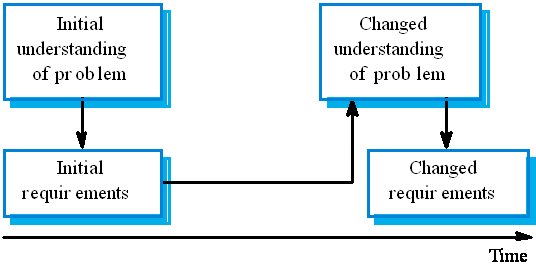
Requirements are inevitably incomplete and inconsistent
-
New requirements emerge during the process as business needs change
and a better understanding of the system is developed;
-
Different viewpoints have different requirements and these are often
contradictory.
-
Requirements change
-
The priority of requirements from different viewpoints changes during
the development process.
-
System customers may specify requirements from a business perspective
that conflict with end-user requirements.
-
The business and technical environment of the system changes during
its development.
-
Requirements evolution
-
-
Requirements management planning
-
During the requirements engineering process, you have to plan:
-
Requirements identification
-
How requirements are individually identified;
-
A change management process
-
The process followed when analysing a requirements change;
-
Traceability policies
-
The amount of information about requirements relationships that is
maintained;
-
CASE tool support
-
The tool support required to help manage requirements change;
-
Traceability
-
Traceability is concerned with the relationships between requirements,
their sources and the system design
-
Source traceability
-
Links from requirements to stakeholders who proposed these
requirements;
-
Requirements traceability
-
Links between dependent requirements;
-
Design traceability
-
Links from the requirements to the design;
System modelling
-
System modelling helps
the analyst to understand the functionality of the system and models
are used to communicate with customers.
-
Different models present
the system from different perspectives
-
External perspective
showing the system’s context or environment;
-
Behavioural
perspective showing the behaviour of the system;
-
Structural perspective
showing the system or data architecture.
-
Model types
-
Data processing model
showing how the data is processed at different stages.
-
Composition model
showing how entities are composed of other entities.
-
Architectural model
showing principal sub-systems.
-
Classification model
showing how entities have common characteristics.
-
Stimulus/response model
showing the system’s reaction to events
3.5 Context models
-
Context models are used
to illustrate the operational context of a system - they show what
lies outside the system boundaries.
-
Social and
organisational concerns may affect the decision on where to position
system boundaries.
-
Architectural models
show the system and its relationship with other systems
-
The context of an ATM
system

-
Process models
-
Process models show the
overall process and the processes that are supported by the system.
-
Data flow models may be
used to show the processes and the flow of information from one
process to another.
-
Equipment procurement
process
-

3.6
Behavioural models
-
Behavioural models are
used to describe the overall behaviour of a system.
-
Two types of behavioural
model are:
-
Data processing models
that show how data is processed as it moves through the system;
-
State machine models
that show the systems response to events.
-
These models show
different perspectives so both of them are required to describe the
system’s behaviour.
-
Data-processing models
-
Data flow diagrams (DFDs)
may be used to model the system’s data processing.
-
These show the
processing steps as data flows through a system.
-
DFDs are an intrinsic
part of many analysis methods.
-
Simple and intuitive
notation that customers can understand.
-
Show end-to-end
processing of data.
-
Order processing DFD
-

-
Data flow diagrams
-
DFDs model the system
from a functional perspective.
-
Tracking and documenting
how the data associated with a process is helpful to develop an
overall understanding of the system.
-
Data flow diagrams may
also be used in showing the data exchange between a system and other
systems in its environment.
-
Insulin pump DFD
-

-
State machine models
-
These model the
behaviour of the system in response to external and internal events.
-
They show the system’s
responses to stimuli so are often used for modelling real-time
systems.
-
State machine models
show system states as nodes and events as arcs between these nodes.
When an event occurs, the system moves from one state to another.
-
Statecharts are an
integral part of the UML and are used to represent state machine
models.
-
Statecharts
-
Allow the decomposition
of a model into sub-models (see following slide).
-
A brief description of
the actions is included following the ‘do’ in each state.
-
Can be complemented by
tables describing the states and the stimuli
-
Microwave oven model
-
Microwave oven state
description
-

-
Microwave oven stimuli
§
3.7 `
Semantic data models
-
Used to describe the
logical structure of data processed by the system.
-
An
entity-relation-attribute model sets out the entities in the system,
the relationships between these entities and the entity attributes
-
Widely used in database
design. Can readily be implemented using relational databases.
-
No specific notation
provided in the UML but objects and associations can be used.
-
Library semantic model
-

-
Data dictionaries
-
Data dictionaries are
lists of all of the names used in the system models. Descriptions of
the entities, relationships and attributes are also included.
-
Advantages
-
Support name
management and avoid duplication;
-
Store of
organisational knowledge linking analysis, design and
implementation;
-
Many CASE workbenches
support data dictionaries.
-
Data dictionary entries
-

-
Object models describe
the system in terms of object classes and their associations.
-
An object class is an
abstraction over a set of objects with common attributes and the
services (operations) provided by each object.
-
Various object models
may be produced
-
Inheritance models;
-
Aggregation models;
-
Interaction models.
-
Object models
-
Natural ways of
reflecting the real-world entities manipulated by the system
-
More abstract entities
are more difficult to model using this approach
-
Object class
identification is recognised as a difficult process requiring a deep
understanding of the application domain
-
Object classes
reflecting domain entities are reusable across systems
-
Inheritance models
-
Organise the domain
object classes into a hierarchy.
-
Classes at the top of
the hierarchy reflect the common features of all classes.
-
Object classes inherit
their attributes and services from one or more super-classes. these
may then be specialised as necessary.
-
Class hierarchy design
can be a difficult process if duplication in different branches is to
be avoided.
-
Object models and the
UML
-
The UML is a standard
representation devised by the developers of widely used
object-oriented analysis and design methods.
-
It has become an
effective standard for object-oriented modelling.
-
Notation
-
Object classes are
rectangles with the name at the top, attributes in the middle
section and operations in the bottom section;
-
Relationships between
object classes (known as associations) are shown as lines linking
objects;
-
Inheritance is
referred to as generalisation and is shown ‘upwards’ rather than
‘downwards’ in a hierarchy
-
Library class hierarchy
-

-
User class hierarchy
-

-
Multiple inheritance
-
Rather than inheriting
the attributes and services from a single parent class, a system which
supports multiple inheritance allows object classes to inherit from
several super-classes.
-
This can lead to
semantic conflicts where attributes/services with the same name in
different super-classes have different semantics.
-
Multiple inheritance
makes class hierarchy reorganisation more complex
-
Multiple inheritance
-

o
Object
aggregation
-
An aggregation model
shows how classes that are collections are composed of other classes.
-
Aggregation models are
similar to the part-of relationship in semantic data models.
-
Object aggregation
-

-
Object behaviour
modelling
-
A behavioural model
shows the interactions between objects to produce some particular
system behaviour that is specified as a use-case.
-
Sequence diagrams (or
collaboration diagrams) in the UML are used to model interaction
between objects.
-
Issue of electronic
items
-

3.9
Structured methods
-
Structured methods
incorporate system modelling as an inherent part of the method.
-
Methods define a set of
models, a process for deriving these models and rules and guidelines
that should apply to the models.
-
CASE tools support
system modelling as part of a structured method
-
Method weaknesses
-
They do not model
non-functional system requirements.
-
They do not usually
include information about whether a method is appropriate for a given
problem.
-
The may produce too much
documentation.
-
The system models are
sometimes too detailed and difficult for users to understand.
-
CASE workbenches
-
A coherent set of tools
that is designed to support related software process activities such
as analysis, design or testing.
-
Analysis and design
workbenches support system modelling during both requirements
engineering and system design.
-
These workbenches may
support a specific design method or may provide support for a creating
several different types of system model.
-
An analysis and design
workbench
-
Analysis workbench
components
-

·
Analysis
workbench components
-
Diagram editors
-
Model analysis and
checking tools
-
Repository and
associated query language
-
Data dictionary
-
Report definition and
generation tools
-
Forms definition tools
-
Import/export
translators
-
Code generation tools
-
Key points
-
A model is an abstract
system view. Complementary types of model provide different system
information.
-
Context models show the
position of a system in its environment with other systems and
processes.
-
Data flow models may be
used to model the data processing in a system.
-
State machine models
model the system’s behaviour in response to internal or external
events
-
Semantic data models
describe the logical structure of data which is imported to or
exported by the systems.
-
Object models describe
logical system entities, their classification and aggregation.
-
Sequence models show the
interactions between actors and the system objects that they use.
-
Structured methods
provide a framework for developing system models.
|









 SE notes is now available
online
SE notes is now available
online