The partitioning usually involves temporal and spatial subsampling or coarser quantisation parameters at the base layer, for temporal, spatial and SNR4.1 salability, respectively. This assigns a low-quality version of the sequence to the base layer, leaving the fine details to the other layers. A similar partitioning is including the lower spatial frequency transform coefficients in the base layer, leaving the higher frequency components for the enhancement layers. Last, data partitioning, is the inclusion of the most important and sensitive information, such as motion vectors, in the base layer, leaving the less sensitive data for the enhancement layers.
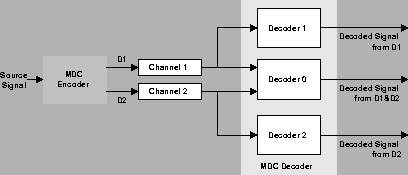
The guaranteed delivery base layer channel assumption on which layered coding is based, is not valid for many packet networks, such as the Internet. For these networks it has been shown that Multiple-Description Coding (MDC) works better. This coding scheme assumes that there are several parallel channels between the source and the destination and that each channel may be temporarily down, or suffering from long burst errors. It transmits different versions, or descriptions, of the same source signal over these channels. At the destination, depending on which descriptions are received correctly, different decoders are invoked, as illustrated in Figure 4.4.
The MDC encoders and decoders are designed in such a way, as to provide acceptable quality of the reconstructed images, with one only of the descriptions, and that incremental improvement is achievable when receiving more descriptions. Therefore, every description should carry sufficient information for the original signal, implying that there will be overlap, or correlation, in the information contained in different descriptions [WZ98]. This reduces the compression efficiency of the scheme, but eliminates the need for use of other error-control bits or latency, which an error-resilient single description codec might require.