|





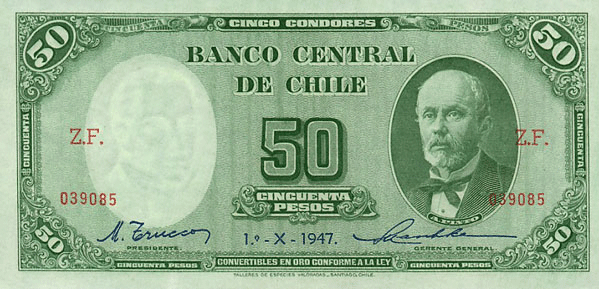
Area: 736,905 sq. km (284,520 sq. mi.) Capital City: Santiago Gross National Product per capita: $ 1,510 (1988 estimate) Currency unit: Peso Population: 13'173,000 (1990 estimate) Density: 16.7 persons/sq. mi. (1986 estimate) Urban-rural population: 83.6 urban, 16.4 rural Nartural increase: 1.6 % (1985-1990) Illiteracy rate: 5.6 % (1985 estimate) Highest point: 22,572 ft (Ojos del Salado) Main cities: Concepcion, Vina del Mar, Valparaiso National Holiday: Independence Day, 18 September ECONOMYChile's economy is based on its rich mineral resources, on agriculture, which takes advantage of the wide variety of Climate Conditions, on its rich fishing grounds, and on industry. There have been, however, much instability in the value of the most important minerals (copper, iron, nitrate) mined in Chile and their contribution to the GNP and to the country's exports. These depend largely on demand and prices in the world market and on Chile's ability to compete with other mineral-producing countries. The exploitation of Chile's mineral resources is to large extent in the hands of foreign, mainly U.S., companies. Mining plays a dominant role in central Chile. Forestry, fishing, and mining are important in the south. The fluctuation in the extend and value of the production of minerals has prompted the development of industry and agriculture, especially for export. The annual GNP per capita was $1,510 in 1988. It has only risen by $100 since 1978. Economic growth over recent years has been, on the average, 4 to 5 percent annually. Inflation has been one of the lowest in Latin America
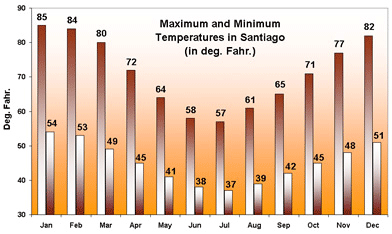
CLIMATE Extending over 38 degrees of latitude, from the tropics to the vecinity of Antarctica, and from sea level to altitudes of over 20,000 feet, Chile has a wide variety of climatic conditions. Extreme aridity prevails over the northern part of the country; the average annual rainfall in this region is 0.04 inches. Temperatures are moderate along the coast throughout the year and more extreme inland, especially in the central basin. The average temperatures for the hottest (February) and coldest (July) months are 72F and 60F. Central Chile (30-40 degrees latitude) has a Mediterranean type of climate, with cool and rainy winters (April to September) but without a completely dry season. Average annual precipitation increases substantially and temperatures decrease toward the south. The average temperatures for the hottest (January) and coldest (July) months at Santiago are 68 F and 46.6F, respectively. The average annual precipitation at Santiago is approximately 15 inches. The climate of the southern region is cool and rainy the year round. It is characterized by abundant low clouds. The average temperature for the warmest (January) and the coldest (July) months are 57F and 40F respectively.. The average annual precipitation is 119 inches. The changes of the snow line on the westward-facing slopes of the Andes can serve as an indication of the variation in climatic conditions with latitude and altitude. The line of permanent snow is approximately 18,000 feet in Chile's extreme north. It descends to 14,000 feet opposite Santiago and to 2,200 feet at Tierra del Fuego.
|