
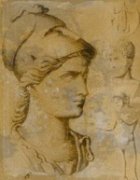
 According to the ancient Greek history, Poseidon, god of the sea and Athena, goddess of peace and wisdom, disputed over whose name would be given to the newly built city, in the land of Attica. To end this dispute, it was decided that the city would be named after the one who offered the most precious gift to the citizens.
Poseidon struck his trident on a rock and salt water began to flow. Athena struck her spear on the ground and it turned into an olive tree. It was decided that the olive tree was more valuable to the people of Attica, hence the new city was named Athens in honour of Athena.
Even today, an olive tree stands where the legend took place. It is said that all the olive trees in Athens were descended from the first olive tree offered by Athena.
According to Homer, the olive tree has been thriving in Greece for over 10,000 years. It was considered sacred and according to Solon's law, anyone who uprooted or destroyed an olive tree, was judged in court and if found guilty, was sentenced to death.
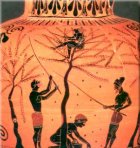 For the Ancient Greeks, the olive tree was a symbol of peace, wisdom and triumph. An olive wreath was made, and used to crown the Olympic champions. The first prize was usually a few pots of olive oil since it used to be very valuable.
After thorough examination of the archeological evidence regarding the use and the meaning of the olive tree in Ancient Greece it is confirmed that it was one of the most used and loved trees due to its sacredness, the economic value and the many uses of its products in every day life.
In older days it was wrongly supported that the cultivation was brought in Greece from Palestine. Newer evidence that came to light from pollen analysis are confirming its presence in Greece from the Neolithic period.
According to mythology the olive tree was brought in Greece from Goddess Athena which also taught the Greeks its cultivation. Indicative for the significance of the olive tree to the Athenians is the fact that there coins portrayed Goddess Athena with an Olive wreath on her helmet and an amphorae with olive oil.
 The Greeks were the first to be involved in the full-scale cultivation of the olive. Between the 7th and 3rd centuries BC ancient philosophers, physicians and historians undertook its botanical classification and referred to the curative properties of olive oil (Dioscorides, Diocles) and its history (Anaxagoras, Empedocles 5th century), while Aristotle elevated olive cultivation to a science.
It was even protected by the legislation of the time. The first Olive Protection Law was introduced by Solon (639-559 BC); in one of his statutes he prohibited the cutting down of more than two trees a year in each olive grove.
The olive and its oil also held a special position in the Orthodox religion. It was a symbol of love and peace, an essential part of several solemn rites, from the service of baptism to the oil lamps used in churches and the little shrine that is part of every Greek household.
The love and high esteem of the Greek olive-grower for the olive tree is passed on from generation to generation and from family to family, With the birth of a child an olive tree is planted which will grow and develop along with the child. When the child starts school at the age of seven, the olive tree is ready to produce its fruit. The blessed tree grows up with the family, only it will have a much longer life and will still be around to be tended by the next generation, and the one after that. Each year, it yields its annual crop of olives in return for the labor and love expended on it
|