| Era of Good Feeling | M issouri Compromise | Marshall Court | Monroe Doctrine | S econd Party System |
|---|

John Marshall served as a chief of justice of the United States for almost 35 years, from 1801 to 1835, and he dominated the court more fully than anyone else before or since.More than anyone but the framers themselves, he molded the development of the constitution : strengthening the judicial branch at the expenses of the executive and legislature branch, increasing the power of the federal government at the expenses of the states, and advancing the interests of the propertied and commercial classes.
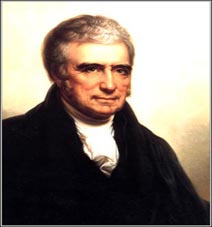 |
The imposing figure in this early photograph is John Marshall, the most important chief justice of the supreme court in American history. A former secretary of state, Marshall served as chief justice from 1801 to 1835 at the age of 80. Such was the power of his intellect and personality that he dominated his fellow justices throughout that period, regardless of their previous party affiliations or legal ideologies. Marshall established the independence of the court, gave it a reputation for nonpartisan integrity, and established its powers, which were only vaguely described by the Constitution. |
|---|
...In conclusion.
*John Marshall was appointed by J. Adams in1800
*served 34 years
*still around in Era of Good Feeling
*his decisions consistently favored the central gov. and the right of property
Fletcher v Peck
In Fletcher v Peck (1810), which arose out a series of notorious land frauds in georgia, the court had to decide whether the Georgia legislature of 1796 could repeal the act of the previous legislature granting lands under shady circumstances to the Yazoo land Companies. In an unanimous decision, Marshall held that a land grant was a valid contract and could not be repealed even if corruption was involved.
Worcester v Georgia
Even more important was the court's 1832 decision in Worcester v Georgia in which the court invalidated georgia laws attempted to regulate access by US citizens to Cherokee country. Only the federal government could do that, Marshall claimed, thus taking another important step in consolidating federal authority over states and over tribes. In doing so, he further defined the nature of the indian nations. The tribes he explained, were sovereign entities in much the same way georgia was a sovereign entity distinct political communities having territorial boundaries within which their authority is exclusive. In defending the power of the federal government, he was also affirming indeed expanding, the rights of the tribes to remain free from authority os state government
The Marshall decisions therefore did what the Constitution itself had not done; they defined a place for indian tribes within american political system. The tribes had basic property rights. They were sovereign entities not subject to authority and state of government.But federal government, like a guardian governing its ward, had ultimately authority over tribal affairs even if that authority was, according to the courts, limited by the government's obligations to protect indian welfare.
Important Supreme Court cases
Marbury v. Madison
Fletcher v. Peck
Darthmouth College v.Woodward
Mc Culloch v.Maryland
Cohens v.Virginia
Gibbons v. Ogden
Era of Good Feeling | Missouri Compromise | Marshall Courts | Monroe Doctrine | Second Party System