|
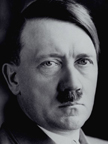 Adolf
Hitler was Chancellor of Germany from 1933 and leader of
Germany from 1934 until his death. He was leader of the National
Socialist German Workers Party, better known as the Nazi Party.
Adolf Hitler was notoriously charismatic and used his personal magnetism
to lead Germany into WWII, the most destructive war in human history.
Hitler gained power in a Germany facing crisis after World War I.
He used charismatic oratory and propaganda, appealing to economic
need, nationalism and anti-Semitism to establish an authoritarian
regime. Adolf
Hitler was Chancellor of Germany from 1933 and leader of
Germany from 1934 until his death. He was leader of the National
Socialist German Workers Party, better known as the Nazi Party.
Adolf Hitler was notoriously charismatic and used his personal magnetism
to lead Germany into WWII, the most destructive war in human history.
Hitler gained power in a Germany facing crisis after World War I.
He used charismatic oratory and propaganda, appealing to economic
need, nationalism and anti-Semitism to establish an authoritarian
regime.
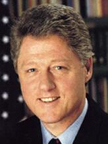 William
Jefferson "Bill" Clinton was the 42nd President
of the United States, serving from 1993 to 2001. Clinton presided
over the period of longest steady growth of the economy in modern
American history. William
Jefferson "Bill" Clinton was the 42nd President
of the United States, serving from 1993 to 2001. Clinton presided
over the period of longest steady growth of the economy in modern
American history.
Clinton's victory came about for several reasons. One of it is
his personal charisma.
Like all but one living former American presidents, Clinton has
engaged in a career as a public speaker on a variety of issues.
He is in high demand and receives very large fees for this, and
his speeches have often been very well received. In these, he continues
to comment on aspects of contemporary politics.
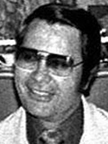 James
Warren "Jim" Jones was the American founder of
the Peoples Temple church that developed into a group with cult-like
beliefs, power structures and practices. On November 18, 1978, most
Peoples Temple members followed Jones' advice to commit mass suicide
by drinking poison in their isolated agricultural intentional community
called Jonestown, located in the jungle of Guyana. Jones was found
dead from a gunshot wound to the head among the 914 corpses there.
The religious scholar Mary McCormick Maaga characterized Jones'
leadership as based on charismatic authority. James
Warren "Jim" Jones was the American founder of
the Peoples Temple church that developed into a group with cult-like
beliefs, power structures and practices. On November 18, 1978, most
Peoples Temple members followed Jones' advice to commit mass suicide
by drinking poison in their isolated agricultural intentional community
called Jonestown, located in the jungle of Guyana. Jones was found
dead from a gunshot wound to the head among the 914 corpses there.
The religious scholar Mary McCormick Maaga characterized Jones'
leadership as based on charismatic authority.
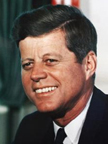 John
Fitzgerald Kennedy (JFK) was the 35th President of the United
States. He served from 1961 until his assassination in 1963. JFK
was generally considered quite charismatic and charming by his political
peers along with the larger public as well. John
Fitzgerald Kennedy (JFK) was the 35th President of the United
States. He served from 1961 until his assassination in 1963. JFK
was generally considered quite charismatic and charming by his political
peers along with the larger public as well.
The charisma of Kennedy and his family led to the figurative designation
of "Camelot" for his administration, credited by his widow
to his affection for the contemporary Broadway musical of the same
name.
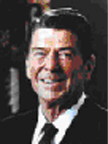 Ronald
Wilson Reagan was the 40th President of the United States
(1981-1989) and the 33rd Governor of California (1967-1975). His
speeches were so expertly delivered and persuasive that the media
dubbed him the "Great Communicator". Reagan had the ability
to express ideas and emotions in an almost personal manner, even
when making a formal address. He honed these skills as an actor,
live television and radio host, and politician, and as president
hired skilled speechwriters who could capture his folksy charm.
Reagan's rhetorical style varied. He used strong, even ideological
language to condemn the Soviet Union and communism, particularly
during his first term. It was perhaps Reagan's humor, especially
his one-liners, that disarmed his opponents and endeared him to
audiences the most. Both opponents and supporters noted his "sunny
optimism" was welcomed by many. Ronald
Wilson Reagan was the 40th President of the United States
(1981-1989) and the 33rd Governor of California (1967-1975). His
speeches were so expertly delivered and persuasive that the media
dubbed him the "Great Communicator". Reagan had the ability
to express ideas and emotions in an almost personal manner, even
when making a formal address. He honed these skills as an actor,
live television and radio host, and politician, and as president
hired skilled speechwriters who could capture his folksy charm.
Reagan's rhetorical style varied. He used strong, even ideological
language to condemn the Soviet Union and communism, particularly
during his first term. It was perhaps Reagan's humor, especially
his one-liners, that disarmed his opponents and endeared him to
audiences the most. Both opponents and supporters noted his "sunny
optimism" was welcomed by many.
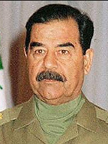 Saddam
Hussein, was the President of Iraq from 1979 until he was
captured by the military of the United States on December 13th,
2003, following the 2003 invasion of Iraq. Conceptualized as malignant
narcissism, this is the personality configuration of the destructive
charismatic who unifies and rallies his downtrodden supporters by
blaming outside enemies. To many arabs, Saddam gets his charisma
and popularity from his strength and his ability to defy his enemies.
Everyone knew about the atrocities he committed in Iraq but still
that would all be forgotten and they'd only see the side of Saddam
that is strong and defiant, the side they loved him for. Many see
Saddam as one who is not willing to let go, who is still confident,
and who can't be broken. And they will be awed by that and will
admire him more. Saddam
Hussein, was the President of Iraq from 1979 until he was
captured by the military of the United States on December 13th,
2003, following the 2003 invasion of Iraq. Conceptualized as malignant
narcissism, this is the personality configuration of the destructive
charismatic who unifies and rallies his downtrodden supporters by
blaming outside enemies. To many arabs, Saddam gets his charisma
and popularity from his strength and his ability to defy his enemies.
Everyone knew about the atrocities he committed in Iraq but still
that would all be forgotten and they'd only see the side of Saddam
that is strong and defiant, the side they loved him for. Many see
Saddam as one who is not willing to let go, who is still confident,
and who can't be broken. And they will be awed by that and will
admire him more.
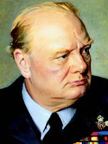 Sir
Winston Leonard Spencer-Churchill, was a British politician,
best known as Prime Minister of the United Kingdom during the Second
World War. Winston Churchill is one of the most well known and successful
leaders of the last century. Churchill had many characteristics
that helped him during his rule. One of it includes his charisma.
His grasp of military strategies meant that he could speak to his
generals and other officials easily and easily construct with them,
at any moment of the war, a careful order of priorities. Churchill
also had great oratory skills. Many authors and inspiring individuals
cite many of his speeches. Churchill could make up speeches at the
spur of the moment, and it is clear that his speeches broke the
crust of the British social class system and brought together citizens
divided by their accent, manners, education and wealth. These characteristics
made many people admire Churchill, and this helped him unite his
country. Sir
Winston Leonard Spencer-Churchill, was a British politician,
best known as Prime Minister of the United Kingdom during the Second
World War. Winston Churchill is one of the most well known and successful
leaders of the last century. Churchill had many characteristics
that helped him during his rule. One of it includes his charisma.
His grasp of military strategies meant that he could speak to his
generals and other officials easily and easily construct with them,
at any moment of the war, a careful order of priorities. Churchill
also had great oratory skills. Many authors and inspiring individuals
cite many of his speeches. Churchill could make up speeches at the
spur of the moment, and it is clear that his speeches broke the
crust of the British social class system and brought together citizens
divided by their accent, manners, education and wealth. These characteristics
made many people admire Churchill, and this helped him unite his
country.
|


 Back to top