 |
||||
 |
 |
 |
 |
 |


PROBLEMS HATSHEPSUT FACED DURING HER REIGN
Hatshepsut, the first female to become Pharaoh of Egypt, began her reign in
1473 B.C. She was the favourite daughter of the pharaoh Tuthmose I and was a
beautiful and charismatic woman.
Her reign was a very successful one. She ruled Egypt for about 15 years, until
she died in 1458 B.C.
However, not all of these 15 years ran smoothly for the queen disguised as a king.
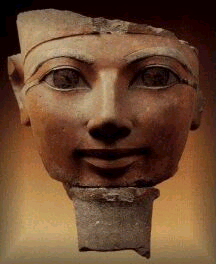
The first in line to the throne was originally Hatshepsut’s half-brother,
Tuthmose II. He died of a skin disease after ruling for about 3 or 4 years.
He had a son with an Egyptian commoner, Iris, who was name Tuthmose III.
Tuthmose III was supposed to succeed his father but he was too young to do so.
Therefore, Hatshepsut took up this role until her nephew was old enough to reign.
The problems started when Tuthmose III became older and was nearing his
ascension to the throne of Egypt. He was often threatening her with warnings
that he would start a revolt, however, Hatshepsut remained on the throne until
she believed that her nephew was old enough.
Another large problem was the population’s view of having a female pharaoh.
They all believed that no one could match the power like that of a strong male
ruler.
To suppress these complaints, Hatshepsut began to present herself as a male.
She wore the customary garb of the male rulers, the shendyt kilt,
the proper names headdress and even the false beard.
She also ordered that anything that was to be built for her have a strong
resemblance to a male, and that any written documents were to note her as a
king, never a queen.
Most other obstacles Hatshepsut faced were easily cleared by her keen political
skills and believable lies.
Unfortunately, the day came when Hatshepsut was forced off her throne and was
replaced by Tuthmose III.
Tuthmose III was a strikingly different ruler to Hatshepsut, and the population
of Egypt did not appreciate it. Tuthmose III was incredibly angry and jealous
that the people belived that Hatshepsut was a better pharaoh than he was, and
he ordered any statues of Hatshepsut to be destroyed, any pictures of her that
had been chiseled into the walls to be covered and most documents containing
her name to be destroyed. Of course, some things were overlooked and therefore
not destroyed.
Hatshepsut may have faced many difficulties in her reign, however, she started
a line of female rulers of Egypt, proving that a woman could rule as
well as any man.
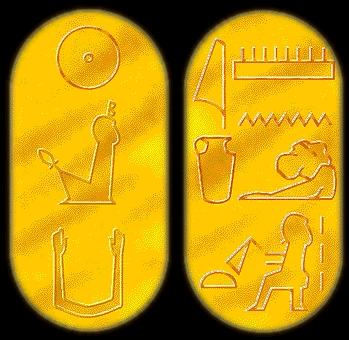
Hatshepsut's Cartouche