 |
||||
 |
 |
 |
 |
 |


HATSHEPSUT'S LIFE STORY
FAMILY
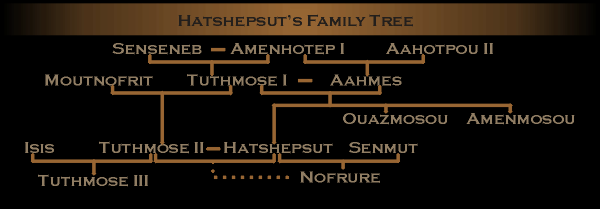
Hatshepsut was the Egyptian daughter of Tuthmose I and Aahmes, a couple both of
royal lineage. She was the favourite of their three children, with two brothers
who both died at a fairly young age. Being the only remaining child of the
royal couple, Hatshepsut was in a unique position to gain the throne when her
father died. When Tuthmose I passed away, his son by the commoner Moutnofrit,
Tuthmose II, was technically next in line to ascend the throne.
It was tradition that royalty married within their own bloodlines, so
Hatshepsut was married to Tuthmose II, her half brother. During the few years
that he ruled, Hatshepsut apparently had a very substantial influence.
Archaeologists believe that Tuthmose II had a skin disease, and he died after
only three or four years as pharaoh.
Hatshepsut and Tuthmose II had produced no offspring. Hatshepsut did have a
daughter, Nefrure, but she was most likely the daughter of her lover, Senmut.
The only son Tuthmose II had was the son
of a commoner named Iris. This son, Tuthmose III, was in line for the throne. It was because of
the young age of Tuthmose III that the co-regency and Hatshepsut’s sole reign occurred.
HATSHEPSUT’S DAUGHTERS
Before she was Pharaoh, Hatshepsut held a title and special job with specific
duties. That was “God’s Wife”. When she became Pharaoh, she had to give up this
job, and she gave it to her daughter Naferura. Up until Neferura’s death at a
young age, Hatshepsut brought her up as a prince. She wore the royal false
beard and the side lock of a youth.
Hatshepsut’s only other known daughter was Marira-Hatshepset, who married
Tuthmose III just before or during his coronation after Tuthmose II died. There
is little that is known about her except that she may have been Amenhotep II’s
mother.
Both daughters were probably the offspring of Senmut, Hatshepsut’s lover – not
Tuthmose II who was her wife when Naferura was born.
BEFORE HER REIGN
Born in Egypt in the 15th century BC, Hatshepsut’s only siblings, two brothers,
died at a fairly early age. Therefore, when her father, Tuthmose I, died,
Hatshepsut was in a unique position to ascend the throne. However, it was both
unprecedented and unheard of for a female to rule as Egypt’s pharaoh, so
Tuthmose I’s son by the commoner Moutnofrit, Tuthmose II, became the technical
heir to the throne.
Because of the Egyptian tradition that the royal bloodline had to be
kept ‘pure’, Hatshepsut married Tuthmose II (Women were the carriers of the
Egyptian royal blood, and males had to marry a female of royal blood to become
Pharaoh). During the few years that Thurmose II ruled, it appears that
Hatshepsut was in control. In 1479 BC, when Tuthmose II died, his only son,
Tuthmose III, was by Iris, a minor wife. This son was too young to rule alone,
and Hatshepsut was appointed his regent.
HATSHEPSUT’S REIGN
Women in Egypt did hold higher status than the women in other cultures at the
time – they could own land, inherit from family members, and even go to court
to defend their rights. Egypt had even had queens who ruled it in the past, but
never had they had a female pharaoh.
In 1473 BC, Hatshepsut ended the co-regency between herself and her stepson,
Tuthmose III, and declared herself pharaoh. She was the fifth ruler of the 18th
Dynasty in Egypt. With the full support of the high priest of Amun, Hapuseneb,
and other officials, she managed the affairs of the nation dressed in men’s
attire.
During her reign, Hatshepsut controlled her country successfully, and cleverly
secured her popularity. She emphasized that she was the favourite child of
Tuthmose I, and claimed that he had handpicked her as his heir. She even laid
claims that she was the biological daughter of Amon, the divine god of the son.
This story is written on her tomb:
Amon took the form of the noble King Tuthmose and found the queen sleeping in
her room. When the pleasant odours that proceeded from him announced his
presence she woke. He gave her his heart and showed himself in his godlike
splendour. When he approached the queen she wept for joy at his strength and
beauty and he gave her his love…
As Tuthmose III grew, he began more and more to resent his lack of authority.
He would not have hinted this openly to Hatshepsut, however, because of the
dangers of such a crime, but it is quite possible that he paid very little
respect to the queen. Hatshepsut died (possibly murdered by Tuthmose III) in
1458 BC.
AFTER HER REIGN
When Hatshepsut died and Tuthmose III ascended the throne as sole ruler, he
ordered that her name be taken from any monument she had built, including her
temple at Deirel-Bahri. Most of her images were males, so the captions were
simply altered to read “Tuthmose” I, II, or III. Senmut’s name was also erased.
Senmut was originally going to be buried in the tomb he designed for
Hatshepsut, but was actually buried in a nearby tomb. His sarcophagus was
completely destroyed a short while after he died, his coffin was found in more
than a thousand pieces, and his mummy was never recovered. Hatshepsut’s mummy
was also stolen and her tomb destroyed. Only one canopic jar was ever found –
it contained her liver.