COMMUNICABLE DISEASES



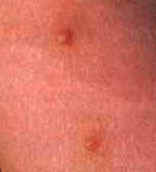
Mumps Measles Chickenpox
Measles also called Rubeola.
An acute, highly contagious, viral disease that occurs foremost in young children who have not been vaccinated.
Transmission: Measles is carried by direct contact with droplets spread from the nose, throat, and mouth of infected patients, usually in the early stage of the disease. Indirect spreading by uninfected persons or by infected articles is unusual.
Symptoms: An inactive period of 7 to 14 days is followed by the beginning stage of the disease. It is marked by fever, discomfort, runny nose, cough, eye irritation, sensitivity to light, and loss of appetite. Diagnosis is based on laboratory tests or on identifying small red spots ('Koplik spots') inside of the cheeks, which appear 1 to 2 days before the appearance of the rash. The temperature may rise to 103o F or 104o F. The rash first appears as irregular brownish-pink spots around the hairline, the ears, and the neck. It spreads rapidly, within 24 to 48 hours, to the body, arms, and legs. The red and dense patches give the skin a blotchy appearance. Within 3 to 5 days, the fever decreases, the spots flatten, turn a brownish color, and begin to fade.
Vaccination: Preventive measures include vaccinating with measles virus vaccine after the child is 9 months of age.
Complications occur sometimes. The most common are middle ear infection (Otitis media), pneumonia, swelling of the bronchial tubes, loss of speech (laryngitis), and, occasionally, brain swelling (encephalitis) and appendicitis.
Chicken pox , herpes zoster virus, Varicella
An acute, highly contagious, communicable viral disease., characterized by clusters of skin eruptions that become vesicular and produce a granular scab.
Causes and Incidence The cause is the Varicella-Zoster virus. Chicken pox is a common childhood illness and occurs mainly in young children., with susceptibility typically extending from 6 months of age to the time the disease is contracted. Epidemics occur in the winter and early spring in 3- to 4-year cycles. Immunity is produced after a course of the disease.
- The virus enters the body by means of direct droplet contact through the respiratory system. The incubation period is 2 to 3 weeks before localized and systemic signs and symptoms appear. The person is considered infectious from the time of exposure until the final lesions crust over. The disease is carried by direct contact with the blisters or by droplets spread from the breathing tract of infected persons, usually in the early stages of the disease. The fluid and scabs from the blisters are infectious until entirely dry .After recovery, the virus is believed to remain in the body in a dormant or latent state in the dorsal root ganglia. Reactivation of the infection in adulthood manifests itself as shingles.
Disease Process
The diagnosis is usually made by physical examination and by the characteristic appearance of the disease.
Symptoms The first signs and symptoms are mild headache, low-grade fever, malaise, and anorexia (loss of appetite), which occur about 24 to 36 hours before the first rash appears. The initial rash, which is maculopapular (blister like eruptions) , appears in crops on the head and mucous membranes and evolves within hours to itching, teardrop-shaped vesicles containing a clear fluid. The vesicles break and crust over within 6 to 8 hours. New lesions erupt in successive crops on the trunk and in sparse sprinkles on the extremities. The acute phase of the disease lasts 4 to 7 days, and new lesions seldom appear after the fifth day. All lesions are generally healed in 2 to 3 weeks..
Blister characteristics:. The rash begins as flat red spots and develops in a day or two to raised bumps. Finally, it leads to blisters surrounding a reddened base and containing clear fluid. Within 24 to 48 hours the blisters turn cloudy. They are easily broken, and become encrusted. They erupt in crops so that all three stages are present at the same time. They appear first on the back and chest; spread to the face, neck, and limbs; and occur only rarely on the soles and palms. In severe cases, blisters in the throat may cause breathing difficulty and pain with swallowing.
The early period is usually mild in children. It may be severe in adultss)
One attack of the disease gives permanent immunity. However, herpes zoster virus (HZV), like all herpes viruses, lies dormant in certain sensory nerve roots following a main infection. The virus is sometimes reactivated later in life (usually after age 50), with the eruption following the path of a nerve on the trunk, face, or limbs.
Chicken pox in childhood is usually benign. Few cases need hospitalization. It may be serious or fatal in people with less resistance, as those getting chemotherapy or radiotherapy for cancer.
Common complications are secondary bacterial infections, as abscesses, pneumonia. Hemorrhagic Varicella (tiny hemorrhages that may occur in the vesicles or surrounding skin) is another complication. Less common complications are swelling of the brain (encephalitis), blood disorders, and liver disease (hepatitis). Scratching of the lesions may cause scarring and disfigurement
Mumps
An acute, contagious viral disease characterized by a swelling of the salivary glands near the neck. It is most likely to affect children between 5 and 15 years of age. However, it may occur at any age. In adulthood the infection may be severe.
Antibodies from the mother usually prevent this disease in children under 1 year of age.
Mumps is most contagious during the late winter and early spring.
The mumps virus lives in the saliva of the affected patient . The disease is spread by droplet or direct contact with infected saliva. It is most communicable immediately before and during the glandular swelling.
Permanent immunity occurs after infection
The symptoms of mumps usually last for about 24 hours. Onset begins with loss of appetite, headache, discomfort, and light fever about 24 hours before swelling of the gland or glands. These signs are followed by earache, saliva gland swelling, and a temperature of 101o to 104o F (38.3o to 40o C). The patient feels pain when drinking sour liquids or when chewing. The saliva glands may become swollen. The glands remain swollen about 72 hours before receding.
Potential Complications The chance for recovery from mumps is good. However, the disease sometimes involves complications, such as arthritis, and inflammation of the pancreas, heart muscle, ovary, and kidney. About one-half of the men with swelling of the testicles suffer some damage to the testicles. Sterility rarely results.
Vaccination within 24 hours of being exposed to the disease may halt the spread of the disease to others or may reduce its effects.
Hepatitis A
also called Acute infective hepatitis. A form of infectious hepatitis caused by the hepatitis A virus, and having slow onset of signs and symptoms. The virus may be spread by direct contact or through fecal-infected food or water.
Hepatitis B
also called Serum hepatitis. A form of hepatitis caused by the hepatitis B virus and having rapid onset of sudden symptoms and signs. The virus can be carried in blood products used for transfusion or by the use of un sterile needles and instruments. The infection may be severe and result in prolonged illness, destruction of liver cells, cirrhosis, or death.
Influenza
An acute viral respiratory disease with clinical manifestations that often resemble a severe form of the common cold.
A highly contagious infection, usually of the lungs, caused by a virus and transmitted by airborne particles. Symptoms include sore throat, cough, fever, muscular pains, and weakness. The incubation period is brief (from 1 to 3 days), and the onset is usually sudden, with chills, fever, and general discomfort. Complete recovery in from 3 to 10 days is the rule. However, bacterial pneumonia may occur among high-risk patients, as the elderly, the very young, and people who have chronic diseases of the lungs. Yearly vaccination with the currently prevalent strain of influenza virus is recommended for elderly or debilitated persons.
Haemophilus influenzae
a bacterium found in the throats of 30% of healthy, normal people. In children and in weak older people, harmful swelling of the throat and lungs may result from infection. It can affect the heart or brain.
Tetanus (Lock jaw)
An acute infectious disease of the central nervous system characterized by tonic spasms (contractions) of the muscles.
Tetanus is caused by the tetanospasmin exotoxin produced by the spore-forming Clostridium tetani bacillus. The toxin is a neurotoxin and is one of the most lethal poisons known .The bacillus is a common resident of the superficial layers of the soil. It is a normal inhabitant of the intestinal tracts of cows and horses. Therefore, barnyards and fields fertilized with manure are heavily contaminated .The bacillus may come into the body through a puncture wound, abrasion, cut, or burn, through a wound contaminated with soil and feces containing viable spores .It also may come into the body via the uterus, into the bloodstream in abortion or afterbirth contamination (sepsis), or through the stump of the umbilical cord of the newborn. . C. tetani infects only wounds that contain dead tissue. . The dead tissue of the area is low in oxygen. This is the environment essential for the replication of C. tetani.
Disease Process The bacillus spores enter and multiply in a skin wound to produce the tetanospasmin toxin. The toxin travels to the central nervous system via the bloodstream and peripheral motor nerves and induces a hyper excitability in the motor neurons (nerve cells) that results in tonic rigidity and spasms of the muscles. Once bound, the toxin cannot be neutralized by an antitoxin.
Symptoms The incubation period ranges from 2 to 50 days, with an average of 5 to 10 days before symptoms occur. The most common symptom is stiffness of the jaw. Others include irritability, restlessness, headache, fever, sore throat, stiff neck, and difficulty swallowing. As the disease progresses, the person has difficulty opening the mouth, facial spasms, and rigidity with a fixed grin; painful, generalized tonic spasms; profuse sweating; Eventually every muscle of the body is in continuous spasm
Potential Complications:
The worldwide mortality (death) rate is 50%, Complications include cardiac and pulmonary failure and muscle rupture. Wounds of the face, head, and neck are the ones most likely to result in fatal infection, because the bacillus may travel rapidly to the brain.
Prompt and thorough cleansing and removal of foreign bodies from the wound are necessary for prevention.
A booster shot of tetanus toxoid is given to previously vaccinated people. Tetanus immune globulin and a series of three injections of tetanus toxoid are given to those not vaccinated.
People who are known to have been adequately immunized within 5 years do not usually need vaccination.
Diphtheria
a serious, contagious disease, it produces a poison throughout the body and a false membrane lining of the throat. It is caused by the bacteria-Corynebacterium Diphtheriae
Transmission is by direct contact with an infected person, carrier, or contaminated articles or surfaces, particularly in crowded and poorly maintained environments.
The poison is very harmful to the tissues of the heart and central nervous system. The thick membrane lining the throat may interfere with eating, drinking, and breathing. The membrane may also occur in other body tissues. Lymph glands in the neck swell. If not treated, the disease is often fatal, causing heart and kidney failure. Patients are usually put in the hospital in isolated rooms.
Immunization against diphtheria is available.
Whooping cough (Pertussis)
s caused by Bordetella pertussis, bacillus. It is usually transmitted through aspiration of droplet spray produced by an infected individual during paroxysms (attacks of cough). It occurs in all age groups, but infants and toddlers are the most susceptible.
i
Disease Process When inhaled, B. pertussis attaches itself to the cilia of the respiratory epithelial cells and incubates for about 7 to 10 days before producing symptoms. The Pertussis toxin is absorbed from the respiratory tract into the lymph system, causing a lymphocytosis. T
Symptoms Pertussis has three stages, each lasting about 2 weeks. The individual is contagious from the onset of the first symptom until the end of the second stage or until the patient is treated with antibiotics.
Paroxysmal stage: Exhausting paroxysms of prolonged coughing two to three times an hour, that often end with an inspiratory whooping sound or choking and vomiting accompanied by production of copious, viscid, tenacious mucus with cyanosis (blueness of face) and apnea (no breathing spells)
Potential Complications: Complications most commonly occur in infants and very young children; they include bronchopneumonia, asphyxiation, convulsions, and cerebral hemorrhage, with resultant spastic paralysis and mental retardation.
Poliomyelitis
An acute, communicable viral infection that affects the central nervous system, producing a range of manifestations from a sub clinical or mild nonfebrile illness to aseptic meningitis, muscle weakness, and paralysis.
Disease Process: The polio virus enters the mouth after contact with infected feces or oral or respiratory secretions. It multiplies in the lymphoid tissue of the throat and small intestine. The incubation period ranges from 5 to 35 days, averaging 7 to 14 days.
Symptoms: Most cases are sub clinical and produce no signs or symptoms. Clinical disease may be either minor (abortive) or major. Major illness may lead to paralysis. The person is infectious from the time of infection up to 6 weeks after infection.