|
|

|
HELPING TO PROTECT THE FUTURE
|
|
| Welcome to Help A Whale |
Spouting occurs when the whale surfaces
and clears water from its blowhole along with any moisture trapped in
its air passages. The shape of the spout is characteristic of each type
of large whale. Whales have small eyes, designed to withstand great pressures,
and most species have good vision. Their hearing is also excellent. Many
cetaceans have highly convoluted brains larger than those of humans, and
whales are believed to be extremely intelligent.Most large whales travel
in small schools, or pods, but some, like the fin whale, swim alone or
in pairs; small cetaceans form schools of up to several thousand individuals.
Most large whales are found in open ocean, where they migrate thousands
of miles between feeding and breeding grounds. Dolphins frequently live
in coastal waters. A few dolphin species are found in tropical rivers.
Females of most species give birth to a single calf every two to three years.
Gestation periods range from 9.5 to 17 months. The newborn calf is pushed
to the surface by the mother or by another adult; it is able to swim almost
immediately and is nursed for 6 to 12 months. Some large whales are believed
to have lived 100 years or more in the wild.
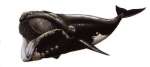
Types of Whales: There are two major groups of whales–the
toothed whales (suborder Odontoceti) and the toothless baleen whales
(suborder Mysticeti).
|
|
This site is dedicated to saving the world's
whales.
|
|