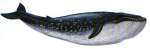
Facts
Despite what many people think, whales and dolphins
do not mate for life.
The only natural predator of humpback
whales is the killer whale (orcas), and possibly sharks to very young
calves or badly injured whales. Up to 15% of humpback whales in an area
may have scars from orca attacks that they have escaped.
The sperm whale is distinctive from baleen
whales because it has a single blowhole on the left side of its body.
It spouts in a forward left direction.
Fin whales can move quickly over large
distances. In 1980, one fin whale was radio tracked covering a straight-line
distance of over 1,000 miles in five days as it moved from the coast of
Iceland to the coast of East Greenland.
A blue whale calf can swim 22 mph.
Wild hybrid whales have been found several
times. Whalers have described several blue/fin whale hybrids, and researchers
working off of Fiji believe they photographed a hybrid humpback/blue whale!
Gray whales spend the winter in shallow
enclosed lagoons on the western side of Baja California. The sheltered,
calm waters aid in survival of young calves; evaporation from warm temperatures
helps increase the saltiness of the lagoons, helping young calves float
more easily; and the strong currents allow the calf to develop strength
for the long migration to the arctic.
Resident killer whale pods are the only
mammalian species where female and male offspring stay with their mother
throughout their entire lives.
Dolphins, commonly thought to be warm
water animals, are found in all of the worlds oceans including the polar
regions (not all species).
Humpback whales form small, generally
cooperative, groups on their feeding grounds. On their breeding grounds,
however, males sometimes form large groups where they battle for the position
next to the female, often physically striking each other violently.
Over 50% of Northern right whales and
New England humpback whales have scars from prior fishing gear entanglements.
The latin name for the blue whale is
Balenoptera musculus. "Musculus" means "winged mouse." Linnaeus
himself, developer of the biological classification system, named it in 1758,
as a joke.
Fin whales are one of the fastest whales,
and can hit top speeds of over 35 miles per hour! They use this speed
to burst into their prey, usually fish schools, and capture the unsuspecting
fish in large numbers. They usually travel at 4 to 7 miles per hour.
A blue whale calf drinks about 130 gallons
of milk per day, and gains up to 200 pounds per day during periods of
its nursing period.
Sperm whales use their sonar to identify
and capture prey. They also use it to stun their prey.
A brand new species of beaked whale has
recently been discovered.
The vaquita, a relative of the harbor
porpoise found in the Sea of Cortez, is commonly regarded as the smallest
cetacean in the world with a length of only 4 feet.
Humpback whales have the longest migration
of any known mammal. A population that feeds off the Antarctic Peninsula
has now been found to breed off Columbia, just north of the equator. This
is a one-way migration of over 5,000 miles.
Some freshwater dolphins are blind and
only use their sonar to "see".
Right whales are identified by using their
callosity pattern which contains rough skin, barnacles, and whale lice.
The killer whale is the largest member
of the dolphin family, attaining lengths of 35 feet.
A 160 ton blue whale is equal in weight
to 30 bull elephants, or 1830 adult humans weighing 175 pounds each.
Sperm whales form strong kinship bonds
with the other members of the pod. Mass strandings are often caused when
the head female becomes sick and strands. The others follow her, because
they are accustomed to following what she does.
Although some people think humpback whales
feed only on krill (small, shrimp-like crustaceans), they are primarily
fish feeders in most of their range, such as in our area. They do feed
on krill in Antarctic waters, where much of the early feeding studies were
done.
Some dolphin species have been seen to
beach themselves on purpose to go after prey (killer whale and bottlenose
dolphin).
A blue whale produces the loudest and
the lowest sound of any animal:180 dB and 10 - 20 Hz.
Southern right whales have been seen to
raise their flukes in the wind and use them as sails.
Sperm whales can potentially live to 60
or 70 years of age. Males reach their physical maturity at 45, while females
reach maturity at age 30.
Many toothed whales are believed to use
their sonar capabilities to stun their prey with a "sonic pulse".
A blue whale's eye is the size of a small
teacup and their external ear is the size of the tip of a pencil.
Gray whales, migrants along the west coast
of North America, are able to swim in water as shallow as 6 feet!
|