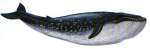
"Smiling" dolphins, "mysterious"
blue whales, "playful" killer whales - whales capture our imagination.
We give them all sorts of human traits and ascribe thoughts and ideas to
their behavior that are of our own making. We seldom allow them to
just be animals, mammals adapted to life at sea. Like all mammals,
they breathe air with lungs, have hair, bear live young, nurse with
milk from mammary glands, and maintain a constant, warm internal body
temperature. The cetaceans - toothed and baleen whales - evolved from land
mammals millions of years ago and have unique solutions to the problems
of mammals living in the sea.
Cetaceans are generally found in the ocean.
The larger whales may venture into cold polar waters, while most dolphins
and porpoises frequent warmer water. Four kinds of dolphins live
in fresh water in large tropical rivers like the Amazon.
Feeding: Whales are carnivores (meat-eaters)
that eat small animals in relation to their own size. The toothed
whales include the dolphins and porpoises, beaked whales, pilot whales,
beluga whales, narwhals, orcas, and one large whale, the sperm whale. Most
feed on schooling fish and squid which they catch with sharp, cone-shaped
teeth. The orca or killer whale eats larger fish and, occasionally,
small marine mammals such as seals. Another small whale, the beluga,
catches crustaceans and molluscs. The teeth are used by these whales
mainly for gripping their prey rather than chewing it. In fact, some of these
whales actually have very worn down teeth or no teeth at all and
are still able to feed.
The baleen whales are among the largest
animals ever to live, yet they feed on small prey which they capture
in great amounts with a unique feeding structure called baleen. Baleen
is a flexible, fringed comb made of the protein keratin. Hair, whiskers, claws,
and hooves are also made of keratin. Hundred of plates of baleen
hang in rows from the whale's upper jaw with a hard edge facing out
and a fringed side facing in.
There are three different ways baleen is
used. Bowhead and right whales swim constantly with their mouths open.
Tiny animals called zooplankton are caught on hairs on the baleen
as the water flows between the sheets and out the corners of the jaw. These
animals function as giant plankton nets. They can be recognized by
their "upside down smile."
The second group of baleen whales captures
larger zooplankton, including shrimp-like krill and small schooling
fish, by engulfing a great mouthful of water and straining out the
food, again trapping their prey on the hairs of the baleen. Since the prey
is larger, the hairs are coarse. The great blue whale, the fin whale
and the humpback are in this group. They can be recognized by the
"pleats" on their throat which allow it to balloon when they engulf
a mouthful of water and prey.
A third strategy using baleen is employed
by the gray whale which swims along the bottom on its side scooping
up and straining out animals living on or near the bottom. It has
short, very coarse baleen.
Insulation: It is hard to maintain
a warm internal temperature while living in cooling water. Whales
have a heavy insulating layer of fat below the skin called blubber
and eat large amounts of food for energy. Some whales such as bottlenose
dolphins avoid very cold waters, but others like the beluga live year
round in cold polar waters.
Blubber is also useful as stored food energy.
Whales can store energy in the form of fat when food is plentiful
and live off their blubber when food is scarce.
Breathing: Although they all must
surface to breathe air, some whales can dive deeper and stay down
longer than others. For example, sperm whales dive up to an hour to
depths of 1000 meters or more while dolphins generally stay closer to the
surface. During diving a reflex response causes the heart rate to
slow and shuts off blood flow to the muscles, saving oxygen-rich blood
for the brain and heart. While underwater, whales may build up an
"oxygen debt" by producing energy in their muscles without using
oxygen. When they come up, they remain at the surface for a bit to repay
this debt.
Baleen whales have two "nostrils" in their
blowhole. Toothed whales have only one opening. Unlike people, whales
are voluntary breathers; the blowhole stays closed unless the whale
actively opens it.
Swimming: Dolphins, porpoises and
whales have lost their hind limbs and have tail fins called flukes
that are horizontally flattened. As their tail moves up and down,
the animals are pushed through the water. Their flippers steer and stabilize.
A streamlined shape helps them slip through the water.
Hearing: Whales live in a dark and
murky world. Many toothed whales have systems of echolocation or
sonar which can locate food or obstacles. Dolphins and porpoises are
particularly adept at echolocation. They emit a series of clicks which
are focused by the rounded melon on their head. The clicks travel
out, hit and bounce back from animals and objects in their path such
as other dolphins, potential prey, and irregularities. A good deal
of dolphin and porpoise brains is devoted to processing information about
sound.
In the darkness of the sea, sound is also
used for communication with other members of the same species. The
songs of humpback whales, the low pitched boom of blue whales, the
chirps and trills of the beluga and the whistles of dolphins are all means
of cetacean communication. The very low-pitched sounds of the blue
whales may travel hundreds of miles through the water.
The great splashes whales make when they
breach (leap up out of the water) make loud sounds that carry for
many miles and may also be a form of communication; perhaps the message
is "a whale goes here."
Seeing: Cetaceans can see in air
as well as in water. No one is certain how good their vision is, but
dolphins can catch small objects thrown to them with ease. Many whales
stick their heads out of water and appear to be taking a look around. The
behavior is called spyhopping.
Reproducing: Whales normally have
one offspring per year or every other year. They bear their young
in the water. While dolphins typically stay in warmer waters, many
whales migrate from cold feeding grounds to warmer seas so that their offspring
can start life in warm water. Newborn calves lack a thick blubber
layer and can not keep warm as easily as adults.
Whale calves nurse on very rich milk squirted
from nipples hidden within a slit in the mother's belly. The rich
milk helps develop an insulating layer of blubber. Because the babies
may be attacked by sharks or killer whales, many of the whales appear to cooperate
in the protecton of their young. Some live in a small group called
a pod. Many smaller oceanic species live in large schools.