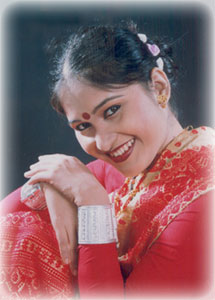


Join heikrujam_online - A group of young girls and boys. Are you new to our group? Please sign up now
Click here and complete the form. Send Demand Draft for Rs.150/- favouring H. Sanatombi Devi, payable at Guwahati, as the processing fee. Your membership will be confirmed, just after we receive your demand draft Address: Heikrujam_Online, C/o. Bipul Chandra Deori, Ganeshguri Kachari Basti, Backside of Hotel Ambarish, Guwahati - 781005
Our URL: www.geocities.com/heikrujam_online Email: [email protected] Cell: 098640-75846
Silk - The Queen of Textiles - S.S. Heikrujam
Silk, which is known as "Queen of Textiles" with its unique fineness, lustre, elgance and strength, has been the favourite for fashion designers all over the world. Its usefulness and excellent qualities have made it a popular textile fibre and maintained its unique position in the world of Textile Industry. Silk fabric is non-allergic, very absorbent, hygienic and has superior properties of comfortable wear. There are four types of silk - "Muga - The King of Silk", "Eri - The Eco-friendly Silk", "Mulberrry Silk" and "Tasar Silk".
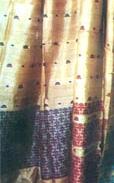
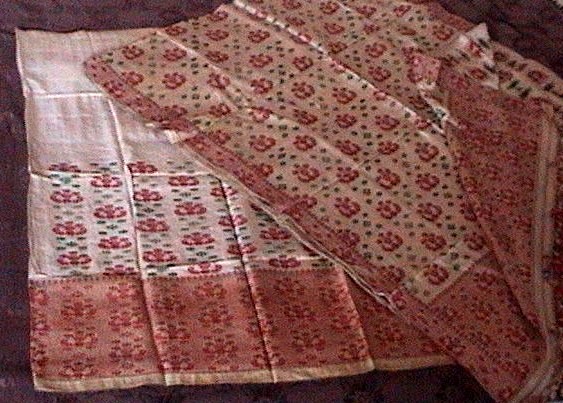
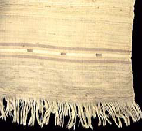
"Muga - the king of Silk" has a pleasing golden colour in its original form. The shining of the Muga fabrics increases with every wash and it never decays with time. It is the most durable silk among the other textile products. Muga fabrics are comfortable in both summer and winter wear.
Products: Sarees, Mekhela Chadars, Dress materials, Ties, Scarves, Furnishing materials, Curtains, Wall hangings etc. Apart from making dress materials, Muga silk can also used in manufacturing of aircraft tyre, fishing nets, ropes used in docks and parachute etc..
What are the exceptional qualities of muga silk fabrics ?
It is eco-friendly as no dyes & chemicals are used in its production to retain the natural golden colour.
 ..
.. 
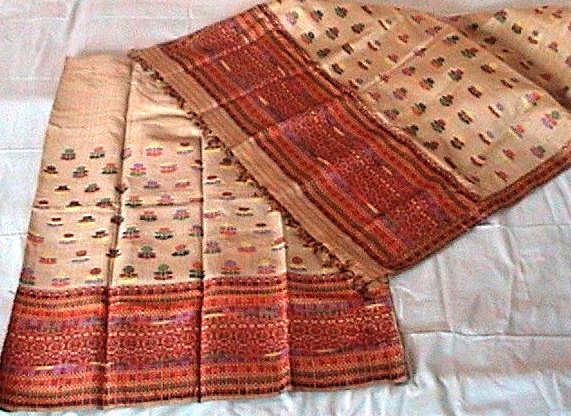
We deal in quality natural silk fabrics and yarn. For price list and catalogue, please write us at [email protected]
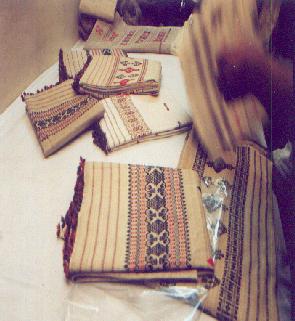
The eco-friendly Eri Silk - drawn without killing the pupa is a fibre made from ERI silk cocoons. It is used for making of winter garments. Its durability is more than world's finest cotton. It has natural off white colour and also can be dyed. It is the only silk which is drawn without killing the pupa and hence qualifies as most eco-friendly among silk. Products: Shawls, Jackets, Dress Materials, Wall hangings etc. It has the finish of wool, the look of cotton and the softness of silk. Textiles woven with this Eri silk have strength, durability, less wrinkle and greater elasticity. Eri silk has specific thermal property which makes its alternative fibre to wool. Product range are from dress material to quilt to winter cloth to furnishing etc.
Sericultural Practice - [Mulberry Silk]
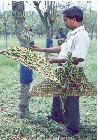
Sericulture or the raising of silkworms, involves the incubation of the tiny eggs of the silkworm moth until they hatch and become worms. In case of mulberry - after hatching the silkworms are placed under a layer of gauze feeding with finely chopped mulberry leaves, almost continuously for six weeks. At the end of this period, they are ready to spin their cocoons, and branches of trees or shrubs are placed in their rearing houses. The worms climb these branches and make their cocoons in one continuous thread, taking about eight days for the process. The silkworm secretes a filament, which it wraps around itself. Inside this cocoon it changes into a pupa. A moth emerges after 10 to 12 days, mates, and lays its eggs.


Copyright © 2004 heikrujam_online All Rights Reserved. Go to Top Back Home