|
|
|
 |
 |
 |
 |
 |
 |
 |
 |
 |
|
|
 |
 |
 |
 |
 |
 |
 |
 |
 |
 |
 |
 |
 |

|
 |
 |

|




|
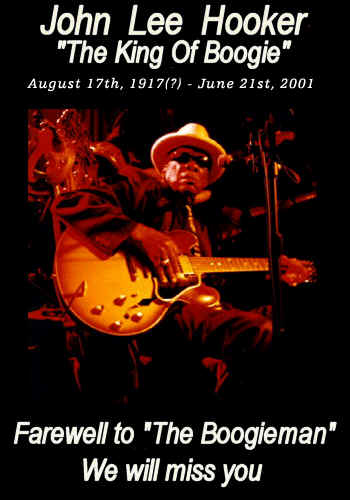
"THE FATHER OF THE BOOGIE" JOHN LEE HOOKER 1915-2001 I'M
LEAVING BABY By his own count, Hooker had recorded over seven decades in a career that yielded 100 plus albums. Like many postwar bluesmen, Hooker got cheated by one fly-by-night record producer after another, who demanded exclusivity or didn't pay. Hooker fought back by recording with rival producers under a slew of different names: Texas Slim, John Lee Booker, John Lee Cocker, Delta John, Birmingham Sam and the Boogie Man, among others. Through it all, Hooker's music remained hypnotic and unchanged - his rich and sonorous voice, full of ancient hurt, coupled with a brooding, rhythmic guitar. He sang of loneliness and confusion. Neither polished nor urbane, his music was raw, primal emotion. ``There are no superlatives to describe the profound impact John Lee left in our hearts,'' musician Carlos Santana said in a statement Thursday. ``When I was a child he was the first circus I wanted to run away with.'' ``He just kept going. .... He wanted to keep working,'' said John Wooler, senior vice president at Virgin Records America and president of Point Blank Records, Hooker's label. ``He was planning to do a new record, but he hadn't started.'' His distinctive sound influenced rock 'n' rollers as well as rhythm and blues musicians. Among those whose music drew heavily on Hooker's style are Van Morrison, the Rolling Stones, Eric Clapton, Bruce Springsteen, Bonnie Raitt and ZZ Top. In 1961, the then-unknown Rolling Stones opened for him on a European tour; he also shared a bill that year with Bob Dylan at a club in New York. Even in the '90s, when his fame was sealed and he was widely recognized as one of the grandfathers of pop music, Hooker remained a little in awe of his own success, telling The Times of London, ``People say I'm a genius but I don't know about that.'' Like many postwar bluesmen, Hooker got cheated by one fly-by-night record producer after another, who demanded exclusivity or didn't pay. Hooker fought back by recording with rival producers under a slew of different names: Texas Slim, John Lee Booker, John Lee Cocker, Delta John, Birmingham Sam and the Boogie Man, among others. Hooker's popularity grew steadily as he rode the wave of rock in the '50s into the folk boom of the '60s. In 1980, he played a street musician in ``The Blues Brothers'' movie. In 1985, his songs were used in Steven Spielberg's film, ``The Color Purple. Hooker hit it big again in 1990 with his album ``The Healer,'' featuring duets with Santana, Raitt and Robert Cray. It sold 1.5 million copies and won him his first Grammy Award, for a duet with Raitt on ``I'm in the Mood.'' Several more albums followed, including one recorded to celebrate his 75th birthday, titled ``Chill Out.'' ``For musicians and common people - all of us feel enormous gratitude, respect, admiration and love for his spirit,'' Santana said in the statement. ``Working with him on 'The 'Healer,' 'Chill Out' and also playing live on the blues festivals is something that I will deeply treasure." Wooler got to know Hooker over the past decade through the album label and said the blues master was a ``very humble, sweet man, always in good spirits.''
the As a youngster Hooker initially turned his attention to religious music. "I first started up on spirituals when I was about 13 years old," he recalled. "I did that for five or six years, playing and singing spirituals, but I switched from spirituals to blues. You take spirituals and blues - maybe I'm wrong but I think I'm right: the blues come from spirituals. They are the background of all [black American] music. They use the same patterns. I really don't know why I switched. Gosh, I just had a lot of soul for the blues, could express myself better and tell my story and hard times of different peoples and myself and the things that you come through - trials and tribulations. Blues can express it better." He had begun playing guitar shortly before taking up spiritual singing, inspired by the playing of his stepfather. He credits him with setting him on the musical path he has followed since for, as he has observed on numerous occasions, "My style come from my stepfather. The style I'm playing now, that's what he was playing." When he was quite young, Hooker's parents had separated, and some time later his mother married Will Moore, who worked his own farm and frequently performed blues in the countryside around Clarksdale. He occasionally performed with Charley Patton when the celebrated Delta Bluesman periodically left his home base at Dockery's Plantation to play in Clarksdale area. "Hooker remembers Moore playing Patton tunes like Pony Blues around the house," observed Robert Palmer in his Deep Blues, "but Moore had grown up in Shreveport, Louisiana, and the brand of blues he'd learned there was very different from what was current in the Delta. It was basically hypnotic, one-chord drone blues, with darkly insistent vamping, violent treble-string punctuations, and songs that fitted both traditional and improvised lyrics into a loose, chant like structure ... Robert Pete Williams and other Louisiana country bluesmen have recorded in a somewhat comparable style, but Hooker's guitar playing really doesn't sound like anyone else's. His heavy, dramatic vocals are more recognizably in the Delta mold; he, sometimes sounds a little like Muddy Waters, who considers him one of the deepest of blues singers and, like Muddy, he was a regular churchgoer from childhood through his early teens." In addition, Hooker learned more from several local performers - singer-guitarist James Smith and Coot Harris - and his interest in the blues was fanned even higher through contact with several legendary bluesmen whose recordings he had heard on the family's wind-up phonograph. "I saw Blind Lemon Jefferson one time when I was about nine years old," he recalled vividly several decades after the event. "He came to our house to see my stepfather. Gosh, he was a great guitar player, Blind Lemon was. Blind Lemon, Blind Blake, Charley Patton - I remember those three. They used to come to my stepfather's [house] because he was a musician. But at that time, at that age, I wasn't playing anything then. But I remember seeing them. Still, my soul was in it at that age. I said [to myself] that if I ever got of age, I'd do this, and I did - I mean my whole heart, soul was in that [the blues] and nothing else." Until he learned more about the instrument, Hooker largely followed in his stepfather's footsteps. "I was doing what my stepfather did," he told me, "because I knowed what he did at that time. And he taught me what he knowed, and I loved what he did, so I just went that way." Hooker hit the road to perform by the age of 14. He worked odd jobs by day and played small bars at night in Memphis, Tenn., then Cincinnati and finally Detroit in 1943. In Detroit, he was discovered and recorded his first hit, ``Boogie Chillen,'' in 1948. ``I don't know what a genius is,'' he told the London newspaper. ``I know there ain't no one ever sound like me, except maybe my stepfather. You hear all the kids trying to play like B.B. (King), and they ain't going to because, ooh, he's such a fine player and a very great man. But you never hear them even try and sound like John Lee Hooker.''
``All these years, I ain't done nothin' different,'' he added.
``I been doing the same things as in my younger days, when I was
coming up, and now here I am, an old man, up there in the charts.
And I say, well, what happened? Have they just thought up the
real John Lee Hooker, is that it? And I think, well, I won't tell
nobody else! I can't help but wonder what happened.'' Mostly, though, he hung out with friends and family at his homes in Los Altos and Long Beach, watching baseball and enjoying a fleet of expensive cars.
May You Rest in Peace Boogieman |
 John
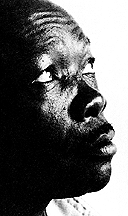
Lee Hooker was born August 22, 1915 - at various times he's also
given the year 1917 and 1920 - one of 11 children born to a
sharecropping family in Coahoma County, near Clarksdale, in the
very heart of the Mississippi Delta bottomlands that have given us
so many superb blues singers. "Mississippi produced the best
blues singers out of all the states," he has observed.
"It's been discussed a million times as to why, but I really
can't explain it. Take Muddy [Waters] and Jimmy Reed, and there's
Arthur Crudup, and you've heard of Robert Nighthawk - all great.
But as for me, there's nobody that plays my style. Some of them
tries but they're not even close to it. So many singers sound
alike - when you heard one, you done heard 'em all. So why am I
different? Can't explain it, cant explain."
John
Lee Hooker was born August 22, 1915 - at various times he's also
given the year 1917 and 1920 - one of 11 children born to a
sharecropping family in Coahoma County, near Clarksdale, in the
very heart of the Mississippi Delta bottomlands that have given us
so many superb blues singers. "Mississippi produced the best
blues singers out of all the states," he has observed.
"It's been discussed a million times as to why, but I really
can't explain it. Take Muddy [Waters] and Jimmy Reed, and there's
Arthur Crudup, and you've heard of Robert Nighthawk - all great.
But as for me, there's nobody that plays my style. Some of them
tries but they're not even close to it. So many singers sound
alike - when you heard one, you done heard 'em all. So why am I
different? Can't explain it, cant explain."