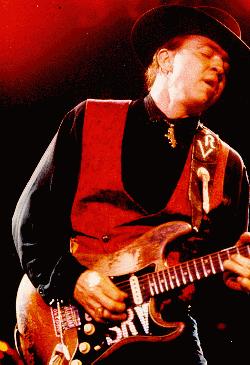
It was a hot night in southern Wisconsin.
Hundreds of sopping-wet bodies, miserable from the sticky air, crammed even
closer together near the bug-swarmed stage to get a better look at the action.
The date was August 26, 1990, and Stevie Ray Vaughan was claiming his place in
history as he stood alongside Eric Clapton, Buddy Guy, Robert Cray, and his
brother Jimmie Vaughan at Alpine Valley Music Theatre in East Troy. Despite
the suffocating night and a very sore throat, Stevie Ray never felt
better.
Thirty-five thousand souls sat there in the dark, eyes all focused on
Stevie as he blasted into a guitar solo. His right hand fanned the frets of
that old tattered Stratocaster so quickly, the rings on his fingers shone in
the lights. His whole body was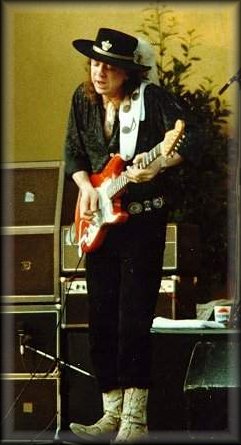 caught up in the throes of performance--a blur
to the crowd, he resembled a purple tornado against a dusty Texas sky. He
stopped playing for a moment and barked at the crowd between some
teeth-gnashing grace notes. Then he was back at it, totally in rapture. It was
as if something otherworldly was playing his guitar that night, as if some
force were bending the notes toward a melody it wanted to hear. But the melody
was like nothing he had ever played before. It was unbelievable--it sounded
like some manic metallic shit, bleeding, eating through the amplifier like a
hungry monster. It surprised even Stevie, and all around him. caught up in the throes of performance--a blur
to the crowd, he resembled a purple tornado against a dusty Texas sky. He
stopped playing for a moment and barked at the crowd between some
teeth-gnashing grace notes. Then he was back at it, totally in rapture. It was
as if something otherworldly was playing his guitar that night, as if some
force were bending the notes toward a melody it wanted to hear. But the melody
was like nothing he had ever played before. It was unbelievable--it sounded
like some manic metallic shit, bleeding, eating through the amplifier like a
hungry monster. It surprised even Stevie, and all around him.
He performed that night as he always had, as
if the song of the moment would be his last. During the blistering, all-star
jam on Robert Johnson's “Sweet Home Chicago,” it seemed as if the blues had
made a full circle. Johnson's troubled spirit was reincarnated in Stevie, who
stood toe-to-toe with the white god of electric blues himself, next to the
young savior of rhythm and blues, and shoulder-to-shoulder with Middy's longest-lasting right-hand man. No moment this glorious could last very long,
but the four musicians played on.
The song had nearly stretched out for twenty
minutes, and everybody had taken a solo. They were just vamping and looking
for a way to end it, not wanting to take it home yet. Then Stevie just erupted
and took another solo. It was passionate, ingenious, and LOUD. When he
finished, he looked over at Clapton. Eric knew he couldn't top it, shrugged
his shoulders, forced a weak smile, and brought the tune to a close. They all
joined hands, taking bows and hugging each other for the longest time before
they left the stage. Stevie was the last one off, as usual. He took one final
bow, tipped his hat to the crowd and exited stage left. It would be Stevie`s
last stand.
On the
stage of Alpine Valley Music Theatre, Stevie Ray Vaughan had played an
incredible set with his own band, Double Trouble, earlier in the evening. He
was cleaner, sharper, and more energetic than ever. He played like his soul
was on fire, ripping through “Texas Flood” with reckless abandon, bending and
twisting his guitar in every configuration.
During “Pride And Joy,” Stevie tipped his hat
generously to his hero, Buddy Guy. Like several nights before, Buddy was
standing on the wings of the stage, watching Stevie teach a new generation
about songs like “Leave My Little Girl Alone,” “Mary Had A Little Lamb,” and
“Let Me Love You Baby,” all once minor, obscure hits for him in the
mid-sixties. But now, Vaughan's recorded versions had made them instant
contemporary blues classics. For the first time in his 30-year career,
Buddy
Guy was receiving royalty checks and had Stevie to thank for it. “You tell `em
kid!” Buddy thought to himself, breaking into a huge grin. He looked up to
find Stevie staring right at him through the bright lights, as if he knew what
Buddy was thinking. Stevie smiled and winked, then strutted away.
Robert Cray, still wiping the sweat from his
forehead after his set, approached Buddy, tapped him on the shoulder, and
said, “Stevie`s kicking ass!” Buddy, laughing, told him, “It`s damn sure the
most incredible set I've ever heard him play. I've got Goosebumps
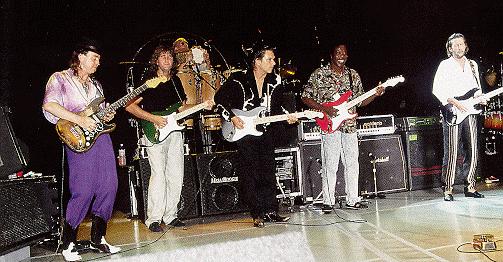
Stevie
Ray Vaughan, Jimmie Vaughan, Buddy Guy, and Eric Clapton
onstage at Alpine Valley - August 26, 1990
Goosebumps ran rampant during Stevie`s tribute to his mentor, Jimi
Hendrix. For eight years, Stevie had ended his show every night with inspired
guitar acrobatics--soloing behind his back and head; playing with his teeth or
boot; and finally tossing the instrument to the floor, jumping on it, and
shaking it for all it was worth. Stevie never grew tired of this routine, nor
did his audience, although many of them had seen these gimmicks a zillion
times before. It was the way he went after it, how he walked way out on the
edge of music, with nothing but a thread connecting him to the notes, bars,
and melody. But somehow, in the midst of losing himself altogether, he
remained aware of the ground on which his feet were planted.
Tonight
was special for another reason--Hendrix had also, coincidentally, given his
last major performance on this very day twenty years before at the Isle of
Wight Festival. Located below the British Isles, the Isle of Wight is
literally one degree from the end of time--Greenwich, England.
Robert Knight, a photographer who had often
worked with Hendrix, was on assignment to shoot a poster of the four
superstars for Fender guitars. “I was right below him in the front of the
stage,” he remembers. “I had never seen Stevie play so wild, so uncontrolled.
I felt that tonight I had seen Hendrix again, only better. In fact, during the
final number ' Voodoo Chile,' I got gooseflesh so bad I left and went
backstage.”
As
Stevie was nearing the end of his set, he introduced his epic “Riviera
Paradise” with words that proved to be sadly ironic, dedicating the number to
“anyone who's had pain in their life,” and adding, “I wish and hope we all
find the happiness we are looking for.” His rendition that night was
beautiful, imaginative, and personal; it was as if he were making a special
apology to everyone he'd ever loved and hurt.
Jimmie joined him onstage for the last three
songs, “Crossfire,” “Couldn`t Stand The Weather,” and “Goin' Down,” a most
fitting close to his final show. The night ended same way it all began--with
the two brothers trading licks together. Stevie walked offstage satisfied. It
had been one more night of playing the blues and spreading the news. He spied
Robert Knight and stopped briefly to talk to him. “Hey! Why'd you leave during
'Voodoo Chile'?” he asked.
“Where were you the night Hendrix
died?”
Knight asked bluntly. “Why?”
“Because tonight I saw Jimi Hendrix onstage.
I've got gooseflesh all over me! Look at this shit!”
Stevie held up his arms proudly. “I know. Me
too,” he added, smiling. “Sometimes I don't know myself where the energy comes
from.”
He
opened the door to his dressing room to find Jimmie sitting there. “Way to go,
little bro'!” Jimmie yelled, slapping him on the back. “You hear that? Listen!
They're going nuts! Stevie, I've never heard you play like that! You're great!”
Maybe it
was the first time he heard Jimmie say it, maybe it was the first time he
believed it, but Stevie`s eyes watered up and he hugged Jimmie tight, saying,
“Thanks, man. You know how much that means to me.”
While Clapton was preparing to begin his own
show, after having been thoroughly blown away by Stevie Ray and Double Trouble's
performance, he turned to Buddy Guy with a worried expression and
earnestly asked him, “How am I supposed to follow this guy?” “Well, Eric,”
Buddy replied, “You just do the best you can.”
Later, all the musicians gathered around the
wings of the stage to watch Clapton. During one passage, Clapton quoted
“Strangers In The Night.” Cray got Jimmie's attention and shouted, “Check him
out!” “Aw,” said Stevie, turning around, “he`s been trying to do that all
night and he finally got it right.” Jimmie and Stevie had a good guffaw over
that one. A few minutes later, around 11p.m., the three of them were onstage
grinding their axes with God himself.
Shortly after the last note rang out at 11:20,
the five exhilarated musicians left the stage through a rear exit, exchanging
hugs and kind words. They posed for pictures together, signed autographs,
compared calluses on their fingertips and chided each other, saying “Check
this one out, man” and “No, look at this. Mine's bigger than yours!” It was
all punctuated with uproarious laughter.
For well over an hour they talked about
jamming together again soon and Clapton remarked, “Hell, this is so much fun
we ought to take it on the road!” Clapton told Stevie plainly that he was the
best he'd ever heard. Buddy stood behind, nodding and smiling. Cray grabbed
Stevie`s shoulder meaningfully, and, as always, Stevie pointed to Jimmie. It
was a very human moment. Here were five of the most respected blues guitarists
trading heartfelt compliments. A few minutes later, Peter Jackson, Clapton`s tour manager, busted in and said, “Guys, I'm sorry, but the weather's getting
really bad and we gotta move it out of here.”
Four helicopters waited outside.
Text Copyright © 1993 Keri Leigh from
"Soul To Soul"
|
|
Quotes
About Stevie Ray
B.B.
King
- "...
not just a loss to music, it's a loss to people as a whole. The only
thing that keeps me from crying is knowing the joy he brought us.
I've said that playing the blues is like having to be black twice.
Stevie missed on both counts, but I never noticed it.... he was
always quick to show gratitude to me and other artists who have been
around. But when it came to playing the blues he earned plenty of
respect himself."
-
Eric
Clapton
- "I
don't think anyone has commanded my respect more, to this day. The
first time I heard Stevie Ray, I thought, "Whoever this is, he
is going to shake the world". I was in my car and I remember
thinking, I have to find out, before the day is over, who that
guitar player is. That doesn't happen to me very often, that I get
that way about listening to music. I mean, about three or four times
in my life I've felt that way, in a car, listening to the radio,
where I've stopped the car, pulled over, listened, and thought, I've
got to find out before the end of the day, not, you know, sooner or
later, but I have to know NOW who that is....and I remember being
fascinated by the fact that he never, ever seemed to be... lost in
any way. It was as though he never took a breather... or took a
pause to think where he was gonna go next, it just flowed out of
him. He seemed to be an open channel and music just flowed out. It's
going to be a long time before anyone that brilliant will come along
again."
-
Buddy
Guy
- "It
was an honor to have him do [my] tunes, because just like I went to
Muddy Waters and paid tribute to him, everyone pays tribute to
someone they admired a lot. Music is handed down to the next
generation. And he wasn't just some white kid saying, 'I got it.' He
told the truth. 'I got this from Buddy Guy or Albert Collins,' or
whoever he wanted to talk about. That was some of his greatness.
Stevie is the best
friend I ever had, the best guitarist I ever heard, and the best
person anyone will ever want to know. He will be missed a lot."
-
Bonnie
Raitt
- "The
most lasting memory I have of Stevie is his passion... I don't think
there's anyone that tears into a song the way he did. I think Stevie
Ray was coming from some place so deep and so beautiful that there's
no one you can compare to him. To me Stevie Ray was
the greatest blues guitarist. For fire and passion and soulfulness,
he was untouchable. He was scary to those of us who watched
him. But he was so humble and gracious as a friend and he wasn't
stuck up about his playing."
-
Robert
Cray
- "...
for a long time coming there's going to be a lot of frustrated
guitar players trying to pick up on Stevie's stuff. I'll always
remember how he kicked my ass all the time on the guitar. It was
inspirational, you know?"
-
John
Lee Hooker
- "The
first time we met was in Austin, Texas at Antone's, and it was him
and his brother Jimmie. That was fifteen or twenty years ago, and at
the time he could play tremendously. And I said 'Someday, this kid's
going to shake the whole world up.' And he was one of the nicest
people. You couldn't help but like him; you couldn't help but love
him."
- "I
never cry, but yesterday when I heard [about Stevie's death], I
sat down on my bed and cried like a little baby."
-
Lonnie
Mack
- "As
I got to know him better, it was easy to see that he had a really
good spirit. Stevie was a giver, man - not only to his friends, but
to everybody. He was a very spiritual person. He played his complete
self through the guitar. And he knew that playing music wasn't about
who sounded better than who else. It was the style that counted, and
it was about having a good time."
-
Albert
Collins
- "We
jammed many times, and I had so much fun. I really miss him. He did
some Jimi Hendrix, some Albert King, a little of me, but he had it
together for what he wanted to do. He had a direction and he made it
work. The kids really liked his fire."
-
Gregg
Allman
- "I
remember when he first came out, he was doing [Voodoo Chile], and I
heard all these people going 'Ah, he's just trying to do Hendrix.'
But he went a lot further than that. He was absolutely 100-proof
pure blues. Albert Collins, Muddy Waters - the essence of that was
in everything he played. More than the Allman Brothers, he was
straight-down-the-line blues." "Stevie
was always playing. After he'd get offstage, he'd get on his bus.
And he had all these Stratocasters hanging there. He'd grab one and
start goin'."
-
Joe
Satriani
- "As
a guitar player, he had an incredible signature tone and an extreme
intensity. He played one of the most difficult guitars to play - the
Fender Stratocaster - and he played with really heavy strings. And
he strung it with high action, which means you have to really work
harder than anyone to try to get a sound out. But if you've got what
it takes, then what comes out is something very big and bold and
original. In August of 1988, we opened two shows for him at the Pier
in New York, and I got to really listen to him up close. You could
tell he was always striving to find that magical point. He was good
at reaching for the magic and finding it. I think what I'll really
remember is the way he stood, you know? Sweat-drenched, with his
eyes closed, grabbing some incredible note. Someone has to be
totally absorbed to play like that. To play that intensely sort of
wreaks havoc on the body - it's sort of a painful ecstasy. He played
the blues, you know? I guess I'll remember that most of all."
-
Hubert
Sumlin
- "[Stevie]
was a friend of mine, partner - one of the best. I been knowing
Stevie a long time, since he was a kid - him and Jimmie. I played
with them so many times in Austin when Antone's had the first club
on 6th and Brazos." "I'll
tell you the truth: That boy was something else, man. I feel like he
was one of the greatest guys and guitar players who ever lived. And
he was really just getting to do his thing."
|