Equinoctial gales are quite common features of the British Isles weather and are well known for their intensity, frequently more severe than winter storms - as the 'hurricane' of October 1987 fully testifies. Indeed a particularly vicious storm on 24th November 1824 is still known as 'The Great Gale' in which no less than 15 vessels were wrecked along the Dorset coast alone.
Certainly November 1898 has long been remembered as one of the stormiest months on record, particularly during the last week of the month. From the 22nd the British Isles was lashed by ferocious winds and torrential rain. The severe south-westerly gale, which at times reached speeds in excess of 70mph, brought tremendously heavy seas along the length and breadth of the English Channel. One Southbourne resident later told a reporter that on the evening of 23rd, '...it was not a night for faint hearts...God help the seamen sailing in such a hell...' Southbourne-on-Sea, as it was known then, was just being developed by a Bournemouth doctor as a resort to rival Bournemouth.
Just some of the poor seamen that had the misfortune to be caught in such violent weather were the crew of the Ernst, a three-masted schooner, which had left Liverpool on 10th of the month bound for Danzig with a cargo of salt. It was commanded by its owner, Captain Wallis, with a mainly German crew. The Ernst had encountered very heavy seas all the way around the coast and by eight o'clock in the morning of 23rd was close to the Needles Channel as the captain desperately tried to seek some shelter in the Solent. However, as all the vessel's canvas had been carried away in the fierce storm the Ernst was virtually unmanageable. The captain decided to drop anchor in about 11 fathoms in a very slender hope of riding out the storm. Unfortunately almost immediately the vessel was dragged towards the western end of the Shingles and within about 30 minutes it struck the bank.
A lifeboat rescue
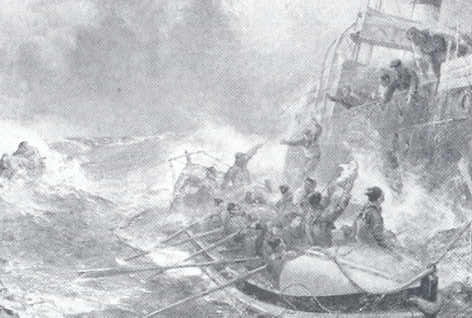
Although the Ernst was constantly swept by huge waves all hands were on deck where they lit flares in a vain hope that some ship or lifeboat would see their distress signals. The captain later said, 'A fearful hurricane was raging and we were completely at the mercy of the storm. We were in God's hands'. With great difficulty they succeeded in launching one of the ship's boats but almost immediately it was swamped by the boiling seas. They renewed their signals for help and this time the lights were seen by the Totland Coastguard across on the Isle of Wight, who contacted the Totland lifeboat station.
Just after nine o'clock in the evening the Totland lifeboat Charles Luckombe was launched, but because of the severe conditions the lifeboatmen took some time locating the Ernst, only to find that because of mountainous seas it was quite impossible to get alongside the stranded vessel or even to anchor. The lifeboat stayed around in these fearful conditions for an hour or so before returning to Totland to telegraph for a steam tug from Southampton. The crew remained at the station only long enough to get a change of clothing and take some quick refreshment before they ventured out again.
About six o'clock in the morning the vessel showed signs of breaking up. As the lifeboat coxswain said 'We tried all manner of ways to get to her but all had failed, so was nothing more to do than stand by 'til she broke up...' The vessel gave a 'loud and thundering crash, quickly settled down and was gone in minutes'. All the lifeboat crew could hear were desperate cries for help. They found the Captain first, clinging to a piece of wreckage. After nearly an hour of searching they picked up just two more survivors - the mate and a seaman - who were in an almost submerged boat. It was later discovered that the boat had capsized three times, and each time they had managed to right it - using their sou'westers in a vain attempt to bale out the boat. Unfortunately they lost sight of one man who had been hanging on to the rungs of the ladder. This man, the carpenter on his last trip before retiring, was not seen again. The three survivors were landed at Totland to rapturous cheers from the large crowd that had gathered near the lifeboat station. The captain, who was described as 'a shady side of 60...a hale and tough old salt' later admitted that it was his first casualty in over 35 years at sea. This was in direct contrast to the mate, who had been shipwrecked three times in just the last two years!
There was no rest for the lifeboat crew who went out almost immediately to try to locate a raft, reported to be drifting towards Christchurch with four men aboard. The crew searched the area for almost five hours without success. When they arrived back at Totland they were drenched, numb with cold and utterly exhausted. It was reckoned that they had been out for over 16 hours - a quite remarkable feat which demonstrated the bravery and dedication of the crews of the Lifeboat Service.
The Christchurch Coastguard had been telegraphed about the possibility of a raft drifting in their direction so they were out in strength along the Mudeford beach, which was likely to be its landfall. Finally a raft was sighted and appeared to have four survivors on board, but the Coastguard men were most concerned that it might overturn as it reached the breakers near the shore. One man - Isaac Conkes - went into the sea without a cork lifejacket in a brave attempt to reach the raft but he was knocked over by the heavy waves and was lucky to escape with his life.
Eventually the four men were safely landed. They had not eaten for two days and were suffering from extreme exposure, having spent so many hours adrift on their frail raft, which turned out to be the wooden roof of the ship's galley. A couple of hours later two dead bodies drifted ashore; one was that of a 19 year old seaman, who had dressed in all his clothes - three shirts, three vests, four trousers and a lifebelt - in a vain attempt to keep himself warm.
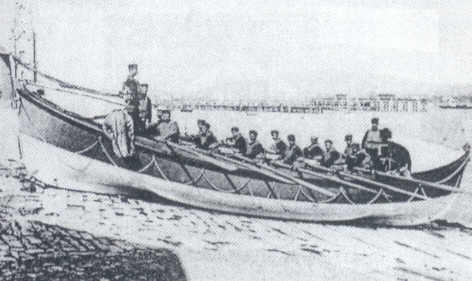
During the afternoon of the fateful 23rd the Swanage and Poole lifeboats had been out several times helping vessels in distress off the Dorset coast. A schooner from Leith, Velocity, was reported to be in great peril just off Studland, and eventually the six-man crew were rescued by the Swanage lifeboat, William Earle. The Poole lifeboat, City Masonic Club was out aiding a small barquentine Frier, which was in difficulties off Flag Head chine, where the lifeboat finally resuced the eight-man crew. Whilst it was away from its station a signal was received from the Southbourne Coastguard that there was a vessel just off Southbourne pier in some danger and the captain had requested provisions. As the Poole boat was already in action and the Swanage crew were too exhausted to go out again, the lifeboat secretary managed to gather together a scratch reserve crew from Poole to man the William Earle.
The Swanage lifeboat William Earl in November 1898.
The vessel which had anchored in a dangerous position just off the pier proved to be Bonne Mère from Le Havre. The reserve lifeboat crew did manage to get food on board but the captain adamantly refused to let the crew be taken off. However, he did agree that a steam tug should be called to provide some assistance. The Poole lifeboat was launched the following morning and helped to connect the towline from the tug to the Bonne Mère which was towed to Southampton with the Poole lifeboat bringing up the rear just in case it should be needed. Certainly it had been a most active couple of days and nights for the lifeboats in the area; for instance the Poole coxswain, John Hughes, who was over 70 years old, had been on duty for almost 48 hours!
But there was still more excitement to come for the new residents of Southbourne-on-Sea. Two days after Christmas 1898, yet another vessel was sighted off the pier, having considerable problems battling against a fierce south-westerly gale, and at one stage the vessel seemed likely to strike the pier. The local Coastguard discovered that it was another French vessel, Marie Thérèse, a small three-masted barquentine and by a strange quirk of fate belonging to the very same company that owned the Bonne Mère.
The pier and promenade (or 'parade') was thronged with spectators who had braved the severe weather. They watched Captain Bevan's fantastic attempts to prevent his vessel being driven ashore. Unfortunately he lost out to the weather and the sea, and the Marie Thérèse struck at Beer Pan Rocks near Warren Head. Within minutes the vessel started to break up. A local newspaper reporter was on hand to leave a vivid eye-witness account of the brave rescue of its crew:
'Chief Officer Norkett [of the Coastguard] with many willing helpers had got the rocket apparatus out and set up near the ill-fated ship. Three rockets were fired, the last of which secured and after some little difficulty arising from some unforeseen hitches. The crew of a dozen all told (including an apprentice) were safetly landed at the base of the cliffs at Warren Head to great public acclaim and cheering. It was a most rousing experience to see these men being hauled from the angry sea...The Captain was understood to state that they had drifted up with the gale under close reefed sails and he had somehow missed his reckoning in making for the Solent...The Marie Thérèse had its back broken and is likely to be a total wreck. She is quite close to the shore and at low water is almost accessible...'
A steam tug from Southampton attempted to remove the wreck but without success, then the following June a party of Royal Engineers attempted to blow it up. There were crowds of spectators gathered to view this spectacular even, even the local gentry were represented as Lady Meyrick, a leading figure in Bournemouth society, had been persuaded to formally push the button - alas it was not successful! For several years the remains of the wreck were still visible at low tide. Southbourne pier, which had only been opened in 1888, was not so lucky; it was badly damamged by a severe storm in December 1900 and within days was almost a complete wreck with most of the construction washed away. It was not dismantled finally until 1907.
