There is no doubt that certain shipwrecks leave an indelible mark on the history of a locality. Stories of terrible storms and tragic shipping disasters live on and are retold from generation to generation. For those who live by the sea these dreadful tales are a constant reminder of the awesome powers of the elements and all the inherent risks incurred in not giving due respect to such potentially destructive forces. Deeply engrained in the folklore of the Isle of Purbeck is a shipwreck that happened over 200 years ago.
On 1st January 1786 the Halsewell, a fine East Indiaman of 758 tons, left the Downs on the start of its third voyage to Bengal under the command of Captain Richard Pierce, one of the most senior captains in the Company. Already he had made what was then described as 'a competent fortune' and it was his avowed intention that this trip would be his last, as he planned to retire to his large estate at Kingston in Surrey and enjoy the abundant wealth that his 25 years in the East India Company's service had brought him.
On this particular voyage there were eight passengers on board, a relatively small number for a Company ship - one gentleman and seven young ladies - of which two were the Captain's own daughters. Amongst the crew were seven midshipmen and five supernumaries - young lads of about twelve years taking their first steps towards a prosperous career in the very coveted Company. With the addition of an unknown number of troops going to serve in the various East India garrisons the total number on board the vessel was reportedly about 240 persons.
The second day out in the Channel found the vessel becalmed off Dunnose Head, the most southerly point of the Isle of Wight, but this was just the lull before the storm. By the evening the wind had freshened with more than a hint of snow in the air. The next day saw a strong gale blow from the north-east, so that the Halsewell made quite extraordinary speed down the Channel but at the same time shipping a fair amount of water. By late evening the glass had dropped alarmingly and during the night the greatly strengthening wind had veered to the south. It was then realised that some damage had been sustained by the vessel, apparently it had sprung a leak and the crew were set to work at the pumps.
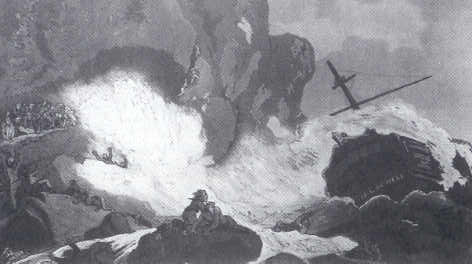
Halsewell: 'She disappeared into a terrible cavern'. (National Maritime Museum).
On the 4th the vessel now had at least seven feet of water in the holds, it was rolling most dangerously and the situation appeared serious. Captain Pierce ordered that the mizen (third after) mast be cut down to lighten the vessel, and a few hours later the main mast was also cut away. In the process five seamen were carried overboard in the mass of rigging; their bodies were never recovered. Certainly nothing was going right for Captain Pierce on his last trip. By mid-morning Berry Head was sighted, this is the most southerly point of Torbay and as the weather had eased somewhat the captain decided to turn back and bear away for Portsmouth. With some blessed relief from the elements he ordered jury masts (a temporary makeshift rig) and as much canvas as could be safely carried in the conditions. There seemed no doubt in Captain Pierce's mind that the vessel could safely make Portsmouth.
But after a day of slow and painful progress in worsening weather Portland Bill was sighted to the north-east. The Captain knew that he could not make for the shelter of Portland Roads so he attempted to guide the vessel to Studland Bay. Now the Halsewell was at the mercy of the tides and the howling gale. Just before midnight St Aldhelm's Head was sighted about a mile and a half to the leeward. All sail was reduced and a small anchor was released, but in less than an hour this failed to hold the vessel. The sheet anchor was dropped which again failed to stop the vessel as it was being driven towards the rocky shore.
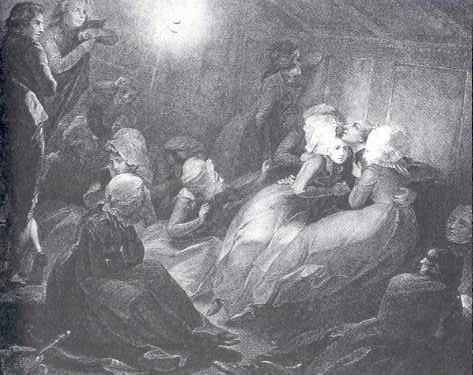
About two in the morning of 6th the Halsewell struck the rocks just below Winspit near Seacombe. A more inhospitable spot could not have been found - formidable cliffs almost rising perpendicular from the rock-strewn seas. The vessel went on to the rocks with 'such violence as to dash the heads of those who were standing in the cuddy [a small cabin at the aft usually reserved for the Captain and passengers] against the deck above them...A shriek of horror burst at one instant from every quarter of the ship...' Utter terror had struck the passengers as the vessel creaked and groaned as it was ground upon the rocks before turning broadside to the cliffs. The Halsewell was effectively lying in the mouth of a large cavern hollowed out of the cliffs, making it completely invisible to any person on the cliffs high above - if indeed anybody was about on such a night!
Several reports suggest that the crew refused to obey orders and were only concerned in making their own escape from the doomed vessel. Mr Meriton, the second mate, was amongst the first to get ashore on to the rocks in an attempt to raise the alarm but even in the pitch darkness he quickly realised that the sheer cliff-face seemed unassailable. Other members of the crew had managed to escape, crowding on to the rocks and the floor of the cavern, which was continually flooded by heavy waves. Shortly before dawn, just as two officers were washed off the vessel, making the comparative safety of the rocks with the greatest of difficulty, with a final horrendous crash 'She [Halsewell] disappeared into a terrible cavern'.
Many of those that had escaped from the vessel did not survive until morning, some had been dragged off the rocks by the force of the sea and others died from cold and fatigue. Then, with the coming of the morning two brave men - the cook and the quartermaster - managed with great skill to climb the cliff face. They staggered to the nearest house, the home of a Mr Garland, who was the steward of a nearby quarry. He quickly gathered together a party of quarrymen well acquainted with the cliffs and very experienced with ropes and stakes. Ropes were dropped over the cliff into the mouth of the cavern and slowly and perilously the survivors were hauled to safety; some were so numb with cold that they experienced problems just tying the ropes around their bodies. One report suggests that the intrepid rescue lasted for almost 24 hours. One of the last persons to be rescued was Meriton, the second mate, who later wrote about the wrecking and the rescue. In total 74 persons were rescued by these methods although it was thought that almost the same number had escaped from the vessel but had died during the night. The death toll of the Halsewell was at least 160 persons - a terrible shipping tragedy. The Captain, his two daughters and the other passengers all went down with the ship.
Captain Pierce with his daughters & their companions in the cuddy of the Halsewell. (National Maritime Museum).
Near the site of the wreck on the cliffs above there are still traces of four long graves, though it is not known how many bodies they contain. The nearby church of Worth Matravers records only one burial from the Halsewell, that of a body washed ashore almost one month later. The vicar recorded in his Parish Register, 'On 4, 5, 6 Jan - a remarkable snow storm sometimes a hurricane with the wind at south, on the latter day Halsewell - Never did happen so complete a wreck. The ship long before day break was shattered to pieces and very small part of the cargo survived.'
The financial loss of the vessel was estimated by the East India Company to be in the region of £50,000. In recognition of the brave and daring rescues by the quarrymen, the Company awarded them with 100 guineas to share amongst themselves; later their quarry was renamed the Halsewell. There was quite an outcry in the press when it was known that seven young ladies had died in the wreck. Several reports condemned the whole concept of taking young girls over to India to be paraded in what they called 'the marriage market for East India Company moguls'! Also there was a rather dramatic account of the shipwreck in the Annual Register, which is said to have so impressed Charles Dickens that he used it as a basis for his story The Long Journey. Other than the folk memories of this 'Great Shipwreck' as it was called by some Victorians, a few items from the Halsewell have survived; one of which is an hour-glass that runs for four hours. Washed ashore with the green glass intact, it is now housed in the Dorset County Museum.
