April 1908 proved to be a month that the Admiralty would not care to remember. In just three weeks no less than three warships came to grief in three seperate shipping accidents - two destroyers and one cruiser with a total death toll of 56 officers and men. It was a crippling blow, but these casualties were mercifully light considering the number of personnel serving on the three vessels and the gravity of the incidents. This disastrous month came less than two years after the spectacular wrecking of the large battleship HMS Montagu in the Bristol Channel. Apart from the heavy financial loss this rash of shipping accidents seriously undermined the confidence of the British public in the professionalism of their Navy and its officers, and in particular cast doubts on the officer training system. Several reports suggested that the Admiralty was 'firmly rooted in the past and the old days of sail...incapable of recognising the training needs of a modern Navy'. These strictures may not have been either fair or justified, but it is incontestable that the morale of the Royal Navy received a severe blow.
The first sinking happened on the second day of the month. The destroyer, HMS Tiger, was engaged in a large night exercise with the Home Fleet some 20 miles south of the Isle of Wight. Whilst making a dummy attack on the main Fleet a small group of torpedo boats lost contact with each other, causing utter confusion with neighbouring vessels. As a result Tiger crossed the bow of a nearby cruiser and was virtually sliced in half, its bow section sinking almost immediately. Fortunately the remaining stern section stayed afloat long enough for over half the crew to be rescued, but the captain and 27 members of the crew were drowned. The second destroyer to be lost was HMS Gala, which suffered an almost identical accident in the North Sea off Harwich but in this incident, although the vessel sank as it was being towed back to Harwich, only one officer was lost.
Without doubt it was the sad wrecking of HMS Gladiator that stole the headlines and made the greatest impact on the public. The unhappy story had all the ingredients of tragedy on a grand scale - atrocious weather, the collision of two big and heavy vessels, a large number of passengers and crew, brave rescues, lurid survivors' tales, a court of inquiry, and a protracted recovery of the vessel's hull.
There seemed a grim inevitability of disaster as the two large vessels steamed towards each other in terrible weather conditions. Coming out of Southampton was the American liner St Paul and in the opposite direction came HMS Gladiator from Portland, bound for its home port of Portsmouth. Both were travelling at a fair speed on a course that would take them through the narrow Needles Channel. The scene was set for tragedy.
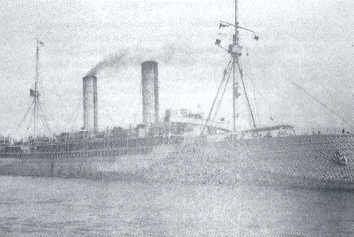
The St Paul was a large American liner of 11,260 tons and fitted with 20,000 hp engines which were capable of a maximum speed of 21½ knots. It was known as 'an express mail liner' and was 13 years old at the time. Unlike many cross-Atlantic liners it was not lavishly furnished; deliberately so as the United States Congress had decreed that in time of war it should be converted into a fast gun-carrying cruiser, and indeed the vessel had served in that capacity during the American/Cuban war. St Paul had another claim to fame. During November 1899 Marconi had been on board and he sent the first ever vessel to shore wireless message to his receiving station on the Isle of Wight.
On the fateful day - 25th April - the liner had left Southampton bound for Cherbourg prior to sailing to New York. It was commanded by Captain Frederick Passow and had on board a Trinity House pilot - George Bowyer - to see the vessel safely through the Western Solent. The weather forecast was not too favourable - the strong threat of heavy snow showers with gale force winds was not particularly seasonal for the end of April. The pilot maintained a relatively high speed whilst entering the Solent because a vessel of its size and bulk needed to retain a good turn of speed to maintain its steerage - at least that was his explanation given to the Court of Inquiry. Once the vessel was in the Solent the weather positively worsened. A force eight gale was blowing and this strong wind whipped the snow flurries into a virtual blizzard. With the visibility down to less than 800 yards the pilot ordered half speed, especially as the St Paul was nearing Hurst Point - the narrowest and most dangerous part of the Solent. Nowadays because of the lack of sea room and the formidable tides encountered in the Hurst Narrows, very few large vessels use this Channel - despite the fact that they have all the advantages of modern radio and radar navigational aids.
HMS Gladiator was a second-class battle cruiser of 5,750 tons, built in 1896 at the cost of £287,000. It was under the command of Captain William Lumsden and had a crew of 250 officers and men. The vessel had left Portland at 10.30am and because of the deteriorating weather Captain Lumsden decided to remain on the bridge all of the time, despite the presence of the navigation officer, Lieutenant Mainguy. The vessel was sighted by a hardy Bournemouth resident (considering the weather at the time!) who was on the pier during the late morning. He later recalled, 'the large battleship was making a fair head of steam despite the weather, which I thought at the time was a trifle unwise...' At about 2.30pm the Gladiator was approaching the western end of the Solent at a reported speed of nine knots in what were described as 'blizzard conditions'.
When the distance between the two vessels was no more than half a mile the lookouts on both vessels saw that they were on a collision course. In such cirumstances the 'International Regulations for Preventing Collisions at Sea' decreed that each vessel should pass port side to port side. However, Captain Lumsden considered that he did not have sufficient sea room for such a manoeuvre (the court martial later thought otherwise) so he quickly put the helm to starboard in an attempt to pass the St Paul on the starboard side.
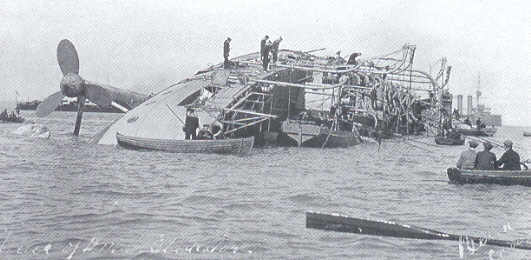
Wreck of the HMS Gladiator, April 1908.
The pilot on St Paul attempted to reduce the closing speed by ordering all his engines to be stopped. However, as it was such a long and heavy vessel it was quite plain that the powerful engines would not reduce the speed sufficiently to prevent a collision. As Captain Passow later testified, '...I saw a puff of steam and heard just one blast of the siren...' The International Regulations stated that one short blast of the siren indicated that a vessel was altering its course to starboard and two short meant to port. Captain Passow ordered full astern with the starboard engine and gave a signal to indicate what evasive action he had taken. Passow now expected the other vessel to turn to starboard, which would have meant that they would be hoving away from each other. To his horror he realised that the Gladiator was moving right into his path. He immediately ordered the engines full astern in a vain attempt to prevent the collision. Sadly there was not enough time or sea room to save the two vessels and the bows of the St Paul crunched heavily into the Gladiator just at a point to the forward of the after boiler room.
The liner was travelling at about three knots when it struck the Gladiator but the damage it wrought was quite horrendous. The men in the aft boiler room had little chance of escape, some were killed outright and many more seriously injured. Then, as the liner slowly backed away, tons of sea water rushed into the gaping hole, giving the Gladiator a serious list to starboard. The action of the sea water caused another boiler to burst resulting in further serious injuries to those in the engine room, but the watertight bulkheads held and prevented the vessel from immediately foundering. Some of the Gladiator crew jumped into the water in an attempt to swim to shore - Sconce Point on the Isle of Wight which was about 500 yards away. The remainder of the crew crowded along the now upturned hull of the vessel waiting to be rescued.
The Gladiator slowly drifted in towards the shore and when it touched bottom there were cheers from officers and men assembled on the hull. Though some of the lifeboats on the St Paul were severely iced up and it took almost 20 minutes before they could be launched, they rescued over 100 seamen, including Captain Lumsden and several other senior officers. The men who had taken to the water were eventually rescued and helped by soldiers from the nearby Royal Engineers garrison at Fort Victoria. There were countless acts of bravery by these soldiers wading into the cold and rough seas to aid the exhausted, bitterly cold survivors. Amazingly, the death count was not high - one officer and 28 ratings - but of these only three bodies were ever recovered.
The Bournemouth Echo of 29th April 1950 published a letter from Commander M. Brotherton, RN (Retd.), who recalled how he had survived the Gladiator disaster:
'There was a fierce snow blizzard raging in the Channel that day with visibility from a hundred yards to half-a-mile. I had just come down to the wardroom when suddenley without the slightest warning there came a prolonged and shattering uproar and I heard a shout of "By thunder we've struck"...it seemed for quite a long time the ship reeled and shook like some large animal mortally wounded. I gained the upper deck...the sight at topsides was indeed impressive and memorable, for as I emerged into the snowstorm's twilight I saw an immense black wall that towered high up over my head and realised that it was a bow of a great ship that had torn and ripped its way through our side right up to the base of our funnels. Both ships had by now been brought to a standstill. Down on the deck near me a man was dragging himself along by his elbows, both his legs had been torn off. I have never had any fear of the sea but have always dreaded the cold water, and watching some of the men - including one lieutenant - trying to swim away but quickly succumbing to the cold, and the damaged boats crammed with men making their precarious way towards where we knew the shore lay, decided me and a half dozen other officers including our Captain Lumsden to stick to the ship, and trust to be rescued by one of the St Paul's boats before being forced to take to the drink.
As the ship slowly turned over upside down we climbed over the rail and walked across her side and finally seated ourselves upon her sea-worthy keel. I felt pretty warm as we had been kept pretty busy trying to get the boats launched at a dangerous angle of the keel...'
The American liner St Paul which survived until 1923.
Commander Brotherton further explained that the excitement of the incident overcame the fear he felt at the time. He also casually mentioned that he was involved in yet another collision at sea just a week or so after the Gladiator had sunk!
When the St Paul returned to Southampton with the survivors it needed urgent repairs to the gaping hole in its bows, and was in the dry dock for several weeks. The salvage of the Gladiator proved to be a formidable task and it took nearly five months before the hull was towed to Portsmouth. Indeed for most of the summer of 1908 the sad scene became an essential tourist sight for the coastal pleasure steamers. The Admiralty finally decided that the vessel was only good for scrap and it was sold for £15,125, but as the salvage work had cost in excess of £50,000 it had proved to be a most expensive collision.
In June 1908 Captain Lumsden had to face a court martial, and although the speed of the St Paul was thought to have been too fast for the narrow seaway and quite critical as far as the accident was concerned, the court also felt that Captain Lumsden was partially at fault for ignoring the International Regulations, and he was rather fortunate to receive only a severe reprimand.
With one of those strange quirks of fate which seem to bedevil life at sea, exactly ten years later to the very day of the fatal accident, the St Paul foundered in the Hudson river whilst approaching Pier 61 in New York. All but four of the 400 crew escaped safely. Five months later, in November 1918, it was refloated and repaired at a cost of over $1,000,000. The St Paul had a relatively short life as an Atlantic liner because its engines were found to be too old and worn for the prestige crossing and it was finally scrapped in 1923.
