The provision of royal yachts goes right back to the days of Charles II but it was not until the reign of Queen Victoria that they really came into prominence and regular use. She and her consort Prince Albert both loved the sea and their yachts, in which they travelled to northern Europe as well as to all parts of their kingdom in some considerable comfort and ease, and with the added bonus of almost complete privacy. During Victoria's long reign no less than seven royal vessels were built and used by various members of the royal family and their households. All of these vessels, irrespective of their size, were paddle-steamers. From the opening of Osborne House, the Queen's private residence at East Cowes on the Isle of Wight, the vessels became a very essential part of the royal household. They provided convenient transport for members of the royal family, distinguished visitors, government ministers, also official despatches and papers to and from the mainland. After the death of Prince Albert the vessels came into almost constant use as the Queen spent more and more time at Osborne House.
By the 1870s there was a small flotilla of royal vessels. The pride of the fleet, and certainly the Queen's favourite was the Victoria and Albert a large paddle-steamer of 2,470 tons. This vessel had two small steam tenders - the Elfin and the Alberta - which were required as they had small enough draughts to use the Trinity pier (the landing place for Osborne House) in all tidal conditions. The Elfin was used almost exclusively for delivering London papers daily to Osborne House as well as official reports to and from the Island - so regular were its sailings that it was known locally as 'the milk boat'! So it was the Alberta that was most frequently used by the Queen for local pleasure cruises around the Island.
The royal yacht Alberta in the Solent, 1895.
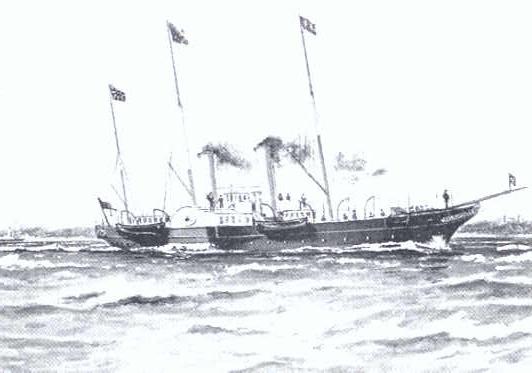
The vessel had been built in 1863 and was an elegant little steamer with two funnels and three masts. The furnishings were luxurious with a very high standard of comfort, and it was stipulated that 'lack of motion is all important as Her Majesty takes days to recover after a rough passage. Speed is to be sacrificed if necessary'. The captain of the Victoria and Albert was the Queen's nephew, His Serene Highness Prince Leiningen. He was not particularly impressed with this new addition to the flotilla, indeed he was downright critical and described it as 'the greatest beast that ever floated'. He also claimed that its engines were far too powerful 'shaking so bad that HM would be very frightened'. There was lengthy correspondence over the matter and the Admiralty did not take too kindly to the prince's criticism. In the end certain alterations were made and the two 'warring parties' were told quite firmly that their chief object 'was to serve the Queen'. The sailing master of the Alberta - Commander Welch RN - had served in royal yachts for a number of years and he was more than happy with the trim little vessel.
On 18th August 1875 the Alberta was destined to achieve a certain notoriety. On that day it left Trinity pier for a gentle pleasure cruise around the Island. Prince Leiningen was in command of the vessel with Commander Welch as the navigating officer. On board with the Queen were some members of her family and her personal secretary Ponsonby. The weather was clear and bright with hardly a hint of wind. At about a quarter past six in the evening the Alberta was steaming through Stokes Bay close to the Spit buoy when a schooner yacht appeared on the vessel's port bow. This yacht, the Mistletoe, was owned by Mr E. Heywood, though he was not on board at the time. Suddenley the small yacht tacked right across the bows of the Alberta, resulting in 'a very sharp and hard collision' as the royal yacht struck the Mistletoe between her fore and main masts, burying her bows into the yacht's hull by some ten feet or more.
When the two vessels collided the Queen rushed forward in great anxiety and screamed out 'Take care the people are saved!' When the Alberta backed off, water rushed into the large gash in the Mistletoe's hull and she sank immediately. Some of the crew had been thrown clear by the force of the impact and were quickly rescued by the Alberta. Within an hour naval divers from HMS Excellent, the Royal Naval Diving school based at Portsmouth, were on the scene and successfully located the yacht, which was lying almost intact and upright in 13 fathoms of water. The body of Miss Ann Peel, the sister-in-law of the owner, was found beneath the main mast and that of the sailing master, Thomas Stokes, beneath the decks. No trace was found of the mate, Nathaniel Turner, who was thought to be at the tiller at the time of the collision.
As can be imagined the papers of the time reported the sad accident in great detail and there were veiled but implied criticisms that the officers of the Alberta were to blame by steaming 'as if they had some special privilege or divine right to use these waters as they thought fit without due regard for other users of this busy tideway' At that time anti-royalty feelings were running high, for since the death of Prince Albert, the Queen had isolated herself and had come increasingly under the influence of John Brown, her Scottish servant - indeed in some circles she was referred to as 'Mrs Brown'! There had been quite serious discussions on abolishing the monarchy and replacing it with a republic, furthermore Prince Leiningen was considered 'a most arrogant man and a foreigner to boot'!
These strong anti-royalist feelings were present when the inquest was held in Gosport on 27th August. A large crowd gathered outside the Star Inn and when HSH the Prince Leiningen and Commander Welch arrived and left the court they were loudly booed and hissed. The Queen had left Osborne House and had hidden herself away at Balmoral, where she was celebrating the anniversary of the birthday of her beloved Albert. Nevertheless she followed the court proceedings with close interest. It was left for the jury to decide whether the accident had been caused by neglect or want of caution, either by the officers of the Alberta or the Mistletoe. The jury was out for almost nine hours before the foreman, a Mr Mumby, said that they had not agreed on a verdict and that there was not the slightest prospect of them doing so. The members of the jury were bound over to appear at the next assizes at Winchester where they would have 'the advantage of the judgememt of the presiding judge'. Queen Victoria thought the foreman of the jury 'a horrid little man' and firmly believed that he was a communist!
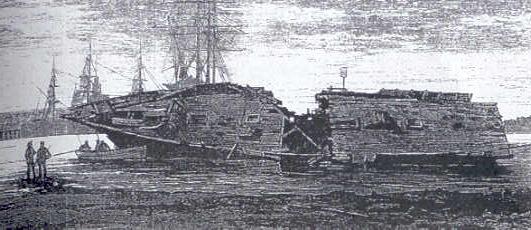
Meanwhile the recovered wreck of the Mistletoe had been placed on one of the jetties in Portsmouth very close to Nelson's Victory. The wreck proved to be more than a nine-day wonder, attracting large groups of sightseers. It was said that the two clocks which had been found on board had both stopped at the same time - eighteen minutes past six. Because of the 'unhealthy' public interest in the vessel, the hull was quickly put up for auction and sold for 'a small sum of money'.
The wreck of the yacht Mistletoe in Portsmouth harbour.
The body of Nathaniel Turner, the mate of the Mistletoe had been washed up on the shore near Portsmouth. The inquest found that the drowning was caused by an accidental collision. However it was felt that 'there was an error of judgement on the part of the navigating officer of the Alberta, as a slower rate of speed during the summer months especially, would be more conducive to public safety and there should have been a more efficient look-out employed'. The verdict was greeted with loud applause by the crowds gathered outside the court and the Prince and Commander Welch suffered 'some physical and verbal abuse' as they left the courthouse.
The whole sad incident greatly affected the Queen and from that time she lost her enthusiasm for pleasure trips, though, as she was then almost 60 years of age she obviously sought more comfort in her travel arrangements. She wrote, in some exasperation, to her daughter the Princess Royal, 'I assure you I wish I cld [could] avoid ever going on the Sea again wh [which] as we happen to be an Island and Osborne is on one, is quite impossible'. Certainly she seldom again used the Alberta, at least for pleasure cruises. Ultimately, on 22nd January 1901 the Alberta brought the body of the late Queen over from the Isle of Wight to Portsmouth. It was never again used by the Royal family and was finally sold in 1908.
