'One of the most notorious 18th century crimes that received
the sanction of the entire local community' is how Tobias
Smollett described wrecking in his New History of England,
published during 1757/8. But for this bold and outright statement
to be more factually accurate one should substitute 'smuggling' for
'wrecking' because more arrant nonsence has been written about wrecking
and wreckers than any other maritime subject. If only half the stories
are to be believed then Cornwall appears to have cornered the market
in this particular brutal activity. Nevertheless some of the more lurid
and gruesome tales of wreck survivors being callously murdered owe more
to the vivid imaginations of writers throughout the years than to
well-researched and documented evidence.
Nevertheless it is true that tales of wrecking are deeply embedded in
the folklore of most maritime areas and the coasts of Dorset, Hampshire
and the Isle of Wight prove no exception to the rule; with Chesil Beach
and the coasts of Portland, Purbeck and the Isle of Wight being in the
forefront of this activity. On close examination most of these legends
relate to the systematic looting of wrecked vessels of their equipment,
cargo and crews' possessions rather than any deliberate and premeditated
acts of wanton wrecking. On the contrary there are very many examples
of valiant attempts to rescue crews and passengers by these local
communities before they turned their attention to looting.
Certainly there is undeniable evidence that extensive pundering of
wrecks did go on along these coasts, especially in the 18th and early
19th centuries. But there is not a single instance of deliberate wrecking
and the inhumane murder of survivors. But undoubtedly for centuries
wrecked vessels were considered to be 'God given' and the goods and
materials they provided viewed as a very precious and necessary bounty
to alleviate the harsh and meagre existence of the coast dwellers.
They also felt strongly that they had an inherent and unalienable
right to any goods washed up on their shores. Whilst certainly not
provoking wrecks by the use of false lights they nevertheless viewed
stormy weather with a certain anticipatory pleasure; indeed Falkner,
the author of Moonfleet maintained that the children of the Fleet
were taught an old rhyme 'Blow wind, rise storm. Ship ashore before
morn!' And fisherman talked about 'a good wreck season' just as they
would about fishing prospects and then 'thank Providence for it!' Such
sentiments also prevailed along the Devon, Welsh and Yorkshire coasts -
certainly to my knowledge.
The tradition of plundering wrecks along the coasts of Dorset and the Isle of Wight goes back a very long way right to the earliest medieval records of shipwrecks. In 1305, when a Spanish vessel was wrecked at Portland, reportedly over 200 local people boarded it not only to carry away the cargo but also to break the vessel into many pieces. Fifteen years later the Sainte Mary, another Spanish vessel, was wrecked near Yarmouth on the Isle of Wight and no less than 50 people were charged with 'the misuse of wrecked goods'. Several years later a French vessel laden with wine was stranded near Christchurch and according to the chronicles the wine quickly disappeared 'before the Prior's men could stoppeth them in their barbarous acts'. Towards the end of the century there are several references to plunder along the Chesil Beach and in one instance the owner of the wrecked goods was 'insulted, wounded and maltreated'. The State Papers of Tudor times make note of the prevalence of plundering and some of these relate to the Isles of Portland and Wight.
During the 18th century far more incidents are recorded. The main reason was not necessarily that the plunder of wrecks had become more frequent but that the Customs service was more organised and so many of their early records have survived. It was the responsbility of Customs officers, as 'Receivers of Wrecks', to ensure the security of wrecked vessels and their goods which, of course were liable to duty, though only at half the normal rate! The Customs records of Weymouth, Poole and Cowes give ample evidence of the wrecking habits of 'the country people' - as they were always called in official papers and reports. The Weymouth Collector wrote in 1760, 'such wrecking practises have gone on for years upon years and we almost find it impossible to prevent unless we have the support of the military as they do gather in such great numbers and insult and attack my officers when they try to halt their wicked crime'.
In 1702 the Catherine, a French vessel, was wrecked at Portland with a cargo of chestnuts. The Weymouth Collector in his report to London said that 'the country people did not only imbezle and carry away the cargo but beat and abused the officers in ye execution of their duties'. He was ordered by the Customs Board in London to obtain 'particular proof of some of the notorious offenders to deter others from such barbarous practices'. Fourteen years later, in January 1716 the Jesus Maria Joseph stranded on Chesil Beach and the Customs men were unable to secure the cargo of wine, as they were 'Beat, Hounded and Resisted by the Countrie people'. And again, just whereupon 'Great numbers of Portland men came down upon us [Customs] with Axes, Hatchetts, Clubbs, and beat us from the Goods wounding Serverall of Us very much...'
Perhaps one of the most famous wrecking incidents to occur along the Dorset coast was in the winter of 1748 when the Hope from Amsterdam became stranded on the Chesil Beach. The vessel was said to be carrying over £50,000 in gold coins and such a bonanza attracted 'the country people in great hordes'. Over 300 assembled each day to scrabble through the shingle and pebbles in a desperate search for the gold, and most reports suggest that it took almost ten days before the Customs supported by the militia managed to restore order.
Wrecking, the subject of this fine painting by Morland, was both
widely condemned
and widely practised. (Museum of Fine Arts, Boston).
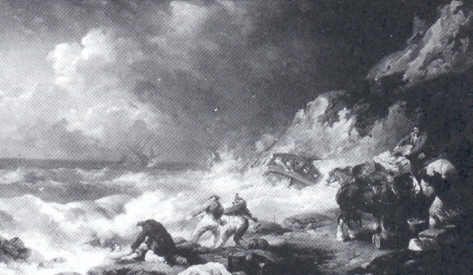
Three years later 'a Gentleman from Bridport' wrote about the attempted plunder of a French vessel Reine Gabrielle, which had become 'stranded on our Beach'. He said that 'the Country People, as is their wont, came down in great Numbers in the Hopes of making a prey of both Ship and Cargo [honey]' He was 'gratified to relate that their Barbarous Designs were frustrated by the Courage and Vigilance of Mr Brown, Officer [Customs] of this Town and others he call'd to his Assistance...' This indeed was a rare instance of wrecked cargo being secured by the authorities. In April 1753 when HMS Assurance came to grief at the Needles, the Collector at Cowes had to report 'certain violence offered to his officers, whilst they bravely attempted to secure the stores and possessions of the unfortunate saylors'. He also hinted darkly that 'the gentry of the neighbourhood did not offer his officers assistance'! Like smuggling the plunder of wrecks was, by and large, condoned by the local gentry, magistrates and some of the clergy.
Despite the Act of 1753, which not only made the wrecking of vessels a capital offence but also introduced the sentence of transportation for 'the looting of wrecked vessels and their cargoes', the plunder continued almost unabated. This can be explained by the simple fact that all coastal communities considered that wrecked goods belonged to the by 'ancient right'. In fact after the troop transport William Pitt had been driven ashore at Chapman's Pool on the Isle of Purbeck in November 1795, the Poole Customs Collector called out the dragoons to escort part of the salvaged cargo and stores 'for fear of the violence of the Country people, who had been frustrated in their evil and regular trade'. And just two months later after the tragic wreck of the Halsewell, when the local quarrymen had showed such bravery in saving lives, many items of the valuable cargo had been spirited away before the Customs could secure it. Then in December 1798 when yet another East Indiaman, the Henry Addington was stranded on Bembridge Ledge at the eastern tip of the Isle of Wight, the Deputy Controller at Cowes collected 'a strong force of officers and responsible citizens to prevent embezzlements by the Island people who frequently cause great offence at such times'.
There seems no doubt that these habits continued well into the 19th century, for there are many instances of clergymen in coastal parishes being regularly exhorted by their bishops to preach a sermon at least once a quarter on 'the cruel and un-Christianlike enormity of plundering wrecked vessels'. Local and national newspapers often carried strongly worded editorials on 'the wicked trade'. However, the very serious plundering with such fatal consequences which occurred at the wreck of the Royal Adelaide at the Chesil Beach in 1872 does seem to be a rather isolated incident - at least in its enormity. Probably the reason for this is more to do with the greater number and therefore intensified activity of the Coastguard along the more notorious coasts rather than a marked improvement in the age-old proclivities of such communities. Indeed, as Fred Mew has clearly shown in his delightful book Back of the Wight, during both World Wars the many wrecks along the coast brought a most welcome bounty in food and other scarce goods to the Island people; it was like 'corn in Egypt'!
There have been some isolated incidents in more recent times, which only show that old habits die hard; so perhaps it is best not to condemn too strongly the wreck plunderers of yesteryear. At least it could be said that they were in far greater need of the welcome bounty so fortuitously supplied by the sea.
