An essential part of the maritime activity of these coasts has
always been the ferry boats, the majority of which operated
along and across the 'inland waters' of the Solent, Spithead and
Southampton Water. Many of these vessels, hoys, wherries,
steamers and paddlers, became very familiar and much beloved
sights as they busily crossed back and forth to Ryde, Cowes and
Yarmouth from Portsmouth, Southsea, Southampton and Lymington.
And besides these 'local' ferries there have been
regular sailings to Cherbourg, Le Havre and the Channel
Islands. Perhaps the most famous cross-Channel service was the
mail-packet ferry from Weymouth to the Channel Islands,
which first operated in 1794.
The sheer number of these ferries and the frequency of their sailings,
often in direct competition with one another, would
leave one to expect an inevitably large number of accidents. On
the contrary, the number of incidents have been amazingly few
and most of them of a minor nature. The most disastrous
accident to a ferry in these waters was caused by enemy action,
namely the Portsdown, which struck a mine in 1941. Not too
surprisingly the most serious ferry accidents occurred along the
Dorset coast and off the Channel Islands, and not in the
sheltered waters of the Solent and Spithead.
It fell to the Weymouth mail packets to provide the first
serious accident. The fast cutter Francis Freeling had been built
in Portland in 1809 specially for the service and was named
after one of the Post Office administrators. On 6th September
1826 the vessel left Weymouth and, with its crew of 18, was
never seen again. Apparently it had been run down by a large
Swedish brig off Portland, because some time later the captain
reported such an incident. Devastated by the sad news the
port raised a public subscription for the crew's dependents.
Rather shamed by the public's demonstration of generosity
the Post Office later granted pensions to the widows and
orphans.
The introduction of the steam vessels on to this service almost
cut the passage time by half but they did bring their own
problems, as in the case of the small steam paddler, Meteor,
which had been built in 1820 and had served on the Irish Sea
crossing from both Holyhead and Milford Haven before
transferring to Weymouth in April 1828. On the morning of 23rd February
1830 the vessel left Guernsey under the
command of Lieutenant Ross Connor in not particularly
favourable weather - the visibility was poor due to a heavy sea
haze. By the evening the Meteor was off Portland Bill in very
dirty conditions - a thick fog shrouded all signs of the coast.
So not surprisingly the vessel ran on to rocks at Church Ope.
Demonstrating a fine presence of mind the mate, Edward
Thresher, struggled ashore and with the aid of ropes all the passengers and crew
were landed safely. The mail finally
arrived at Weymouth at 2am the following morning, having
been brought overland. Later that night the passengers' luggage
and possessions were looted by crowds of local people who had
gathered at the stranded vessel. Over 50 years later, on
Christmas Day 1883, there was an almost replica wrecking
when another Weymouth ferry boat operated by the Great
Western Railway, the South of Ireland went aground on rocks
at Warbarrow Bay, to the east of Lulworth in dense fog. This
vessel, as its name suggests, had previously operated on the
Milford to Waterford service. On this occasion the South of
Ireland was returning from Cherbourg with just one passenger.
Fortunately the passenger and crew of 23 were saved but it proved
impossible to refloat the vessel and it became a total
wreck.
The Lymington to Yarmouth is perhaps the most famous Isle
of Wight ferry route, due in no small measure to Lord
Tennyson's poem 'Crossing the Bar', which was written whilst
he was on board one of the little ferry steamers. Some of the
most famous Victorian literary figures and artists used this
crossing to visit Tennyson's house on the Island. And, of course, with the opening
of Osborne House in 1846, the Island
came into far greater prominence heightened by the coming of
the railways, when most of the ferry boats were owned and
operated by the various railway companies. Many travel writers
have suggested that the Lymington crossing is the best way to
reach the Island and it can certainly claim to be the most picturesque
ferry route.
Although the first little steam vessel came into service in April
1830, the local boatmen still made the crossing in sailing
boats, possibly because many of the locals could not afford
the steamer's fares. In April 1837 a 23 foot wherry carrying
12 passengers - mainly women and children - unfortunately
capsized in a sudden and heavy squall. All the passengers and
the boatman were swept overboard and ten were drowned.
The boatman, John Webster, survived by gripping the mail
bag in his teeth whilst holding up a young girl, who later
died in his arms. At the subsequent inquiry no blame was
attached to Webster, in fact he was complimented for his
brave actions. Webster died seven years later at the age of
76 years.
Several years were to pass before there was another ferry boat
incident. In March 1851 the Duke of Buccleuch, which had
operated on the Southampton to Cowes ferry route since 1829
was in Southampton Water just off Calshot when it collided
with a small Lymington yacht, Sea Dog. The yacht sank almost
immediately but the three crewmen were thrown clear and were
quickly rescued by the steamer's boat. There was no sign of the
owner, but as the Duke of Buccleuch cruised around in the area,
faint cries for help were heard and the commander, Captain
Calpine, jumped overboard with a lifeline and managed to
rescue the man.
Another Southampton steam ferry was involved in a far more
serious incident. It was the Alma, which had been built in 1894
for the London & South-Western Railway Company and came into operation
on the Southampton to Le Havre service. It was
the very first cross-Channel steamer to have two-berth cabins
for first-class passengers, making it a very comfortable and fine
vessel with a good turn of speed - 19 knots. In April 1902, it
appears to have been going too fast for the prevailing weather
conditions - a very thick fog. The Alma struck the Cambrian Princess
near the entrance to Spithead, and although no ferry passengers
were injured in the collision, the Cambrian Princess
capsized and sank with the loss of 11 lives. The Alma continued
on the Le Havre service for another ten years before being sold
and spending its last years off the coast of Algiers.
Perhaps of all the ferry boats that used these coastal waters the most beloved were the
paddle steamers, many of which
operated on the Portsmouth to Ryde crossing, first for the London & South Western Railway
Company and later for the Southern Railway. Some of the most popular were the 'Duchess'
series - two of which, the Duchess of Edinburgh and the
Duchess of Connaught, were fondly dubbed the 'ugly sisters'! But it was another
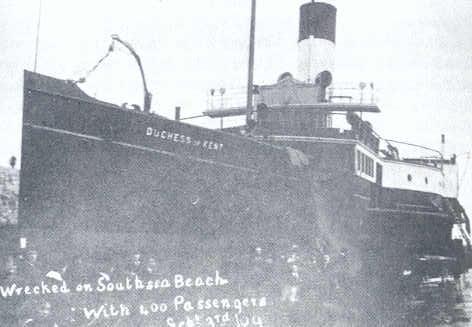
'Duchess' that hit the headlines in 1909 - the Duchess of Kent. On 3rd
September it left the mainland for
Ryde with 400 passengers but in less than ten minutes it collided with the Transporter,
a steamship carrying coal. When the collier backed off the paddle steamer began to take in so much water
that the captain decided to ground it on Southsea beach at a spot close to Victoria pier.
All the passengers were safely landed but the vessel needed urgent repairs before
attempts were made to refloat her. Obviously she became a
two-day wonder with hordes of sightseers gathering to view the
'stranded whale'. The vessel, after a complete overhaul, remained on the crossing until
1933 when it was sold and for the next four years was employed as an excursion steamer at Blackpool.
The Duchess of Kent grounded on Southsea beach 1909.
All 400 passengers were landed safely.
Of all the ferry boats that used these waters surely the Ibex can lay claim to be the most
unfortunate. It was a fine steamship with a schooner rig, which had been built in 1891 for
the Great Western Railway Company to operate from Weymouth on the Channel Island crossing. The
vessel had been specially ordered to compete with the Lydia, a fast new vessel
operated by the rival London & South Western Railway Company's Southampton to the Channel
Islands service.
The sorry chapter of accidents started in 1897 when the Ibex struck some rocks
off Jersey, whilst reportedly 'racing' the Frederica, another LSWR steamer. The captain
was suspended for six months for negligence. Three years later, in January 1900, the vessel was
under a different captain when it struck rocks off Guernsey and sank with the loss of two lives.
This commander was also suspended for six months. The later
wrecking came nine months after another ferry disaster when the Stella, again an LSWR
steamer from Southampton, had foundered after striking the Casquets rocks just to the northeast
of Alderney with a terrible loss of 105 lives.
Two months later the Ibex was refloated and after a complete overhaul and repaint was
brought back into service. For the next 13 years it operated quite safely without any serious
mishap. But on 18th April 1914 whilst off Portland the vessel collided with the disabled
schooner Hannah Croasdale causing considerable damange to both vessels. Then to crown an
inglorious career, three years later, on 19th September 1917, Ibex collided with a
Great Western Railway steamer the Aletta some 20 miles from Weymouth. Unfortunately
the steamer sank but all the crew were saved. The Ibex was finally broken
up in 1926; no doubt there were many deep sighs of relief
when it was heard that the Ibex had 'crost the Bar' for the last time!
