Lyme bay was considered to be 'veerie dangerous in tyme of wynter and tempests', at least according
to certain Elizabethan seamen. There is no doubt that this bay had long been
notorious for bringing disaster to ships and seamen; reputedly
as far back as November 1377 no less than 50 ships were lost at Lyme
in a series of disastrous storms. The bay is thought to
have been the graveyard of well over 1,000 vessels. But that
unusual breakwater at Lyme Regis - The Cobb - which is
thought to date from the end of the 13th century, does at least
offer some protection to shipping caught along the coast in bad
weather, though one 'Pilot's Handbook' is none too reassuring
with a dismal warning that 'In south-westerly gales the sea
breaks so heavily at the entrance [to the Cobb] that the harbour
is unapproachable'.
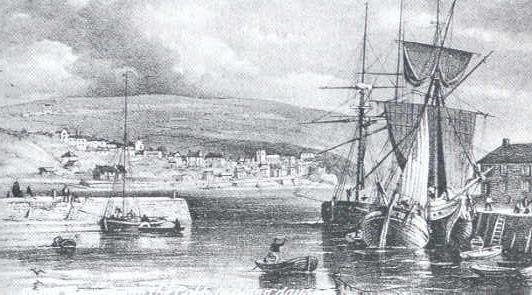
Lyme Regis from the Cobb.
So perhaps with a long and unhappy history of shipping
disasters around the Lyme coast, it is hardly surprising that the
town can claim more life-saving awards than any other harbour
along the Dorset and Hampshire coasts. The critical time for
life-saving at sea was reached in 1824 and this coincided with
the 'Great Gale' of November 1824 when a storm of hurricane
force struck the entire English Channel coast. At Lyme Regis
the Cobb was severely breached with the result that several
vessels sheltering there were destroyed, including the revenue
cutter Fox which sank with the loss of four Customs mariners.
Another vessel, the Unity, was carried away by the ferocity
of the storm and driven ashore midway between Lyme and Charmouth with all
of its crew still on board. From this
incident ensued a remarkable rescue. A local resident, Captain
C. Bennett RN, organised a small rescue party, which included
William Porter, a local pilot, and John Freeman,
another local man. Porter was lowered down a cliff face and
managed to rescue the master of the Unity; Captain Bennett
followed shortly and with great fortitude saved a member of the
crew who had fallen from the rigging into the raging sea.
Another two members of the crew were so utterly shocked and exhausted that they had to be cut from the rigging
and bodily carried safely ashore. For this gallant rescue the captain was
awarded a gold medal from the National Institution for the
Preservation of Life from Shipwreck (which later became the
RNLI), only the third time that the Institution's highest award
had been made. The other two men were each presented with a silver medal.
Just months or so later Captain R. Spencer, the Commander
of the Coastguards at Lyme, adapted an old rowing boat into
an experimental lifeboat by fitting airtight cases under the
thwarts with some also lashed to the gunnels. Captain Spencer
carried out the trials personally as apparently no local pilot or
fisherman was prepared to trust such a makeshift craft! Some
modifications were suggested for this boat, such as the use of further
air-bags and cork sheets laid along the gunnels to
increase the vessel's buoyancy. Although there is no evidence it
is possible that this home-made lifeboat served the port for a
number of years, probably manned solely by Coastguard
boatmen.
In December 1836 a small schooner William and Mary was
wrecked near Lyme and a Coastguard cutter (perhaps the
lifeboat?) under the command of John Keough went out to
assist the crew. Keough managed to rescue four out of the five-man
crew and brought them back safely. He then returned in
a rather foolhardy attempt to rescue some of the schooner's
stores but tragically he drowned. Keough was posthumously
awarded the Institution's silver medal - the fourth such award
in twelve years.
The next tragic incident came on Boxing Day 1852, when the
barque Heroine was caught in a severe storm whilst crossing
Lyme Bay. The master tried to make for the Cobb but his vessel
struck rocks not far from the entrance. The Heroine was bound
for Port Philip (later Melbourne) in Australia with a small
party of emigrants on board. The ship's long boat and a smaller
boat were finally launched with 45 passengers and crew
crowded into the two boats. The commander of a revenue cutter Frances,
which happened to be in port at the time,
launched one of his boats in a laudable attempt to help guide
the other two boats into the harbour. Unfortunately as the
Customs' boat was returning, the heavy seas at the entrance to
the harbour capsized it and four of the five-man crew were
drowned. The survivors of the Heroine were more fortunate, all
were landed safely at Lyme. A fund was set up in the town for the
widows and orphans of the four men to which the
Institution subscribed £20 as well as giving the sole survivor -
William Buckle - a silver medal.
Undoubtedly the Heroine disaster helped to accelerate the
provision of a lifeboat for Lyme. In the previous October the
Lyme Coastguard had petitioned for a lifeboat and had waited
patiently until the following June before receiving a reply from
the Institution merely enquiring what had happened to the
'Spencer lifeboat'? An answer was quickly returned that 'It had capsized
when tried, almost drowning one man so it had not been used
and the stores sold off a number of years past'. Now
if the Institution had acted with some alacrity then perhaps the
deaths of the four men in December might have been avoided.
As it was the provision of a lifeboat was granted only on
condition that the town was prepared to fund two-thirds of its
cost. This was readily agreed and the first lifeboat - a 27 ft
Peake self-righter - arrived in September 1853. Unlike most
other ports this lifeboat was to be manned by Coastguardmen -
eight of them in all - and was not named.
It was not long before the boat was brought into action. In
the following January it went out into Lyme Bay to assist a
French brigantine Jeune Rose which was flying a distress flag.
The Coastguardmen managed to board the vessel and offer
assistance but as they were preparing to tow the vessel back to
port it suddenly partially rolled over causing the lifeboat to
capsize, trapping three men in an air-pocket under the vessel.
Unfortunately, before the craft could be righted one man had drowned.
Then two years later, in August, the lifeboat was
being skippered by another Coastguardman - William
Callaway - and on this occasion he and his crew were
responsible for saving the lives of two men who they plucked
from the sea; this was a deed that gained Callaway a silver
medal for 'his complete disregard for his personal safety'.
The same citation could equally have applied to the next
silver medal that was presented in August 1864, except for one
important difference - this time the recipient was a young lady
who was 'sojourning at Lyme Regis'. One afternoon Miss Alice
de Geyt was rowing in the sheltered waters of the Cobb
accompanied by a lady friend when their attention was drawn
to a great deal of shouting and commotion near the entrance to
the harbour. Apparently two young boys had fallen into the sea
and were in imminent danger of drowning. Miss de Geyt
immediately turned her boat towards the entrance of the
harbour despite the very heavy seas there. With great skill she
managed to manoeuvre the small boat until she and her
companion could haul the two frightened and exhausted boys
on board.
Some spectators on the Cobb wall who had watched the
daring rescue said they were certain that on several occasions
the little rowing boat was in very real danger of being swamped.
Their eye-witness accounts of the brave rescue were no doubt
contributory to Miss de Geyt being awarded the RNLI's silver
medal for her 'outstanding courage and bravery'. Although this
rescue was not in the same mould as Grace Darling's immortal
deeds in 1838, it was only the second time that a woman had
been honoured by the Institution - a true heroine!
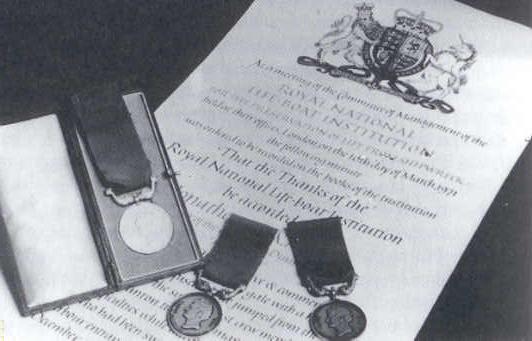
Gold, silver and bronze medals with Vellum Thanks of the RNLI.
(RNLI)
The last medal to be won by a Lyme person came less than
three years later. During a particularly severe January storm in
1867 Lieutenant W.H. Elton, RN, who commanded the
Coastguards at Lyme, went out into the Bay accompanied by
five Coastguard boatmen. On this day Lyme's lifeboat William
Woodcock was unable to be launched. Elton and his small crew
were instrumental in saving three lives from several little local
vessels that were in difficulties. Lieutenant Elton's brave rescue
was acknowledged with a silver medal.
One gold and six silver medals in the space of just over 40
years was no mean achievement and quite an amazing record
unequalled by any port along the coast. The Lyme Regis
lifeboat service gave remarkable service until 1932 when the
lifeboat was removed. Thirty-five years later the Service
returned to this ancient port with the provision of an Inshore
Rescue boat. Nowadays the situation has greatly changed with
more and more people using the sea for leisure purposes. At the
time of writing the port has an 'Atlantic 21' - named
Independent Forester Benevolence. This is the RNLI's latest
inshore lifeboat in service, capable of 30 knots with an
operational radius of 45 miles. This sophisticated craft is
manned by three highly-trained and skilled men - a far, far cry
from the 'Spencer DIY lifeboat' of yesteryear.
