The Naval presence at Portsmouth can be traced back to the end of the 12th century
but the port did not develop as a major
Naval dockyard until Tudor times, when the Navy underwent a major transformation
under Henry VIII. In 1511, Portsmouth was officially
recognised as the shipbuilding centre for the king's ships.
Subsequently the port rapidly expanded into the country's premier Naval base and
'Pompey' is now known as the traditional home of the Royal Navy. The inevitable
consequence of so much Naval activity over the centuries is that the
coastal waters of Dorset, Hampshire and the Isle of Wight have been the scenes
of many Naval disasters.
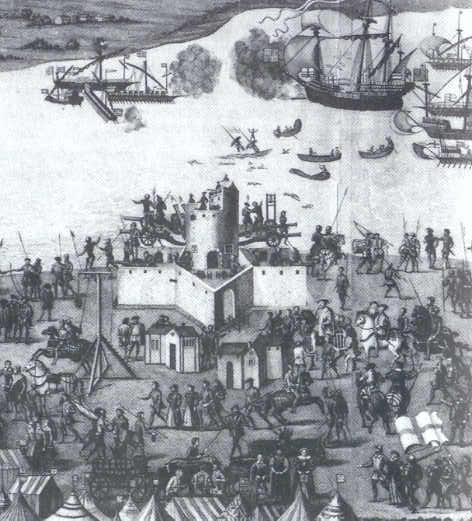
The first and certainly the most famous is the sinking of the Mary Rose in 1545. This
vessel was built at Portsmouth between 1509/10 in what was the earliest dry dock in the
world. It became Henry VIII's flagship and saw service in three French wars. In 1536 it was rebuilt and enlarged with a
complete lower gun deck making it the first true ocean-going
ship of war with the ability to fire a broadside, and was the
prototype for all large battleships for the next two centuries.
When it left Portsmouth on 15th July 1545 to face a French invasion
fleet off the Isle of Wight it was the pride of the king's
navy. But within a mile and a half of the entrance of the
harbour the vessel was swamped with water coming through
the lower deck gun ports and it rapidly sank in just 40 feet of
water. An estimated 700 men lost their lives in the disaster,
including its captain, Sir George Carew, and most if not all of
the 300 heavily armoured soldiers on board. The site of the
wreck was first discovered in 1836 but it was not until October
1982 that the hull of the Mary Rose was dramatically raised
and is now a major exhibition at Portsmouth's historic dockyard.
Two hundred and ten years later saw the first of a series of
shipping accidents which proved very costly for the Georgian
Navy. In April 1755 the 44-gun frigate Assurance was returning
from the West Indies with the retiring Governor of Jamaica and
his accumulated fortune of some £40,000 in gold coins. The
nine year old vessel was under the control of the sailing master
and whilst he was negotiating the tricky and treacherous
Needles Channel the vessel struck an uncharted rock, within
days it was a total wreck. As previously related there was some
suggestion that the Islanders were less than helpful in making
safe the cargo of wrecked vessels!
A far greater disaster struck in February 1758 when the first
Invincible to serve in the Royal Navy was wrecked on Dean
Sands, about 1 ½ miles south-east of Horse Sand Fort at the
entrance to Spithead. This 74-gun man-of-war, named
L'Invincible had been captured from the French in 1747, and
was a new type of vessel which had been evolved by the French
in 1740. So successful was the Invincible that the Royal Navy
adopted it as the standard 74-gun design and these vessels
became the backbone of Nelson's navy. All efforts to free the
vessel were to no avail and within three days Invincible
foundered, but by then all the crew had been saved.
Most 18th century Naval officers were woefully ignorant of the coastal
approaches to the various ports, especially Portsmouth
and Plymouth. Furthermore the available charts
were notoriously inaccurate with many of the shipping perils
and dangerous shoals uncharted. It was also freely
acknowledged that many of the local pilots were incompetent but
despite this it was accepted that Naval officers had no choice
but to rely upon them. Some of the Naval shipping masters
were not much better; reportedly when Vice Admiral Thomas
Cote's squadron returned from the West Indies in 1760 the
vessels had to anchor in Sandown Bay because 'his master not
being well enough acquainted to bring the ships to Spithead'! In
the summer of 1761 the 70-gun Dorsetshire was wrecked at
Horse Sands (close to the Mary Rose wreck site). This shipping
accident caused the Port Admiral (Vice Admiral Fancis
Holborne) at Portsmouth to issue an order to all Naval shipping
masters, '...to sound out the channels, which they should do
several times by way of refreshing their memories, this being the
second great ship they have run ashore lately'. His instruction
appears to have gone unheeded because just four months later, in October,
the 50-gun vessel Portland came to grief on the Middle Ground
just off Ryde.
18th Century engraving of the sinking of the Mary Rose
(National Maritime Museum)
The tragic loss of the Royal George in August 1782 with the terrible
loss of life was a body blow for the Navy, then during the Napoleonic Wars
(1793-1815) over 13,000 seamen died in
either shipwreck or accidents, an appalling figure, which was
double those killed as a result of enemy action, and during this
period no less than 101 Naval vessels were destroyed by
accidental causes. For instance during 1799 no less than 19
Naval ships were lost by either wrecking or fire. Of these the
greatest loss without doubt was that of the 90-gun
Impregnable, which was escorting a convoy of merchant ships
back from Lisbon. As the vessel was making its final approach
to Portsmouth, it went aground near the entrance to Langstone
harbour. Earlier in the year the small captured sloop Les Deux
Amis was wrecked just off the Isle of Wight. Fortunately in both instances
there was no loss of life.
This was also the case in October 1811 when the 38-gun
frigate Pomone was stranded. The frigate was returning from
the Mediterranean where its captain - Robert Barrie - had
gained conspicous success in several engagements with the
French. Barrie was trying to achieve a speedy return to
Portsmouth and had decided to use the Needles Channel. As
with the Assurance he misjudged his course and the Pomone
struck Goose Rock causing considerable damage to the vessel
and ensuring that all hopes of refloating it were futile. During
the following three days hordes of small boats were employed
in clearing the vessel of its guns, stores and other possessions.
Amazingly some thoroughbred Iranian horses, which were a gift
from the Shah of Persia to King George III, were landed safely.
The loss of HMS Eurydice during a squall. (Illustrated London News)
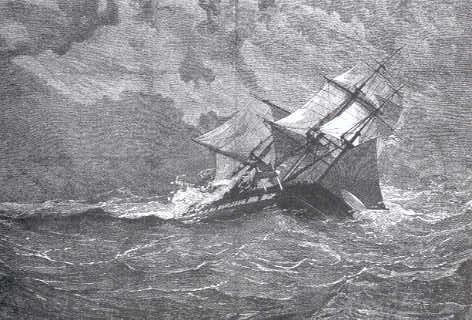
In March 1878 the foundering of HMS Eurydice off Dunnose
Point to the south-east of the Isle of Wight was a Naval disaster of some
magnitude. This accident was made even more tragic
by the fact that so many of the victims were very young seamen
undergoing sail training at the time. Not only was the loss of
the Eurydice a traumatic blow to the Admiralty but it left a deep
impression on the British public as it cast serious doubts on the
might and competence of the Royal Navy. This was especially
so as it came less than eight years after another Naval calamity
in very similar circumstances. This was the loss of HMS
Captain, the Navy's first turreted ironclad, which capsized off
Cape Finisterre in September 1870 with the los of 483 officers and men.
The Eurydice was a wooden fully-rigged fast sailing ship,
which had been built in 1843 and later converted to a purely sail-training
vessel. On 24th March 1878 it was returning from
a training cruise in the West Indies with 300 young seamen on board as well
as 35 passengers. At about 3.30pm it was sighted
by the Bonchurch Coastguard 'sailing hard for Spithead under
all plain sail...' Twenty minutes later a heavy squall
accompanied by a blinding snow storm came suddenley from the land,
catching the vessel completely unawares. In less than ten
minutes the squall had passed, the wind had died down but all
that could be seen of the Eurydice was 'the masts and top
hampers [upper sails and rigging] showing above the water just
about 2½ miles off the island'. Apparently the fierce squall had
turned the vessel's bows to the east causing it to capsize to the
starboard, with the result that water rushed in through the
open ports.
A small schooner, the Emma, which had managed to survive
the same squall, picked up the only four survivors but
unfortunately two seamen later died. The final death toll
was 364 officers and men, most of whom were buried in the
cemetery at Haslar Hospital in Portsmouth. By the end of March
there were plans to salvage the vessel and the hulk was finally brought
into Portsmouth harbour. Such was the public interest
in the sad accident that a Royal Marine guard was mounted
both by day and night. The court martial into the accident took
place in August 1878 and it found that the vessel had foundered
...by pressure of the wind upon her sails during a sudden and
exceptionally dense snow storm, which overtook her when the
approach was partially hidden by the proximity of the ship to
high land and no blame can by attached to the captain, the
officers and men of Eurydice...' Since then there have been several
'sightings' in the area of a fully-rigged sailing ship
moving along at a considerable speed before suddenley disappearing
from view. Of such stories are made the legends of the sea!
After the dramatic collision and sinking of HMS Gladiator
and the ramming and sinking of HMS Tiger during Fleet
exercises off the Isle of Wight in April 1908, all the subsequent
Naval accidents in those coastal waters have been mercifully of
a less spectacular and tragic nature. One that is deserving of
mention is the sad loss of HMS Hazard, the doughty ex-torpedo
gun boat which had given such sterling service as the tender to
the early submarines. On January 28th 1918 the Hazard was
steaming in the eastern Solent when it was rammed by the large
casualty-clearing steamer Western Australia. The Hazard
was virtually sliced in half and sank very quickly. Although it
carried a complement of 120 men, all but three were saved and
a fourth one later died from his injuries.
