In July 1941 Winston Churchill said, 'The Merchant Navy, with Allied comrades, night and day,
in weather fair or foul, faces not only the ordinary perils of the sea but the sudden
assaults of war beneath the waters or from the sky...' During the Second World War over 32,000 British
merchant seamen lost their lives compared with some 51,000 Naval personnel; it was with some
justification that the British merchant fleet was called the 'Fourth Service'. These merchant
seamen paid a very high price to ensure that the vital supplies of food, oil, coal and armaments
arrived safely in ports.
The waters along the Dorset and Hampshire coasts saw more than their fair share of sinkings
during both world wars. It seems almost invidious to select just a few of the countless
wartime casualties to illustrate the heavy toll that was taken of shipping along these coasts.
One of the earliest wartime casualties was the large Belgian passenger liner Alex Van Ospstal,
which was en route from New York to Antwerp when it struck a mine on 15th September 1939
and sank about five miles east of the Shambles lightship. About three weeks later (7th October) a Dutch
freighter of the Holland/Amerika line - the Binnendijk - also hit a mine at almost
the same spot. Then towards the end of November yet another foreign vessel - the Greek steamship
Elena R - was also mined near the Shambles whilst on a voyage from Rosario to Antwerp.
Mines were no respecters of neutrality.
1940 proved to be a particularly horrendous year; it was estimated that one ship was sunk or
damaged beyond repair for every three that left port. From the summer of that year, as the German
forces occupied the air and naval bases in northern France, any shipping movements along the south
coast were prey to enemy attacks by sea and from the air. June 1940 saw
the start of the E-boat campaign, those powerful and fast torpedo boats wrought havoc with
coastal shipping. Then two months later Hitler lifted all restrictions on U-boat targets - neutral
as well as Allied ships would be attacked on sight.
The Cambrian was a small coasting vessel requisitioned by the Navy shortly
after the outbreak of the war. Its duties were to patrol the boom defence system
which had been installed between Southsea and Ryde with the express intention of
preventing enemy submarines from entering Spithead and Portsmouth harbour. On 20th
May 1940 whilst on patrol to the south-east of Horse Sand Fort, the vessel hit a mine
and sank almost immediately with a total loss of life. The wreck was visible
at low tide for many months but as the vessel was so badly damaged it was not considered
worth salvaging.
The coaster Capable hit a mine on 5 June 1940.
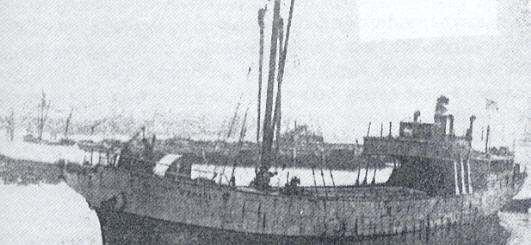
Five days later yet another small vessel came to grief in Spithead. This was the Capable,
a mere 216 ton coaster which was a very familiar sight around the coasts during the
1920/30s. Early in June 1940 it left Alderney with a cargo of stone for Portsmouth;
but on the 5th when almost in sight of the harbour it struck a mine and foundered with
the loss of its five-man crew and two Territorial gunners. This seemed a particularly
sad end for such a doughty little vessel, especially as ten years earlier it had grounded on
Atherfield Ledge off the Isle of Wight. Although not many vessels managed to escape from this dangerous
spot, the Capable was finally refloated and repaired, despite being badly damaged. It
continued steadily to ply its trade until that fateful day off Bembridge.
June saw the enemy take a continued heavy toll of the small vessels that used the coastal waters.
On the 13th a steam tanker, the British Inventor fell prey to a mine just a couple of
miles off St Aldhelm's Head and the vessel drifted towards the Shambles. Fortunately an
armed yacht in the vicinity managed to save the crew, but although an Admiralty tug came out
from Portland, it sank before a towline could be placed aboard. Seventeen days later
the Clan Ogilvy was destroyed by an enemy torpedo
off St Catherine's Head, the most southerly point of the Isle of Wight.
In July Portland began to suffer from enemy air attacks. On the 4th an auxiliary anti-aircraft vessel
Foyle Bank was so severely damaged by bombs that it sank in the harbour. It was
in this attack that Leading Seaman Mantle was posthumously awarded the Victoria Cross for
remaining at his gun position though mortally wounded. On the same day the Elmcrest,
a 4,300 ton steamship, was attacked by E-boats just off the Shambles and finally sank with
the loss of 16 men out of a crew of 38. On the following day the British vessel the Hartlepool
suffered several attacks from enemy aircraft and sank near the entrance to Weymouth
harbour. The morning of the 9th saw Portland under further enemy air attacks during which
Empire Daffodil, a 398 ton Ministry of War Transport, sank. Two days later
the enemy aircraft returned with a vengeance and three vessels were destroyed - Peru, Eleanor Brook and Warrior II; the latter
vessel was an armed steam yacht which had been built in 1904 and had already survived World
War One. The 1,120 ton vessel was dive-bombed and machine-gunned and finally went down
about ten miles south-east of Grove Point. Ten days later a large Norwegian tanker
Kollstregg was bombed some ten miles from Swanage. The port's lifeboat, Thomas Markby
was launched and found the tanker ablaze, although fortunately the crew had been taken off
by a Naval destroyer. Despite the terrible fires that were raging four lifeboatmen
bravely managed to get on board and secure a towline enabling the tanker
to be brought into Portland.
Perhaps one of the most blatant and shameful attacks took place on 24th July. The French liner
Meknes had left Southampton early in the morning with 1,281 French sailors, of whom
102 were crew, 99 officers and 1,080 ratings. Because France had surrendered in June
these French service personnel were being repatriated. The vessel was marked with French
colours and was brightly illuminated to prevent any possibiility of mistaken nationality.
Late in the evening it was attacked by
a German E-boat some miles off Portland. The captain of the
Meknes signalled her name and nationality and brough the
vessel to a halt to await the commandant's reply and instructions.
The reply was short and devastating - it was torpedoed
and sank within ten minutes. Fortunately 898 survivors
managed to make it to the shore, over 100 of whom were badly
injured. More than 380 officers and men were not accounted for, though some might have
reached France in boats.
The air attacks on Portland and the strong presence of E-boats decided the authorities that the
Shambles lightship
should no longer be manned. On 1st August the reserve Weymouth lifeboat Queen Victoria
went out to collect the seven man crew. Of course Portland was only one of the south coast
ports to suffer from heavy air raids. Later, in November 1940, Southampton
was to endure a horrendous blitz, which
has been called 'a savage and brutal assassination'. And in the
early months of 1941 it was Portsmouth's turn to suffer.
Perhaps if we consider what happened to one coastal convoy - numbered CW9 -
in August 1940 then it will be possible to see the dangers faced by small coasting vessels
during the early years of the war. There were no less than 25 vessels in CW9 and
they had loaded coal and coke in the north-east ports, as well as flour and food in London
for ports such as Portsmouth, Weymouth, Portland and Plymouth. These
convoys were fondly known as the 'Coal Scuttle Brigade' because
those towns and ports were quite dependent on their supplies of sea-borne coal.
The convoy left Southend on the afternoon of 7th August
with the intention of passing Dover and the dreaded 'Hellfire Corner' during
the hours of darkness. A destroyer escort and a Hurricane
squadron from Tangmere in Sussex were standing by to give protection.
But during the night the enemy E-boats struck.
The steamship Holme Force and the motor ship
Fife Coast were both torpedoed and sank while the rest of the
convoy scattered. In the fury of the attack two vessels collided
with each other; one sank and the other was badly damaged. By the afternoon
of the 8th the remaining vessels were trying to reform near
Spithead when out of the skies came flights of Junkers 87s - the dreaded
Stuka dive bombers. The first vessel
to be sunk was the Coquetdale, a 1,000 ton steamship,
followed swiftly by the Dutch coaster Ajax. All of the 23 crew
of the Croquetdale managed to escape in boats but four out of
19 Dutchmen were killed. About two hours later another wave
of bombers attacked and in this onslaught the Empire Crusader
was sunk to the west of the Isle of Wight. In total ten vessels
were destroyed and another 13 badly damaged.
Even small harbour vessels were not immune to the ravages of war.
In May 1941 a Portsmouth harbour tug, the Irishman, was
in Langstone harbour towing a barge loaded with a large
crane. It suddenley struck a mine and both vessels 'disappeared
in a huge waterspout'. It was subsequently thought that the
aerial mine had been dropped earlier the previous night. But
perhaps one of the most traumatic shipping accidents of the
early war years was the loss of the Southern Railway ferry -
Portsdown. This small paddle steamer had become a much
loved and familiar vessel serving on the Portsmouth to Ryde
crossing since the late 1920s.
The Portsdown sank on 20 September 1941 after striking a mine.
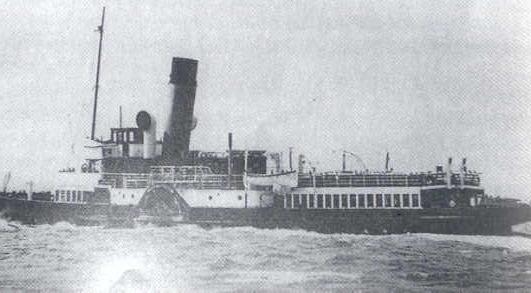
The Portsdown left Portsmouth at 4am on 20th September 1941
on what was known as the 'mail-boat' run. Barely ten
minutes into the journey it struck a mine. The explosion blew off the
bow section, which rolled over and sank. The after and
larger section of the vessel managed to stay afloat in reasonably
shallow water. Fortunately, becuse of the early hour of the sailing, the
ferry had few passengers on board - some 30 of them were servicemen
returning home on leave. The various
resuce services were very quickly on the scene and 24 persons were
saved; 19 lives had been lost although only three bodies were
ever recovered. Considering that the Portsdown was licensed to carry
732 passengers and that it was a popular and well-used crossing, the
accident could have had much more tragic consequences.
1942 proved to be the watershed for British merchant ship losses,
although the following year saw a number of sinkings in the area - most notably the large motor
vessel Moldavia, which was torpedoed whilst crossing Lyme Bay. By the end
of 1943 the battle against the dreaded U-boats had virtually been won,
although on 29th December 1944 the large American steamship
the Black Hawk was torpedoed off Warbarrow Bay,
where it later drifted in and beached on a reef.
During the Second World War over 1,560 British merchant
vessels had been sunk by enemy action. The men who had served under the Red
Ensign thoroughly deserved the tribute paid to them by the Minister for War Transport
in July 1945: 'The merchant seaman never faltered. To him we owe our preservation and our very
lives'.
