The port of Southampton owes its growth and development in no small measure to the famous double
tide of its coastal waters, which gives the port deeper water far longer than any other Channel
port. But its pre-eminence as a major passenger liner port really dates from the early years of
this century when the various facilites - docks, wharves, graving yards, railway links and
passenger terminals - made Southampton one of the finest passenger ports in Europe - 'The Gateway to the World'.
The first major passenger shipping company to avail itself of these fine
facilities by transferring its operations to the port was the White Star Line
in 1907, followed by Cunard in 1919, Canadian Pacific the following year and then
P&O returned to the port after an absence of some 45 years. As well as these famous
lines most of the principal foreign shipping lines used
Southampton as a terminal. With the number and size of all these large passenger
liners using the port and the narrow confines of its coastal waters allied to the
nearby presence of the important and busy Naval base of Portsmouth, the risk of
collision had become quite high.
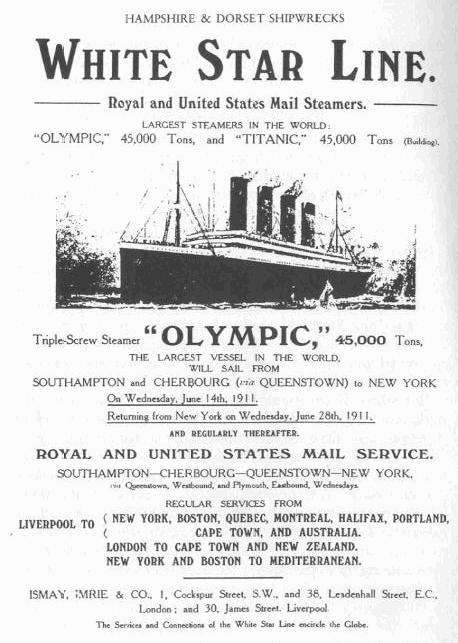
White Star Line
A salutary warning for the future came first in 1902 when the German liner
Kronprinz Wilheim, a 15,000 ton liner, collided
with HMS Wizard, a mere 270 ton Naval torpedo boat destroyer.
Both vessels were cruising upstream in Southampton Water on 8th October
and were just off Fawley beacon when the Wizard's commanding
officer tried to overtake the liner, although at the time the liner
was proceeding at a fairly brisk rate of knots - 17! It may have been a risky
show of derring-do by the Naval Officer. The small warship was literally 'drawn in' to the liner's side
and although the German vessel escaped unharmed, the Wizard suffered heavy
damage to its bows but luckily there were no casualties. A further lesson
should have been heeded in April 1908 when another Naval vessel
collided with an American liner in the approaches to the Solent with
some loss of life, although in this accident the atrocious weather
conditions were considered to be the main factor. Less than three years
later another large passenger liner collided most dramatically
with yet another Naval vessel.
At 11.20am on 20th September 1911, the White Star liner Olympic left
Southampton for its fifth voyage to New York. The weather was clear and bright
with good visibility. The Olympic was then considered
to be the largest passenger liner in the world at some 45,230 tons.
It had been built by Harland & Wolff in Belfast and had made its
maiden voyage to New York the previous June. In charge of this fine
liner was Captain Edward John Smith, the most experienced and senior
commander of the White Star line but, as was normal procedure,
the vessel was under the control of a Trinity House harbour pilot -
George Bowyer.
Just where Southampton Water meets the Isle of Wight the pilot had the choice
of either a starboard route down the Solent or to port to follow
the rather intricate passage around a large shoal known as
'Bramble Bank', and then down through Spithead to the Channel. It was
well known that the very experienced Bowyer favoured the Spithead route.
By about 12.40pm the Olympic was approaching the Bramble
and the pilot sounded the vessel's whistle twice, signalling
that he was making a turn to port. As he did so a grey Naval
vessel was first seen coming up to the rear of the liner about
two miles off the starboard quarter.
This vessel was HMS Hawke, a light cruiser of 7,530 tons, which had spent
the previous day undergoing steam trials in the Solent and was now
returning to Portsmouth under the command of Commander William Blunt. After
completing its manoeuvre satisfactorily the Olympic started
to increase its speed from 11 to 17 knots and both the pilot and Captain
Smith assumed that the liner would soon pull away from the Naval vessel.
But the Hawke quickly reached a point almost level with the
centre of the liner with about 300 yards of water separating them.
Suddenley the Hawke took a sharp turn to port, causing
panic on the liner's bridge as it seemed that the Naval vessel was
attempting to pass under their stern. Several passengers later so testified,
even claiming that the Navy men were 'showing off'!
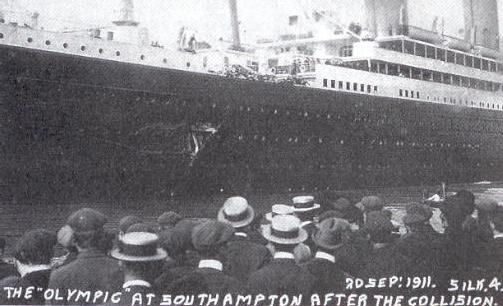
Within minutes there was a tremendous noise as the Hawke rammed
the Olympic some 90 feet from its stern, leaving a large 15 feet
triangular hole, which reached to below the liner's waterline.
The watertight compartments on both vessels were immediately
closed and the Hawke took an enormous roll to port;
some witnesses thought that it was in imminent danger
of capsizing. Then the vessel recovered and was swept clear of the liner's plating.
Once Commander Blunt satisfied himself that Olympic was
not likely to founder he proceeded slowly to Portsmouth.
Because of its damaged condition the Olympic was unable
to return to Southampton until the next high tide, so Captain
Smith anchored in Osborne Bay, just off Cowes, whilst the passengers
were taken off by tenders. Amazingly there was not a single injury,
although it was later said that as the collision had occurred
at lunchtime most of the passengers were away from the cabins which
had been damaged, otherwise the result could have been very different.
A postcard showing the Olympic after the collision.
The liner was compelled to remain in Southampton for two weeks undergoing
temporary repairs just to make it seaworthy for its journey to Belfast for a complete
overhaul, which took another six weeks at a cost of £103,000. By
tragic irony one of the liner's damaged propellors was, to save time, replaced
by one from its sister ship Titanic, then under construction at
Harland & Wolff's yard. This effectively delayed the Titanic's maiden
voyage from Southampton by almost one month. What a fateful chain of consequences was
set in motion by this accident!
The Admiralty Court appointed to inquire into the shipping accident sat aboard the
Duke of Wellington in Portsmouth harbour. It commenced its hearings on
11th November 1911 and did not close until 19th December after listening
to evidence from an endless number of eye-witnesses and a variety
of maritime experts. The White Star Company claimed that the Naval vessel was at
fault, whereas the Navy countered that the accident had been caused by a navigational
error on the part of the pilot. During the evidence it transpired that Commander
Blunt had ordered his helmsman to steer away from the Olympic but the vessel
had become 'uncontrollable' with its helm apparently jammed. At least one expert
put forward the theory that the two vessels had been drawn or sucked together by
hydrodynamics. The heavier the ship and the faster it was sailing the greater were
the pressures and interaction between the two vessels. The Court dismissed
this theory and finally ruled that there was negligence by the Trinity House
pilot - George Bowyer. The verdict shocked the White Star Company and Captain
Smith is said to have exclaimed 'By God we are not going to let them get away with this!' The Company
appealed and it was not until April 1913 that the Admiralty Court's ruling was upheld
and the appeal was dismissed with costs.
But by then the events set in motion by the Olympic collison reached their tragic conclusion.
In 1912 Captain Smith had been appointed as Commodore of the White Star fleet, and at a
salary of £1,250 a year (plus a £1,000 bonus at the end of each successful voyage) he was
the highest paid seaman in the country. On 10th April 1912 he was in command of the White
Star's newest passenger liner the Titanic as it left Southampton on its
fateful maiden voyage. Strangely George Bowyer was again the pilot and within the first
few minutes of the journey there was a near collision with the large American liner New York, which
was berthed in Southampton. It is now history that four days later the Titanic struck
a large iceberg which severely damaged the vessel below the water-line, and it sank
within three hours with the loss of 1,522 lives. This toll included Captain Smith,
Chief Officer Wilde and First Officer Murdoch, all of whom had served on the Olympic, a
coincidence worthy of Greek tragedy.
Subsequently the Olympic had a somewhat chequered but nevertheless successful career.
Converted to a troopship during the First World War it served in the Dardanelles and the Gallipoli landings.
Then near the Lizard on 12th May 1918 it rammed and sank U-103 which had attempted to torpedo it.
Back to peacetime duties Olympic continued to operate on the Southampton to
New York crossing. In 1930 it was extensively refurbished but in May 1934
in thick fog it rammed and sank the Nantucket lightship with a total loss of the lightship's crew,
resulting in a $500,000 claim by the American government. The final trans-Atlantic voyage
of Olympic took place in March 1935, after which it was sold for scrap with the proviso that it would be broken up in Jarrow to
provide some work for the unemployed in the area.
HMS Hawke did not enjoy such a long career. After the collision it needed extensive
repairs before returning to active service. Then in October 1914 while on patrol off
the Northeast coast of Scotland it was torpedoed and sank with the loss of 500 officers and men; there were only 70 survivors.
