The submarine sank immediately with the loss of its 11 men. A general signal was issued to the
fleet the following day, '...These lives have not been thrown away if we consider their splendid
example and cheerful and enthusiastic performance
of duty involving all the risks of war'. Despite this, the newspapers
of the day echoed the public's deep concern at the thought of 'sailors entombed
in iron coffins', submarine disasters were considered most 'distressful and disturbing'.
Alas, this first submarine disaster was destined to be followed by all too many other peacetime
sinkings. Each reported accident elicted deep and sympathetic feelings by emotive headlines
like 'living tombs', 'the perils beneath the seas' and 'Lonely buoy that marks the tombs of the A-1 heroes'.
A-1, one of the earliest submarines, 1903.
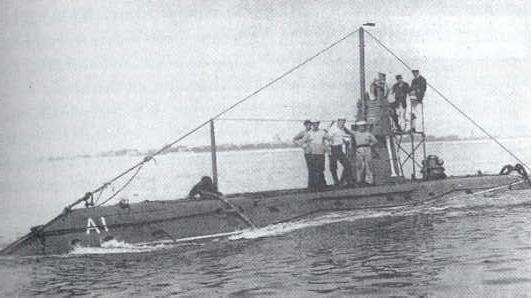
It took about five weeks to recover the A-1, which after a complete refit was back once again in service.
In August 1910 there was a huge explosion on board the submarine as she was lying in Portsmouth
harbour, which was thought to have been caused by an accumulation of petrol gas. Seven members
of the crew were badly injured, one of whom was actually blown through the conning tower.
This time it was not thought worth repairing and exactly 12 months later A-1 was towed
out into Spithead to be used as a target; it is now just another wreck among the countless littering the sea bed.
With the fast increase in the number of submarines, it was merely a matter of time before
another serious accident occurred, especially as one of the major faults of the A Series
vessels was 'a lack of buoyancy'. Stokes Bay was the scene of another potentially tragic
accident. In October 1905 A-4, commanded by Lieutenant Martin Nasmith, was swamped
just as it was diving. The submarine sank to 90 feet - only ten feet short of her
safe diving limit. However, due to the coolness of Lieutenant Nasmith and his crew they
managed to resurface again after about four minutes. The submarine was towed
into Portsmouth harbour by HMS Hazard only to be shaken by two violent explosions
before slowly sinking beneath the waters. The subsequent court martial found Lieutenant Nasmith
guilty of default but he was acquitted on the more serious charge of negligence. Even
The Times, normally a very conservative newspaper on service matters, felt the need
to comment, 'Nothing but the steadiness of the men and the splendid presence of mind
of Lieutenant Nasmith and Sub-Lieutenant Herbert could have saved the country from yet
another appalling submarine disaster'. Nasmith later was awarded the Victoria Cross
for an action with the Submarine Service in the Dardenelles and he finally reached the rank
of admiral.
Almost seven years later yet another submarine disaster attracted universal deep public
sympathy. On 2nd February 1912, HM A-3 was involved in a Fleet exercise to the south-east
of the Isle of Wight. It was just surfacing when it was rammed and sunk by HMS Hazard
with the loss of 14 officers and men. This accident had particularly tragic overtones
in that Hazard, an old torpedo-gunboat, in 1902 had been allocated to the Submarine
Service as its first depot ship.
Unfortunately the Hampshire and Dorset coasts saw more tragic submarine accidents. In January
1924 HM L-24 collided with HMS Resolution just south of Portland Bill and the submarine sank with a total
loss of life. Then eight years later on 26th January 1932 HM M-2 left Portland naval
base with other submarines and a flotilla tender. The M-2 had recently been converted, its single
large gun removed and the space utilised to carry a small seaplane, which was launched by means
of a catapult. At 10am the M-2 submerged, but as by later afternoon it had failed to arrive at the designated
spot it was thought to have met with an accident. The Captain of a coastal steamer, the Tynesider, had
sighted a submarine diving some eight miles off Portland Bill and on arrival in Portland he
enquired whether it was normal for a submarine to dive stern first! Following the bearings of the last sighting of
M-2, the submarine was subsequently located in some 108 feet of water about six miles
from Portland. It was thought that the watertight hanger door had been opened too quickly on
surfacing so that the submarine had slid backwards below the water. The loss of life was appallingly high -
all 60 officers and men perished. Salvage operations were commenced but because of the
endless problems that were encountered and the escalating costs, the operation was finally
called off.
The strong links that HM Submarine Service has made with the coastal waters of Hampshire and
Dorset is acknowledged by the presence of the Naval Submarine Museum at Gosport, where the very first
Naval submarine Holland 1 proudly stands outside the Museum. This vessel, which sank in 1913 just off
the Eddystone lighthouse whilst on tow, was not raised until 1982. The lives of all the brave officers and men of these
early submarines were not lost in vain. Just as Admiral 'Jackie' Fisher prophesised almost
100 years ago, the submarine has become 'the battleship of the future'. Certainly his
vision and judgement of these 'advanced weapons' has been completely vindicated.
