During the last century hundreds of thousands of people undertook
a sea journey of quite unimaginable proportions, they sailed to the
new colonies of Australia and New Zealand - a distance of some 13,000
miles. Most of these intrepid emigrants previously had hardly ventured
far from their towns, villages and hamlets before embarking on such
a sea journey, which would take three months or even longer. They
were driven to such desperate measures by the desire to escape
from their squalid living and working conditions to what promised to be a more prosperous,
healthy life. Their journeys were made possible by government
financial inducements.
Such dauntless voyagers faced a long period of isolation from
all that they knew of the old world, with only their fellow passengers
as company. They were forced to suffer the rigours and perils of a long sea journey -
storms, icebergs, fever and sickness and shipwrecks - when many
had never even seen the sea before let alone sailed upon it. But of all
dangers they faced perhaps their greatest fear was shipwreck. Some of the
worst shipping disasters of the last century involved emigrant vessels,
and many artists' lurid impressions of these wrecks had inculcated
grim foreboding in the minds of all but the most sanguine souls. Those
who finally made such a long and perilous sea journey would
probably have subscribed to Dr Johnson's view,'...a ship is worse
than a jail. There is in a jail, better air, better company, better
conveniency of every kind; and a ship has the additional disadvantage of
being in danger...'
Nevertheless the chances of being wrecked at the outset of such a voyage were relatively slight
as most of the wrecks had occurred off far distant shores when the poor
emigrants were almost within sight of their new home. In the case
of one vessel in 1877 the exception almost disproved the rule. The
Avalanche was an iron sailing ship of 1,210 tons, built for Shaw
Savill & Co only three years earlier and considered to be one of the finest
and fastest vessels operating to New Zealand. Shaw Savill & Co were
one of the leading shipping companies in the emigrant trade; Robert Shaw
and Walter Savill had founded their partnership in 1858 with the
express purpose of consolidating the British connection with New Zealand,
and it maintained this vital link for the next 125 years.
The Avalanche was only the third vessel to be built for the
young company. It was a fine clipper ship and a fast sailer, having
consistently managed to make Wellington in New Zealand in 90 days on
its three previous successful voyages. It was not strictly an 'emigrant' ship
in the true sence as it also carried a fair amount of general cargo.
The vessel left London on 8th September 1877 bound for Wellington under
the command of Captain Ephraim Williams and with a crew of 43. On this
voyage it also carried 63 emigrant passengers - men, women and children.
During its journey down the Thames the vessel was in collision with
a foreign barque and although superficial damage was caused - the Avalanche
lost its figurehead - many of its crew considered this to be an ill-omem for the forthcoming
voyage. In this instance they were proved right. Late on the evening
of the 11th the Avalanche was sailing about 15 miles south of
Portland in quite atrocious weather. A force eight gale
was blowing, there was heavy driving rain and the seas were high
and rough. The vessel still had the Channel pilot on board, well
experienced in all the problems of the Dorset coast in such
conditions. Sailing towards the Avalanche was a slightly larger
wooden sailing vessel, the Forest, built in Nova Scotia, in ballast
and bound for Sandy Hook, New York. It had a crew of 21 men under the
command of Captain Lockhart.
It was the lookout on the Forest who first sighted the light of another
vessel, which appeared to be sailing on a port tack. As the Forest
was on a starboard track, under the Rules of the Sea, it would have the right of way. Nevertheless
Captain Lockhart ordered a flare to be burned to warn the oncoming
vessel. But within minutes the Forest struck the Avalanche right between the
main and mizzen masts, almost cutting the vessel in two. The force
of the impact caused the Forest to rebound and it struck the Avalanche a second time slightly further
aft.
(Southampton City Art Gallery)
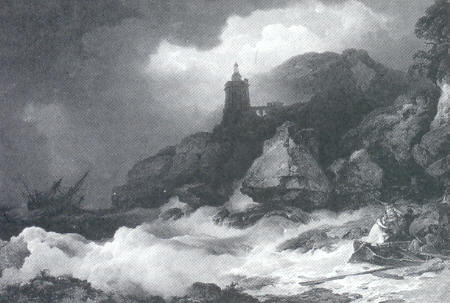
Despite being constructed of iron, the Avalanche did not stand a chance and sank almost
immediately. There was no hope at all for any of the passengers, most
of whom were asleep below decks, and only three members of the crew -
the third mate and two seamen - escaped by jumping on to the Forest
as it backed away. In minutes the Avalanche had become a terrible
shipping tragedy - 103 people were drowned.
The Forest itself was also in serious difficulties; it had suffered badly in the
collision and water was pouring into its holds. Within 15 minutes Captain
Lockhart decided to abandon ship, and its three boats were launched
after great difficulty. One was quickly overwhelmed in the heavy seas and
the second was later washed ashore but with no survivors. The third boat
contained the Captain and 11 seamen, including the three men who had
escaped from the Avalanche.
Just after dawn this boat was sighted off the Chesil Beach. Apparently
the Captain was afraid of making an attempted landing on this dreaded stretch of
coast for fear of foundering in the very heavy surf. Two of the famous
Portland 'lerrets'
were launched, each with a crew of seven staunch fishermen and with great bravery and
skill they managed to bring ashore the 12 survivors of this terrible
collision. The fishermen were awarded £140 for their brave rescue and their
actions, which received much press publicity, did much to improve
the somewhat tarnished reputation of Portland men.
The battered Forrest eventually grounded near Chesil Cove and it was
decided to blow up the remains of the vessel. The task was given up to a
Naval vessel HMS Defense but unfortunately the Naval men
experienced considerable difficulties, and their abortive attempts
created much public interest - even the local coast paddle steamers
ran special excursions to view 'the fun'! The captain of the Defense became
so embarrassed about the whole affair that he towed the Forest
out into the Channel and finally sank it away from prying eyes.
Walter Savill was stunned by the dreadful news - not only at the high loss of
life but the destruction of one of his finest and newest ships. But he
wrote quite simply in his Sailings Book 'Foundered off Portland - Sept 11'.
So determined was he never again to risk the lives of his
passengers through collisions in the English Channel he resolved that
most of the passengers would in future embark at Plymouth.
This sad shipping disaster was not destined to be quickly forgotten.
Some of the bodies that were later washed ashore apparently
were treated with a scant lack of ceremony by the local parish
authorities, whose responsiblity it was to bury them. The Times
newspaper picked up the story and roundly condemned the authorities for
'the hasty and shameful treatment of the dead'. Quite a furore broke out and as a result of
all the publicity, the relatives and friends of the unfortunate
passengers and crew of the Avalanche launched a memorial fund.
A public subscription was started with the help of the press and contributions
were quickly forthcoming from all parts of the country as well as from New Zealand
and Australia. In a relatively short time sufficient funds had been
collected not only to purchase a site at Southwell, Portland, which overlooked
the spot where the Avalanche had foundered, but also enough to build
a memorial chapel. This small church - St Andrew's - was consecrated and
opened for worship in 1879. The church still stands high above
the sea and was, for a long time, known as the Avalanche church. It is,
to my knowledge, the only church in this country built to the
memory of the poor and unfortunate victims of a shipwreck.
