There have been many tragic shipwrecks along the Dorset coast over the
centuries but few have gained more public interest and elicited so
much sympathy than the loss of the Earl of Abergavenny, which
foundered in Weymouth Bay on 5th February 1805. The vessel, a large East
Indiaman was, at over 1,180 tons, one of the biggest in the East India
fleet, then numbering over 80 ships of various sizes. Furthermore it
had gained an enviable reputation for the degree of comfort and
luxury it afforded its 60 or so passengers. Certainly it was a most
prestigious vessel; built in 1789 for the lucrative China and India
trade it had already completed seven voyages to the Far East. But
what really made the wreck so famed was the enormous value
of its cargo, especially its chests of silver coin and the several subsequent attempts
to salvage it. The deep public sympathy had been gained by the terrible
death toll - no less than 261 souls perished in the wreck. If anything
further was needed to ensure the wreck's lasting fame, it was that the
Captain of the vessel was John Wordsworth, youngest brother of the famous
poet William.
One contemporary report described the wreck as 'a calamitous tragedy' and
another claimed that the tragic events were 'a concurrence of circumstances'.
Certainly there was some evidence that Captain Wordsworth was
apprehensive about the approaching voyage but this might be
because he had about £20,000 invested in 'private goods' including
£1,200 on behalf of brother William and sister Dorothy. The right to ship
'personal cargo' was the most valuable perquisite granted
to officers of the East India Company and many had made considerable
fortunes out of their trading. John Wordsworth was, no doubt, deeply
concerned about the financial risk he was taking especially as on
his two previous voyages he had lost several thousands of pounds. In
his last letter to his brother he wrote, '...if we are fortunate to get safe
and soon to Bengal - I mean before any ship of the season - I have no doubt
that I shall make a very good voyage of it, if not a very great one -
at least that is my general opinion...' In fact his ambition was to
make the voyage so successful that he could afford to leave the sea, buy a
property in Grasmere and help support William so that his brother could devote his
life to poetry.
The Earl of Abergavenny left the East India docks during the early weeks of November 1804
to complete its loading in Gravesend. Captain Wordsworth had strict
instructions to be in the Downs a few days before Christmas. Whilst the
vessel was there another East Indiaman destined for the same convoy
dragged its anchor and struck the bows of the Earl of Abergavenny
but fortunately no serious damage was sustained. But to many
superstitious crew members this mishap did not bode well for the coming
voyage. The final port of call was Portsmouth, where most of the 60
passengers - men, women and children - boarded the vessel. With the crew
and a number of East India troops there was a total of 402 on the
vessel when it finally left the port with four other East Indiamen
under the protection of a Naval frigate HMS Weymouth.
On their passage through the Needles Channel the small convoy encountered strong
and unfavourable winds, which resulted in the four vessels losing contact
with their escort. Captain Clarke, who was commander of the Wexford
took charge of the convoy and ordered the other captains to take pilots
on board and to make their own way to Portland Roads to await the
reappearance of the frigate.
By mid-afternoon of 5th February the Earl of Abergavenny was making
slow but steady progress to the anchorage but
rather too close to the Shambles Bank for comfort. Unfortunately the
vessel was driven on to the Bank, seemingly through
a navigational error by the pilot. Neither the pilot nor the Captain
were particularly perturbed about the stranding as they were both
sure that the vessel would clear when the tide turned. So for at least
1½ hours no alarm was raised nor were any distress signals fired.
When the vessel did float free on the flood tide, a serious leak was discovered
in the hull with seawater rapidly filling the holds. Even at this stage John
Wordsworth did not seem particularly concerned about the situation
as he intended to return to Portsmouth for repairs.
The loss of the Abergavenny East Indiaman off Portland.
(National Maritime Museum)
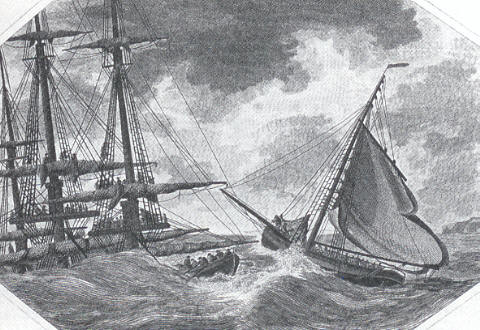
At about the same time that the vessel floated free, the wind had
increased in strength to almost gale force and it was only when
the first mate reported that there was at least 12 feet of water
in the holds that the gravity of the situation at last dawned
upon the captain. The pumps were not making any impression on the level
of the water and one report suggests that the crew had been
issued with spirits to encourage their efforts but this seemed to
have the opposite effect - they became 'most indisciplined'. Only
at this stage was one of the ship's boats launched with the third mate,
the purser and six seamen on board, but they were never seen again.
Apparently the captain, and maybe the pilot, were utterly convinced that
the vessel could be brought safely on to Weymouth beach - this is the most
charitable view one can take considering the apparent sad lack of
urgency shown by Captain Wordsworth.
The Abergavenny lying in 60 ft of water and 5½ ft of sand.
The
illustration also shows the means used in the salvage operations.
(National Maritime Museum)
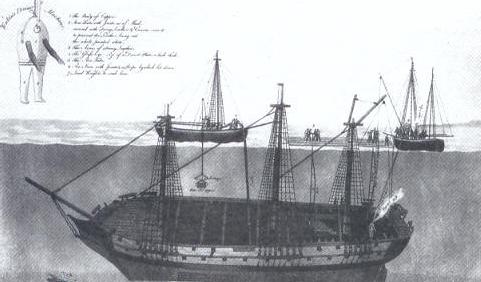
Not until 9 pm did Wordsworth inform the passengers of the very
serious situation, but even at this stage no further boats had been
launched. Shortly afterwards a small pilot boat arrived
alongside and it managed to take off five passengers but strangely
the boat did not return. It also seems that the authorities on the
shore were not alerted as to the perilous state of this large and
valuable East Indiaman just a couple of miles out in the Bay.
At about 11 pm the vessel gave 'a sudden lurch' and within minutes
it had sunk on an even keel in some 60 feet of water. This left some of
the shrouds and about 25 feet of the main mast proud of the water,
where passengers, crew and troops clung for dear life, but very few
survived for long in the intense cold and piercing high winds. Already
some of the crew and troops had managed to escape in the ship's long boat,
which had floated free from the dock when the ship foundered.
Several boats from Weymouth did, in fact, come out to the striken vessel
but not close enough to save any lives, apparently the boatmen were more
interested in salvage. They later attempted to justify their lack of
action by claiming that they were afraid their small vessels would be swamped by
the sheer weight of survivors! Fortunately a large sloop, which had been
attracted by the cries for help, came to the rescue, making three separate
trips and saving some 60 or so persons.
Captain Wordsworth adamantly refused to leave his ship and was seen
clinging to a rope on the main mast. As William Wordsworth wrote,
'My brother was last seen on the hen coop, which is the point from
which he could overlook the whole ship, dying as he had lived
on the very place where his
duty stationed him.' His body was finally washed ashore near Weymouth
on the 20th March and he was buried with nearly 100 others in a
mass grave at Wyke Regis churchyard. There is a memorial stone
to him in St Oswald's churchyard at Grasmere, where other members of the
Wordsworth family are buried.
John's death hit the Wordsworth family very hard. William felt it was
a bad omen and that more deaths were sure to follow, Dorothy was
distraught and became physically ill with anguish. William wrote to his
other brother Richard in London, '...my heart will never forget him. God
rest his soul...God keep the rest of us together. The set is now broken...'
He composed several poems in memory of John; the last, a sonnet, was
written in 1846, over 40 years after his brother's tragic death.
Ultimately John's ceremonial sword was recovered from the wreck
and it was presented to William and is still in the possession of
the family. Fortunately the cargo was insured so at least William
and Dorothy's financial investment was not lost.
The Earl of Abergavenny sank just one and a half miles from
Weymouth beach and considering its prestige it is incredible that
so little rescue effort was made and that so many lives were lost,
especially as it had been in such a dangerous state for well over six
hours. In the months following the disaster strong rumours circulated that
the captain had been completely at fault and that from feelings
of remorse and disgrace he had made no attempt to save himself. This
did not seem to correspond with many opinions of his character; he was
said to be 'firm of mind with an excellent heart', although conversely
he had been given the nickname 'The Philosopher' amongst his fellow officers
for his quiet and introspective manner. These stories only added to
the pain and suffering of the Wordsworth family but Charles Lamb, one
of William's many literary friends, came to the rescue. Lamb, who was
employed by the East India Company, took it upon himself to make a personal
investigation into the disaster. He interviewed many of the survivors
and after almost two months of exhaustive enquiries he concluded that
the Captain was in no way responsible for the loss of the Earl
of Abergavenny.
Because of its valuable cargo the East India Company soon received
many offers to salvage the vessel. During the early summer of 1805 a
Mr Tomkin was the first to explore the wreck but after recovering some
minor items he was defeated by the large, heavy timbers. The company
then turned to John Braithwaite, a well known 'salvor', who had
worked on another East Indiaman wreck with great sucess. Braithwaite used
an adaptation of Halley's (of comet fame) diving bell, which had first
been developed in 1717. His salvage work was closely followed by the
public and the press especially when his efforts proved so
successful. He managed to recover much of the cargo and most of the
heavy chests of silver coin totalling almost £75,000.
In the last 30 years or so the site of the wreck has been most popular
with divers and probably many objects were recovered without being
properly recorded. Then in 1979 the Chelmsford Sub-Aqua Club selected
the wreck for a full archaeological survey to determine the original dimensions
and build of the vessel - this project is still ongoing. But the last
words should be left to William Wordsworth:
'For one poor moment's space to Thee,
And all who struggled with the Sea,
When safety was so near...'
