It is difficult to comprehend just how traumatic was the effect on late
18th century England when one of the largest and most prestigious
Naval vessels afloat sank within a few minutes whilst at anchor
at Spithead. The news of this staggering loss was greeted with utter disbelief
and outright horror, which reverberated throughout the land. Over 900
lives were believed lost in this dreadful catastrophe and one of the
unfortunate victims was Rear Admiral Kempenfelt, who was not only
a national hero but perhaps one of the finest sea officers of his
generation. Even allowing for a certain hyperbole the loss of the
vessel has been described as 'the greatest shipping disaster of the
century' and it was immortalised in a famous poem by William Cowper,
the first lines of which start, 'Toll for the Brave - The Brave!
that are no more...'
The bare facts of the shipping disaster are painfully simple. On 29th August 1782 the massive 100 gun
Royal George was at anchor at Spithead undergoing certain minor repairs
as well as taking on supplies for its imminent voyage to the
Mediterranean, where it was to be part of a Naval force gathering
to relieve Gibraltar. Everything seemed fine then suddenley the vessel
flooded with water; there was 'a heavy crack' and the vessel
capsized and sank all within minutes. As the depth of water was only
15 fathoms (about 90 feet) the top of the masts and part of the bowsprit
could be clearly seen above the water, suggesting that the vessel had settled
on the sea bed on an even keel. Such was the incredulity and
consternation felt by the loss of such a renowned Naval vessel
that people flocked to Portsmouth just to view the masts protruding
above the water, as if they needed confirmation of the seemingly
incredible happening.
The Royal George could not be considered an old vessel, at
least judged by the Naval standards of the time; having
been in service for less than 30 years. It was classified as 'First Rate',
which in Naval parlance meant it had three decks and at least 100 guns.
At the time of its sad demise there were just two other
vessels of equivalent size, one of which was the Victory. The
fire power of these Naval leviathans was awesome; at the battle
of Quiberon Bay in 1759 just two broadsides from the
Royal George sank a large French battleship without a single
survivor.
They did have certain disadvantages; they tended to be rather cumbersome,
were expensive to build and needed a huge crew.
The Royal George was under the command of Captain Waghorn and had
a complement of 880 officers and men - hence the high death toll.
Furthermore because these large vessels were so costly to construct they
tended to be kept in a far better state of repair than most other Naval
vessels, and it was this very fact that proved to be the downfall
of Royal George.
At the time of the accident the vessel was heeled over to make
certain repairs to a watercock. It was at a 'Parliament heel', a Naval
term for a makeshift method of either cleaning or repairing the sides of the
vessel without having to place it in dry dock. It was heeled
over by running the heavy guns from one side to the other.
One of the inherent risks in such a procedure was that it did bring
the lower gun ports very close to the water line and it required
fine judgement to know just how far such a list could be sustained
without endangering the ship's stability. For no apparent reason the
Royal George suddenley increased its list with the result that water
began to pour through the lower tier of gun ports, and before any righting
action could be taken, the vessel quickly became flooded. Then there
was a very sharp cracking noise, as if the bottom timbers had given
way and the vessel just disappeared: 'it sunk like a stone'.
Only 75 men managed to escape and each was allowed £5 compensation by
the Admiralty for the loss of personal effects. The poor captain was
unable to swim, but was saved by some of his crew that could. The Captain's
son lost his life in the disaster. One reason why the final death
toll was never truly known was that a warship at anchor just prior
to a voyage had a vast number of traders on board
selling a variety of goods and food. One contemporary report stated, 'I was surprised at the number of people crying their
different commodities about the ship as in a town... To me it appeared like a little
world...' The report could have added that there was an almost 'drunken and
carnival air aboard the ship'. It was quite well known that on the last
few days before a voyage most Naval vessels were 'out of discipline', so
it was quite impossible to know just how many traders and women were
on board when the vessel sank.
A court martial was assembled on HTML Warspite at Portsmouth on
9th September 1782 to try the captain for negligence, no less than five
admirals sat on the Board. After hearing the evidence of all the survivors
and countless eye-witnesses the Court came to the conclusion that the cause
of the disaster was that part of the vessel's frame had given way
because of the decayed state of its timbers. However, during the hearing
there was conflicting evidence; some of the ship's officers claimed
that they had become concerned about the extent of the heel and had
instructed the carpenter to reduce it; whereas some of the surviving
seamen maintained that it was the other way around and the officers had ignored
the carpenter's warnings. Regardless of these claims, the official view
was that the timbers were at fault and it was also suggested that both
the dock authorities and the Admiralty were aware of the condition
of the vessel but had thought it would last another summer! Captain
Waghorn and his officers were exonerated from all blame.
In the following year the Admiralty decided to try to salvage the wreck
and they employed William Tracey, who had gained a considerable reputation
in underwater salvage work. However, he had never before dealt with the
intransigence of the Navy Board and the Admiralty, who really seemed
hell-bent on thwarting him at every turn. Ultimately he gave up the unequal
task, he was physically and financially a broken man. The prevarication was quite deliberate
as the Navy Board and the Admiralty did not care to have the evidence
of the decayed timbers to prove conclusively the amount of
embezzlement and chicanery that went on in Naval dockyards.
Several others followed Tracey but not surprisingly all their efforts came
to naught - the Royal George was proving a difficult nut to
crack. It seemed as if the vessel would keep its secrets forever.
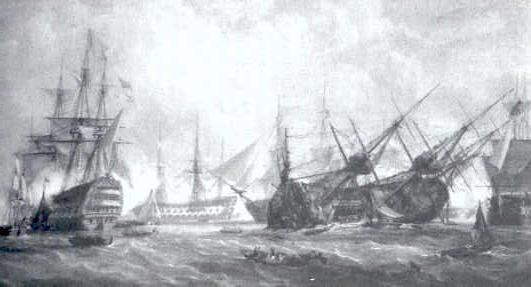
The loss of the Royal George from a painting by John Schetky. (Tate Gallery)
Over the following years the sand and silt slowly collected around
the hull and formed a sandbank, which at low waters proved a hazard to the
vast amount of shipping that used Spithead. It was almost another 50 years
later that the next serious salvage attempts were made. Two brothers
from Deptford, John and Charles Deane, worked on the wreck for
three years from 1836 to 1839 and during this time they managed to
bring up 29 guns. Interestingly these bronze guns were later
melted down and used in the base of Nelson's column. During their work
on the Royal George the Deane brothers were the first to locate
the site of the Mary Rose, and indeed undertook some salvage work
on that famous wreck.
Several attempts were made to raise the Royal George but all failed
and it was finally destroyed by explosives in 1844. This was the
time that Alexander Siebe, who is considered to be the father of
modern diving, showed the efficacy of his new 'closed' diving suit - the now familiar
diver's helmet incorporating an air regulating outlet. Siebe's successful dives
to the Royal George earned him a contract to supply his new diving suits
to the Royal Navy.
Because explosives were used, little has survived of this famous shipwreck.
The ship's bell was saved and is now held by the National Maritime
Museum. Perhaps the best description of the disaster appears in
chapter 19 of Captain Frederick Marryat's novel Poor Jack. He
drew heavily on notes made by John Schetky, the famous marine painter,
who in turn had received a vivid account from one of the survivors.
Schetky's fine painting of 'The loss of the Royal George' is now in the
Tate Gallery. Although Cowper's poem contains a measure of poetic licence,
for instance, 'a land breeze shook the shrouds' and 'Her timbers yet are sound,
And she will float again', he was correct in saying, 'He (Kempenfelt) and his
eight hundred - Must plough the main no more'.
